

To license your photos, you grant someone permission to use your images under terms you both agree on — which uses, where, for how long — while you keep the copyright. There is no photography licence you need to take photos; this is about protecting and monetising work you already own.
The confusion usually starts with words. A buyer says they want to “buy” a photo, and without a written agreement both sides assume something different happened. One thinks the buyer owns it outright, the other thinks it is a limited rental. Six months later somebody reposts it on a billboard and nobody can point to the deal that allowed it.
Below is the process I use when licensing work, in the order that stops the most problems. It assumes the US legal framework because that is where most of my clients are, but the structure travels well — copyright and licensing rules vary by country and by state, so check yours before you rely on anything here.
Table of Contents
What You Need
You do not need a lawyer to start, but you do need five things lined up before you quote a single price.
Clear ownership
Copyright in a photograph exists automatically from the moment you press the shutter, in most countries and for most kinds of work. What trips beginners up is client work, where the default is different. Under US law, a commissioned photo is not automatically a work for hire unless you sign a written agreement saying so, and a work-for-hire agreement for photographs has extra requirements. If you photographed someone else’s wedding or a product on their behalf, you may hold copyright while your client holds the exclusive right to use it. Keep every contract that came with the job.
Your original files and previews
Keep the RAW file, the export, and the metadata together. You will need the full-resolution file at delivery and a watermarked preview for every conversation before that.
A target market
Editorial, advertising, packaging, and personal printing all have different values. Decide whether you are licensing to magazines, to brands, to other designers, or to anyone who downloads — then write terms that fit that buyer rather than a generic “commercial use” line.
A clear position on exclusivity
Understand the difference between exclusive and nonexclusive before you talk money, because it changes both the price and what you can sell next month.
Contact, pricing, and record details
A business name or your name and email, an invoice number system, a payment method, and somewhere to store signed agreements. Licensing without paperwork is how income disappears.
One practical checklist before you begin: ownership documents are in one folder, your terms exist as a reusable one-pager, you know which release forms you need, and you know how you will deliver a watermarked preview.
Step-by-Step: How to License Your Photos
Step 1: Confirm Copyright and Usage Rights
Start by proving, to yourself, that you can license the frame. If you shot it yourself, the copyright is yours. If it involves other people’s work or other people in the picture, dig further.
Client work is the first category. Read the contract again and find the clause about copyright, reuse, and exclusivity. If the contract was silent, in the US you likely still hold copyright and the client has an implied exclusive license for their own purpose — which means you may not be free to resell that image to a competitor. Some contracts assign copyright to the client outright, and there is nothing to license back to them without their permission.
Collages and composites are the second. If you combine a stock image, a texture, and your own photograph into one new image, you usually cannot license the result as entirely your own. It may need permission from whoever owns the borrowed elements, or it may qualify for separate protection only for the original contributions. If you stitched two frames into one deliberately, my guide to blending two photos together in Photoshop covers the technical side, but check the licensing of every piece you put in.
Stock imagery pulled into an AI editing tool is the third, and the one that has changed fastest. Generative tools have their own terms about what you may submit, and the question of whether an AI-assisted edit is protectable at all is still being argued in courts. Treat every asset as carrying its original licence, and keep a note of which tool touched which file.
Finally, check what is in the frame. Recognisable people, private interiors, branded products, and artworks in the background all raise questions. In the US you do not need a release just to photograph someone on a public street, but commercial advertising use is where a model release becomes the difference between a usable image and a legal problem. Keep your records in order: the contract, the releases, and a note of where the original files live. Checkpoint: you can answer “who owns this and on what terms” in one sentence for every frame in your library.
Step 2: Choose Exclusive or Nonexclusive Licensing
A nonexclusive license lets you sell the same image to many buyers. An exclusive license means that buyer alone may use it, and typically for a defined period, so you cannot license that image to anyone else during the term.
Four examples make it concrete. A fine-art print sold to a collector is usually a sale of a physical object plus a limited personal display right, so nobody is stopping you from printing another. A magazine feature is nearly always nonexclusive — other publications can run the same photograph. A website header image is a standard nonexclusive web license with a defined duration. A book cover is different: publishers often ask for exclusivity, because they don’t want a competing edition with the same cover art.
Exclusivity costs money and costs options. You are removing an image from your catalog, and often the buyer will want the exclusivity to be worldwide and perpetual, which removes every future use you could have sold. Ask what the exclusivity is actually protecting — usually it is a marketing concern, and a narrower term or a named category of competing use solves it without giving the whole thing away.
Nonexclusive is the safer starting point for most creators. You can always sell an exclusive right later, but you can never un-sell one. If you only remember one rule from this step: only give up availability when the extra fee clearly pays for what you lose.
Step 3: Define the License Scope, Territory, and Duration
Scope is the list of permitted uses, and it should be specific enough that neither party has to guess. Name the media, the circulation, the print run, and the territory, then list what is forbidden.
A workable sample summary: the licensee receives a nonexclusive license to use “Still Water,” a surreal black-and-white photograph, in a fundraising campaign for a US nonprofit. Permitted uses are the campaign website, social media posts owned by the nonprofit, and one projected event screen at a single fundraising dinner. Duration is twelve months from first publication. Territory is the United States. Prohibited uses are merchandise, resale, print-on-demand products, and licensing the image to any third party. Modification is limited to cropping and file-size adjustments; no retouching or generative extension. There is no renewal unless both parties agree in writing.
That paragraph covers most disputes. Territory, duration, and prohibited uses do the heavy lifting — a license with no end date and no location limit quietly grants worldwide perpetual use, and that is not what a small business usually means to buy.
Two more lines worth adding. Say whether the licensee can sublicense, and say what credit they must give you. Credit language of “Photographer name” with no further obligation is simple and fair; demanding a specific size or placement invites arguments.
Step 4: Set Fees and Write Clear Terms
There is no single right number, because the price follows reach, duration, exclusivity, and production scale. What you can do is build the fee out of named components instead of picking a number and hoping.
- Base image fee — the right to use one image for one defined purpose.
- Extended media — adding print, packaging, apparel, or broadcast to a web-only license.
- Exclusivity premium — removing the image from your catalog for the term and territory.
- Duration multiplier — longer terms cost more, and perpetual rights cost the most.
- Volume or production scale — run size, impressions, or circulation.
- Model release work — securing and handling releases when the image needs them.
Any real quote depends on which of those apply, so quote from a written rate sheet rather than from memory. A personal print and a national billboard are not the same conversation, and pricing them the same is how people end up resenting the work.
I cannot promise what licensing income will be. What I can say is that marketplace royalties are usually small per image, while a single direct license to a brand can pay more than a year of downloads — which is exactly why beginners negotiate per-use pricing by hand instead of accepting the default. Keep the plain-language terms short and specific: what credit is required, whether cropping is allowed, whether the image may be modified, whether sublicensing is allowed, when payment is due (net 14 or net 30 is normal), what happens if payment does not arrive, and whether either side can cancel and on what notice.
If the image has been through a grade or a conversion to monochrome, say so. Many photographers do that work before selling, and how to color grade photos in Lightroom or a black and white edit changes what the buyer is actually receiving. Describe the delivered file, not the shoot.
Step 5: Use a Written Photo License Agreement
Even a one-page document prevents the argument that licensing did not happen. Everything important should exist in writing before the file moves, even if you also discuss it over email.
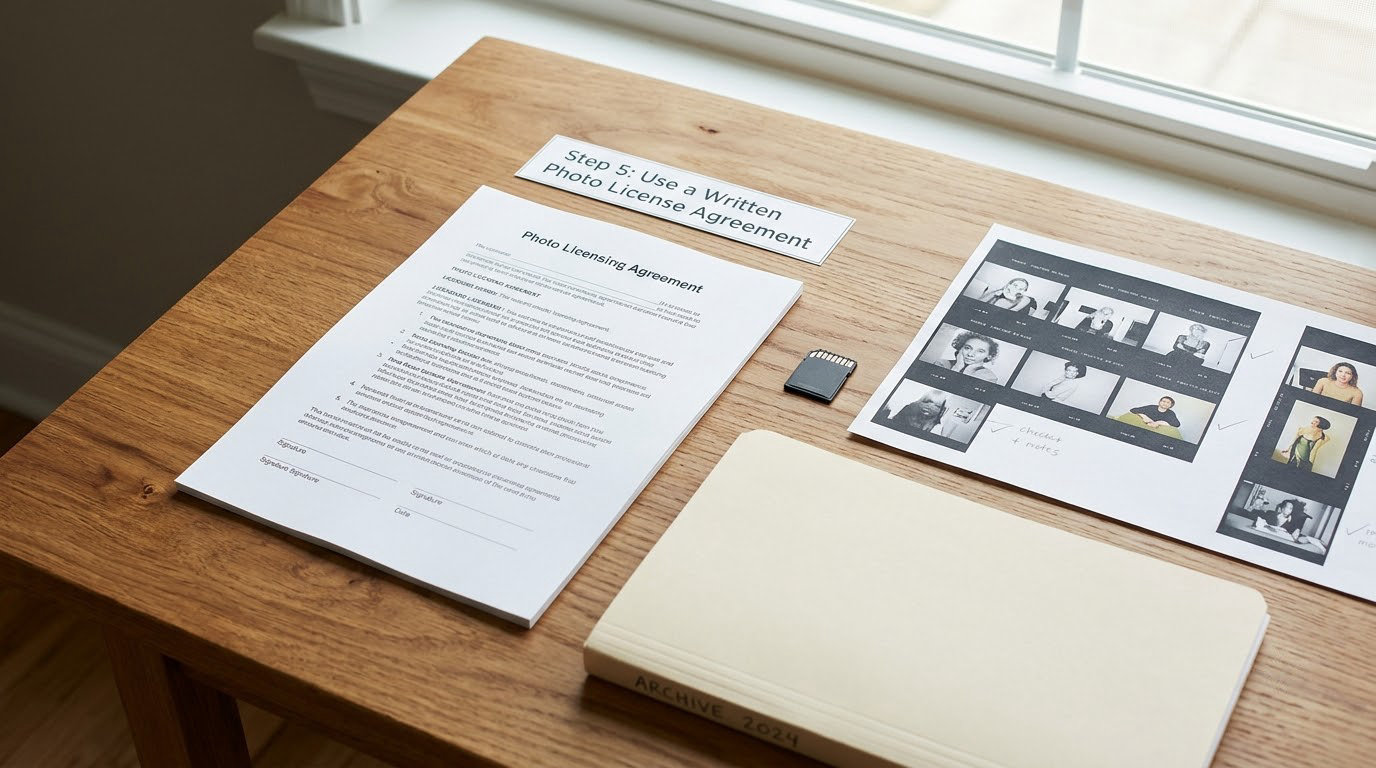
A usable agreement checklist: parties and contact details; image identification with filename, date, and a thumbnail; rights granted; permitted and prohibited uses; territory; term and start date; fee and payment schedule; delivery format and date; copyright ownership statement; credit requirement; modification and sublicensing rules; warranties and liability; cancellation; and signature lines.
The skeleton in plain text looks something like this: “Licensor grants Licensee a nonexclusive license to reproduce Image X in the US for twelve months from publication, on the nonprofit website, on Licensee’s social channels, and on one event screen. Licensee may crop and resize but may not retouch, merchandise, resell, or sublicense the Image. Licensee will credit the Photographer as ‘Photographer name.’ Licensee pays the stated fee within 14 days of signature, before delivery of the unwatermarked file. Copyright remains with the Licensor.” Ten lines, and it answers almost every question that would otherwise surface a year later.
One line must be unambiguous: the copyright stays with you unless the agreement expressly assigns it. I have seen the sloppy version — “sale of all rights” written in an email — which is exactly the ambiguity that costs photographers their work. For high-value or unusual deals, ongoing arrangements, or anything touching AI or merchandise, have a qualified attorney in the relevant jurisdiction review the language. That is cheap next to a dispute.
Step 6: Deliver, Record, and Get Paid
Send a watermarked preview first, so nothing leaves your hands before the paperwork does. Agree the file format and resolution: web and social need one size, a large-format print run needs another, and a full-resolution file is only appropriate for a paid license.
Invoice on signature, take payment before delivering the unwatermarked file, and then deliver. Keep the record: receipt, file name, the signed agreement, the invoice number, the licensee’s contact, and the exact usage start and end dates, with a reminder set for the end date.
Your post-sale record should answer, months later, who can use this image, where, until when, and for what. If it cannot, the license was probably too vague. The final and most important line: copyright remains yours unless the agreement says otherwise, so you can license the same frame again after the term ends.
Common Mistakes
Granting unlimited worldwide rights. The most common clause I see is “unlimited use.” It is rarely what either side wanted. Write territory and term in, even when the buyer swears it doesn’t matter.
Treating a download as a sale. Selling a digital file and licensing it are different things, and the buyer usually needs permission for commercial use. If you want a buyer to be able to use it on their website and in a brochure, license it explicitly instead of hoping.
Leaving exclusivity undefined. “Exclusive” without a term, a territory, and a category of competing use gives away the image forever. Specify all three, or offer nonexclusive.
Using “personal use only” as your entire terms. It tells the buyer nothing about what they may actually do, so you end up arguing about intent later. A short list of permitted uses prevents that.
Skipping releases. Commercial advertising with a recognisable person usually needs a model release; branded or private property needs consideration and often a property release. Keep forms with the image, not in a separate drawer.
Underpricing commercial usage. Editorial and advertising use are not the same product. Price the use, not the effort.
Sending the full-resolution file first. Once the buyer has it, your leverage is mostly gone. Watermarked preview, signed agreement, payment, then the file.
Keeping no record. If the agreement is not filed somewhere you can find it, you cannot prove what was granted — or what was not.
For independent photographers, three habits carry the most weight: write the terms before the sale, price by use, and keep the paperwork. Everything else is detail. Licensing is not about giving something away; it is about being specific about what you hand over.
Frequently Asked Questions
Does copyright transfer when I license a photo?
No. A license gives permission to use the image within defined terms; the copyright stays with you unless a separate written agreement assigns it. That is the main reason licensing and copyright transfer are priced so differently. If you do not want to give the copyright away, say so explicitly in the agreement, because phrases like sale of all rights in an email are often ambiguous.
Do I need a formal contract to license photos?
You need something in writing, but it does not have to be a long formal contract. A one-page document covering the image, permitted uses, territory, term, fee, credit, and copyright retention is enough for most single-image licenses. Longer agreements, ongoing arrangements, or rights involving merchandise or AI use are worth having reviewed by a qualified attorney.
How do I license photos online?
Set up a contact and invoice process, publish a terms page describing your license types, and deliver watermarked previews until the agreement is signed and paid. Stock marketplaces handle the licensing for you under their own standard terms, at the cost of a commission. Direct licensing keeps more control and more of the fee, but puts invoicing, delivery, and record-keeping on you.
How much should I charge for photo licensing?
Build the fee from components: a base image fee, an added media extension, an exclusivity premium, a duration multiplier, and any volume or production scale. Quote from that rate sheet rather than a single number, and raise the fee as the reach, term, and permitted uses grow. Experienced photographers negotiate per use by hand rather than accepting a marketplace default, and reviewers repeatedly report that underpricing is the more common regret.
What happens when a photo license expires?
The permitted uses stop. The licensee must take the image down or stop printing, and any new use needs a new license or a written renewal. Because copyright never left you, you can license the same frame again, to the same buyer or another one. Record the end date when you invoice, and set a reminder, because expiry is where most forgotten income quietly disappears.
Is Creative Commons appropriate for my photos?
It can be, if you genuinely want wide reuse and are comfortable giving up most control. CC0 waives rights as far as legally possible, while the other Creative Commons licenses range from attribution-only to versions that allow commercial use with restrictions. None of them pays you. Many photographers keep Creative Commons for portfolio and community work and use paid licenses for anything a brand or publication wants.
Conclusion
Pick one image and start there. Confirm you own it, decide the specific use the buyer needs, choose exclusive or nonexclusive, write the scope, territory, and term in plain words, set the fee from your rate sheet, and take payment before the unwatermarked file leaves your hands.
Match the license to the project, not to the size of the fee. Nonexclusive and narrow is a fine place to begin for most creators, and substantial commercial rights are worth paying a lawyer to review before you sign.