
A model release is a signed permission form in which someone photographed gives you written consent to use their likeness in your pictures, usually for commercial purposes. In the United States, you need one when a recognizable person appears in an image you plan to use to sell, advertise or promote something. This guide explains what the form covers, when you can skip it, and how to file a valid copy.
Table of Contents
- What Is a Model Release and When Do You Need One?
- What Does a Model Release Actually Authorize?
- When Is a Model Release Usually Not Required?
- Editorial Photography vs. Commercial Photography
- Do You Need a Release for Recognizable People and Personal Property?
- Special Rules for Minors, Employees, and Other Vulnerable Subjects
- How to Get a Valid Model Release
- Common Model Release Mistakes to Avoid
- Frequently Asked Questions
- Conclusion
What Is a Model Release and When Do You Need One?
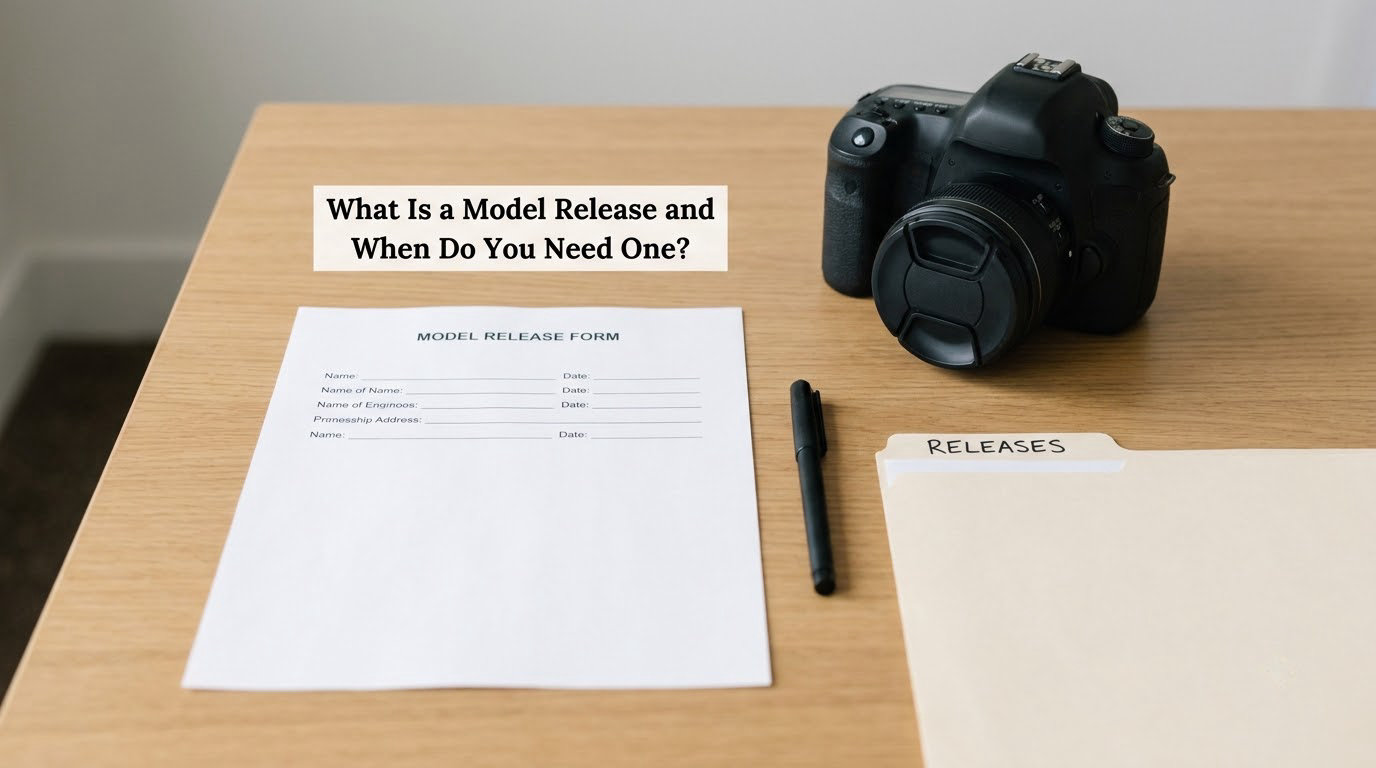
Put plainly: a model release form is a contract between you and the person in the frame. It names the images, sets out the uses you are allowed to make, and lets the subject waive later claims about how their likeness appears. You keep the signed copy as proof of consent.
The reason it exists is the right of publicity. In many US states, people hold a commercial interest in their own name, face and likeness, and that interest can be enforced against someone who uses their image to sell something without permission. Photography itself is usually the easy part. Using the photograph is where permission earns its keep.
Run through four questions before you shoot:
- Is a face recognizable? If a reasonable viewer could identify the person, assume yes.
- Will the image sell, advertise or promote something? Advertising, product pages, paid social and commercial campaigns all qualify.
- Will a client or library use it in a paid campaign? Then your subject needs to have signed, and you need their copy on file.
- Is the situation sensitive? Medical, wellness, minors and grief contexts carry extra weight regardless of the intended use.
Get a signature for commercial advertising of any kind, product and catalogue photography, paid social media content, brand or company photography, user-generated content and influencer-style shoots, corporate headshots that go on a website or in recruitment, print sales and licensing through image libraries, and TFP or unpaid portfolio work you later want to publish commercially.
What Does a Model Release Actually Authorize?
A release grants permission. It does not transfer copyright, which in the US stays with you as the author of the photograph unless you signed something else. The model is giving you a licence to use their likeness, not handing over your image rights.
Before you accept one, read what it actually covers:
- Identified subject. Full legal name, date of birth for a minor, and contact details. A release with blank fields is the classic weak link.
- Identified images. A description or reference for the specific frames. Many photographers write the shoot name and date; some also attach a contact sheet.
- Permitted uses. Advertising, web, print, social, packaging, in-store displays. Vague wording such as any use, in any medium tends to be challenged later.
- Media and territory. Worldwide versus a single country, digital versus print, broadcast or out-of-home.
- Duration. Unlimited or a set term. Perpetual terms are common in commercial work.
- Editing rights. Whether you may crop, retouch or composite. If you plan heavy manipulation, say so in writing.
- Compensation. Paid, unpaid, or trade for print. Note what was exchanged.
- Revocation. Most commercial releases say the subject cannot withdraw consent after signature. Whether that clause holds up depends on state law and the wording.
The practical consequence of a broad release is that the subject usually cannot claw the images back later, which is exactly why the scope and duration wording deserves a careful read before the pen goes down.
What Is a Model Release and When Do You Need One in Commercial Work?
Commercial use is the trigger. If a business pays for the result or the image helps sell a product, a service or an idea, treat a release as required rather than optional. That covers a model signed to a brand shoot, a client using a team photo in recruitment, and a portrait placed on a website hero banner.
Two cases trip people up. A nonprofit or volunteer headshot shoot feels harmless until the organization runs a paid recruitment campaign with those same faces. And a TFP shoot, where the model receives prints instead of a fee, still becomes commercial the moment you license the images or use them in your own marketing.
Image libraries make this concrete. Adobe Stock, Getty and Shutterstock all ask for proof of a release before they will accept recognizable commercial images, so an unsigned frame stays on your drive and never earns.
When Is a Model Release Usually Not Required?
Ordinary editorial and documentary photography generally does not need one. News reporting, most magazine features and documentary work serve a public-interest purpose, and US courts treat that kind of publication differently from promotion.
Private use is the other clear case. Photographs for your own albums, family prints, or sharing in a closed family group are not commercial exploitation, and nobody expects a contract for a birthday dinner.
Many incidental public appearances fall in the same space. Someone walking through a public plaza or sitting in a coffee shop is not usually treated as a model by default. Shooting strangers on the street for your own portfolio is generally acceptable in the US, though some cities and private venues impose their own restrictions.
Three limits on that answer. First, context moves the goalposts: the same face in a street portrait is fine, in an ad for a product is not. Second, recognizability matters more than intent; an out-of-focus figure with a readable number plate can still cause problems. Third, state law varies, and news organizations generally add their own standards on top.
Editorial Photography vs. Commercial Photography
| Factor | Editorial | Commercial |
|---|---|---|
| Purpose | Informs or documents | Sells, advertises or promotes |
| Who pays | Publication, nonprofit, self | Brand, client, advertiser |
| Subject expectation | Being observed in a newsworthy context | Signed on as a participant |
| Release practice | Usually not required, sometimes taken for safety | Standard requirement before delivery |
| Typical examples | Courtrooms, protests, documentary portraits, news portraits | Fashion catalogues, product campaigns, corporate headshots, packaging |
| Editing | Truth standard applies | Client direction and retouching expected |
The dividing line is not the location or the subject, it is the purpose. A barista photographed for a coffee brand ad is commercial; a barista photographed for a story about coffee workers is editorial, and the same person might need a release for the first and not the second.
Do You Need a Release for Recognizable People and Personal Property?
Start with recognizability rather than intent. The test is whether a reasonable person in the image could be identified: a clear face, a distinctive tattoo, a legible uniform patch, or a plate number that resolves to an owner. When identity is genuinely unclear, the practical risk drops sharply, though blurred or hidden faces do not automatically make an image safe for advertising.
Property works differently. A subject release covers a person; a property release covers someone else’s trademark, artwork, logo, interior design or private space. Photographing a handbag with a visible logo in a boutique ad usually needs permission from the trademark owner, not the person holding it.
You will also want a release for private property interiors that carry artistic or architectural significance, private artworks and sculptures you did not create, and recognizable copyrighted designs on products. Stock libraries bundle the two together, and for most shots the answer is both a model release and a property release in the same envelope.
Special Rules for Minors, Employees, and Other Vulnerable Subjects
A subject under 18 needs a parent or legal guardian to sign, in addition to anything the minor signs. Many forms add a date-of-birth line so the age question never comes up later, plus a guardian signature block and a witness line. Keep the guardian’s proof of guardianship with the release.
Employees carry a different wrinkle. A worker agrees to be photographed for work, but that does not automatically mean they agree to appear in a recruitment ad or an investor deck forever. Separate releases for internal use and marketing give you a cleaner answer than one blanket form, and they take pressure off the conversation with staff.
Medical, wellness and grief photography deserves extra care regardless of contract law. A release does not replace HIPAA or other privacy rules where they apply, and it says nothing about consent from patients who may not be in a position to consider terms carefully.
These requirements differ by state, and the law moves. For minors, commercial campaigns, TFP arrangements or anything sensitive, get a qualified local attorney to review your form before the shoot, not after a claim.
How to Get a Valid Model Release
The order of operations matters more than the template. Do this:
- Explain the intended use before the shoot. Tell the model where the images are headed, roughly how long, and whether they are commercial. This is the step people skip, and it is the one that prevents a dispute later.
- Use plain language. Short sentences beat legalese. The subject should be able to say what they agreed to in your own words.
- Identify both parties. Your name and business, the model’s full legal name, the date of the shoot, and the images.
- Set out scope, duration, media, territory and compensation. Include a clause about retouching if that is planned, and one about minors if there is any chance of them appearing.
- Sign before the session, not after. Chasing signatures once the frames are already shot is the habit that weakens a document most often. Get it signed before makeup, before the first frame.
- Hand over a copy. Give the model a copy immediately and note the date. It is a courtesy that costs nothing.
- File it properly. Store signed originals for as long as the licence lasts, and in practice indefinitely.
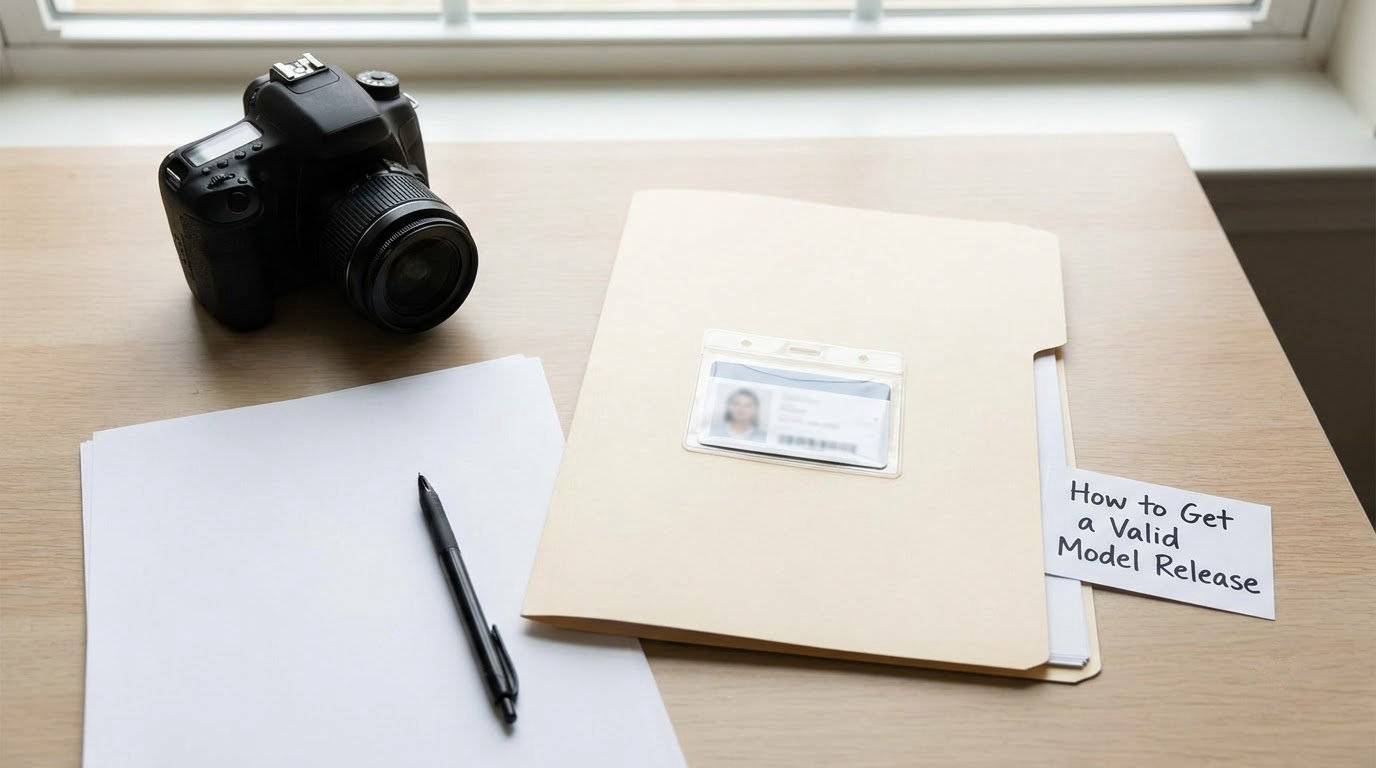
One filing trick is worth stealing: paste a headshot of the model onto the top of the form and write the matching image number next to it. Years later you are looking at a face and a frame number instead of guessing which of forty scans matched which shoot.
Keep scans and originals in more than one place, with a naming pattern like date, subject, shoot. Photoshoot workflow fundamentals such as file naming and consistent archive habits apply here too, and you can see how the same discipline plays out in what dynamic range means in photography.
Common Model Release Mistakes to Avoid
- Vague scope. Any use, anywhere is a clause that invites argument. Name the actual campaign types. Fix: list the media you plan to use.
- Blank fields. A missing date, address or age is the most common defect found later. Fix: refuse to accept an incomplete form and keep a spare copy ready.
- No date. Without a date you cannot show when consent was given relative to publication. Fix: date every signature.
- Weak electronic signatures. A scrawl on an unverified PDF proves little. Fix: use a signing tool that captures an audit trail, or sign in person and scan.
- Assuming a release transfers copyright. It does not. Fix: keep the two concepts separate in your paperwork.
- Paperwork organised by shoot instead of by model. Retrieval becomes painful fast. Fix: index by subject and attach the image number.
- One release reused across unrelated shoots. A signed release covers the images it names. Fix: a fresh release per shoot.
- Losing the paperwork. A release you cannot produce is close to no release at all. Fix: scan on the day, back up in two places, never rely on a single envelope.
Frequently Asked Questions
Do I need a model release for stock photography?
Yes, for any recognizable person in an image submitted for commercial licensing. Adobe Stock, Getty and Shutterstock all require proof of consent, and the library often asks you to upload the signed form with the submission. Editorial or documentary images that were never commercial can be accepted without one, but verify each library’s current rules before you upload. If a face is unrecognizable, say so in the submission notes rather than leaving it blank.
Can I photograph strangers in public places without a model release?
Usually, yes. Photographing people in public for editorial, documentary or portfolio purposes generally does not require permission, provided the images are not used to advertise or promote anything. The picture changes the moment the frame appears in a campaign, an ad or paid social content. Recognizability also matters: a clear, identifiable face carries more risk than an anonymous figure, and private property, venues and state law can add restrictions.
Are electronic or digital model releases valid?
In the US, generally yes, as long as consent, intent and a signature record can be demonstrated. Federal and state e-signature laws plus electronic records rules support e-signed releases, and courts have upheld contracts formed electronically. Use a signing tool that captures a timestamp, IP detail and an audit trail, and save the completed document as a PDF. Handwritten signatures scanned from paper remain the safest fallback when a project is high-stakes.
Do I need a release for photos taken with a smartphone?
The device is irrelevant to the legal question. What matters is whether a recognizable person appears and how the image is used. A casual phone snapshot shared in a family group needs nothing, while the same phone photo used on a business website or in a paid campaign needs a release. Higher resolution does change how easily someone can be identified, which is why phone shots of bystanders on your own site still deserve a second look.
When should I ask a lawyer about a model release?
Ask a qualified attorney in your state when minors are involved, when the shoot is medical, wellness or grief-related, when the model is an employee or contractor, when you plan heavy manipulation of the image, or when compensation and exclusivity terms are unusual. Rules on likeness and consent vary by state and shift over time, so a local review is worth the cost on high-risk projects. For routine commercial work, a well-drafted standard template is usually sufficient.
Conclusion
The rule is short: if a recognizable person appears in an image that sells, advertises or promotes something, get written permission before you use it. Editorial and private work generally does not need it, and public-space photography usually does not either, until the frame becomes commercial.
Start by deciding the use, then the form. Explain the intended use before the shoot, sign one release per shoot, describe the specific images, and file the copy the same day. If the project involves minors, employees, medical settings or unusual edits, have a lawyer in your state review the wording first.