
A photo exhibition press release is a one-page announcement sent to editors and journalists that tells them who is exhibiting, what is on the wall, where and when, and why the show is worth a story. Write it in a fixed order, in third person, with press images and correct credit lines attached, then send it to a named list two to four weeks before the opening. This guide takes about an hour once you have your facts together.
Most photographers I know write a beautiful artist statement and then staple it to the top of a press release, which is why most of their openings are quiet. The press release is a different document with a different job: it is the raw material an editor copies from.
Table of Contents
- What You Need Before You Write a Word
- Step-by-Step: How to Write a Press Release for a Photo Exhibition
- Step 1: Write a Headline That Gets Attention
- Step 2: Build a Release-Ready Exhibition Summary
- Step 3: Write a Strong Lead and Opening Paragraph
- Step 4: Add the Artistic Context, Not the Artist Statement
- Step 5: Include Practical Visitor Information
- Step 6: Add Quotes, Credit Lines, and Boilerplate
- Step 7: Finish With Contact Details and a Call to Action
- Step 8: Review and Distribute the Release
- Common Mistakes That Get a Photo Exhibition Release Ignored
- Frequently Asked Questions
- How long should a photo exhibition press release be?
- What are the 5 W’s in a press release?
- Can ChatGPT write a press release for me?
- What size should press images be for an exhibition release?
- How far in advance should I send an exhibition press release?
- How is a press release different from an artist statement?
- Conclusion
What You Need Before You Write a Word
You cannot write the release until five sets of facts exist somewhere other than your head. Anything you have to dig for mid-sentence will get left out, and editors notice missing facts faster than thin prose.
Exhibition facts
- Exact title, including capitalisation and any subtitle
- Opening date and time, closing date, and whether the run is split across two venues
- Venue name, street address, postcode, and whether it is a gallery, museum, civic space or a private studio
- Opening hours and any admission charge
- Opening reception details, including whether the artist will be present
- The exhibition web page and any booking link
Artist and curator facts
- Full name as it should appear in print, plus pronouns if you want them used
- Where you are based, and one or two lines of career context: education, previous shows, collections
- Curator name and institution for a museum or juried show
- Any prior press coverage you can legitimately cite, with the publication name and date
Press images with their full metadata
For each image you plan to offer, gather the title, the year, the medium, the edition number, the print dimensions, the framed dimensions, the photographer or artist credit, the copyright holder, and the courtesy line. If a client owns the photograph of your work, that photograph needs its own credit.
Media contact details
A named person, a working email address, a phone number, and the postal address of the studio or gallery. An email address that bounces costs you the story.
Supporting material
A short biography in third person, a one-paragraph curatorial text, an optional quote from the artist or curator, and a folder of high-resolution files with human-readable filenames. Nothing named IMG_4482_final_v3.jpg.
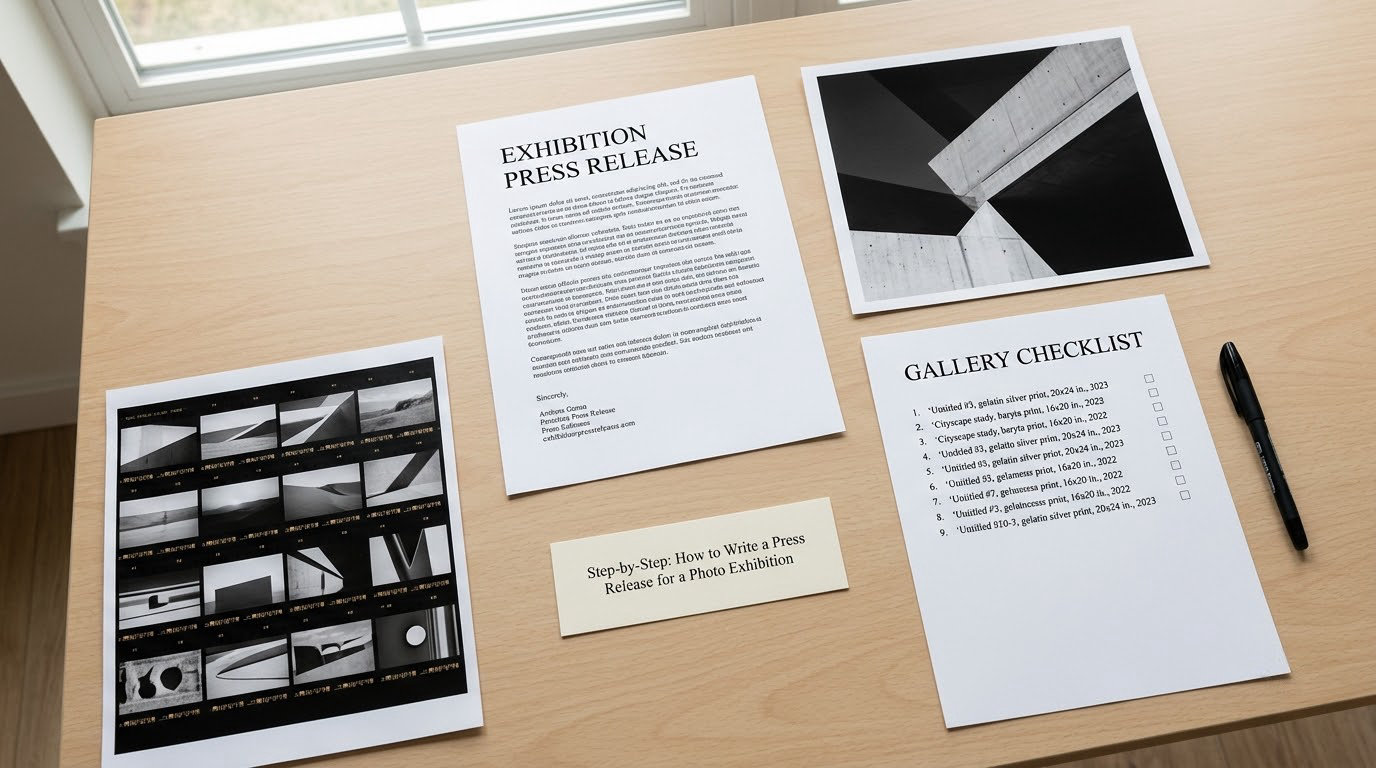
Step-by-Step: How to Write a Press Release for a Photo Exhibition
Step 1: Write a Headline That Gets Attention
Write one plain headline that names the photographer or exhibition, says what the pictures are about, and names the city when the venue is local. It works when a skimming editor could tell what the show is from the headline alone, with no adjectives doing the work.
Weak: A Groundbreaking New Exhibition That Will Change How You See. Stronger: Marta Lindqvist photographs the emptied coast: 24 new large-format prints open at Harbour Hall in October.
Two rules. Keep it under about 90 characters so it survives a listing page, and write a second version for the trade and national press, where the city is noise and the subject matter is the hook. Avoid unique, groundbreaking, must-see, immersive and important. Editors discount every one of them.
Step 2: Build a Release-Ready Exhibition Summary
Before writing prose, write one plain sentence that holds the whole exhibition: title, artist, venue, opening date, closing date, medium, and the single artistic idea in about 30 words. Every later paragraph gets checked against this sentence, so any drift shows up immediately.
Example: Salt Line, a solo exhibition of 24 pigment prints by Marta Lindqvist, opens at Harbour Hall, Whitby on 4 October and runs to 29 November, tracing one shoreline across four winters.
It works when a reader who knows nothing about the project could repeat it correctly after one reading.
Step 3: Write a Strong Lead and Opening Paragraph
The lead answers the five W’s in the first three sentences: who is exhibiting, what, where, when, and why now. Put the dateline in capitals at the start, city and date, then the strongest fact you have.
A dateline looks like this: WHITBY, ENGLAND, 1 OCTOBER. It tells an editor the file is ready to run and where the story belongs.
The hard part is the why. Publicity conversations online keep returning to the same complaint: a line like we are opening a new temporary exhibit reads as a non-story to a local desk receiving the same pitch forty times a month. Give the editor a reason the exhibition exists: a commission, a first body of work, a site-specific series made at that location, a new edition, or a public programme tied to it.
It works when you can point at one sentence and say that is the reason a reader would care.
Step 4: Add the Artistic Context, Not the Artist Statement
Describe the work in the release in two to four short paragraphs: what the photographs show, how they were made, how the series began, and how it is hung in the space. Leave the philosophical language for the wall text.
Photographers describe this paragraph as the hardest part of the job, because the default move is to paste the artist statement. Test every sentence: could you say it out loud to a visitor standing in front of the print? If not, cut it.
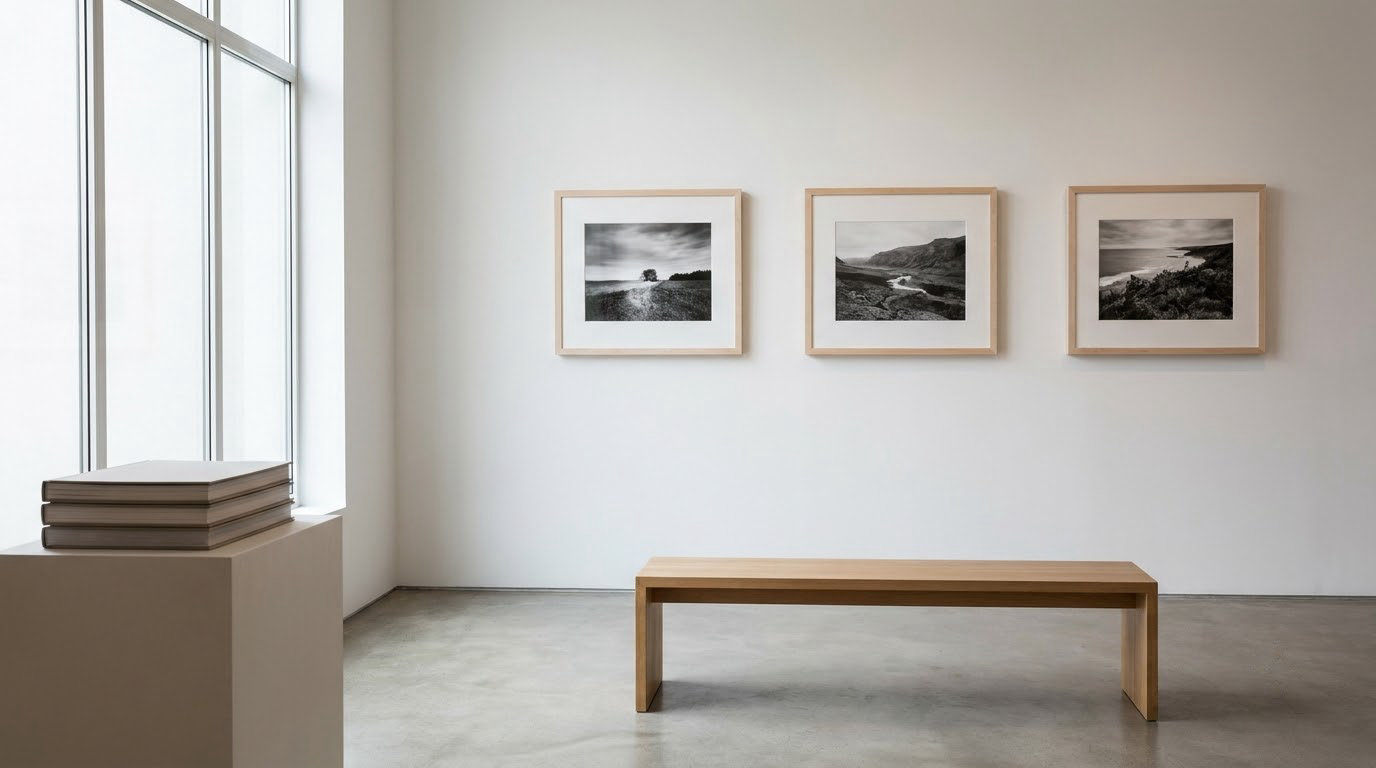
Useful specifics beat abstractions. Where the photographs were made, over what period, on what camera or film, at what size, and what the frames look like in the room. Mention the installation itself: a run of six sea-level frames hung at eye height, prints facing the window light. A curator writing about the hang tells the reader something a photo caption cannot.
For solo shows, this section carries the argument. For group shows, keep it to one paragraph and give the other artists a line each. Links to related editing guides can help you describe the look of the work: our guides on converting a photo to black and white in Photoshop and on creating a surreal photo edit are useful when the series involves tonal or constructed images. If the show includes composites, our photo composite guide covers the process worth naming in the text.
It works when someone who has not seen the show can still picture where the pictures hang.
Step 5: Include Practical Visitor Information
Give readers the exact opening and closing dates, the full address, the opening hours, admission details, whether the venue is step-free or has accessibility provision, and how to RSVP if that applies. Vague information is worse than none, because a listings editor will simply drop the entry.
Keep this as its own short block near the end, headed with something like Exhibition details or Notes to editors, so an editor can lift it in one block. If the venue has a step-free entrance, say so in those words. If the show runs across two venues with different closing dates, list each one separately with its own line.
It works when a reader can plan the whole visit from that block without emailing you anything.
Step 6: Add Quotes, Credit Lines, and Boilerplate
Add one usable quote, one correct set of credit lines, and a short biography a journalist can reuse verbatim. One quote is right. Two is padding, and a quote nobody said is a career problem, so write it yourself and get it approved before it goes out.
For photography, the credit line is the part people get wrong. Fill every field:
| Field | Example |
|---|---|
| Artist | Marta Lindqvist |
| Work title | Salt Line II (Whitby, January) |
| Year | 2026 |
| Medium | Pigment print on Hahnemuhle Photo Rag |
| Edition | Edition 2 of 7 |
| Print size | 110 x 150 cm |
| Framed size | 118 x 158 x 4 cm |
| Photo credit | Photo: Anna Reeve |
| Courtesy line | Courtesy the artist and Harbour Hall, Whitby |
| Copyright | Copyright Marta Lindqvist. Reproduced with permission. |
Give installation views their own credit, since the photographer is often not you. Then supply press-ready files, sized for where they will actually run:
| Where the image runs | Minimum file size |
|---|---|
| Newspaper or magazine print | 300 DPI at final print size, roughly 3000px on the long edge for a full-page image |
| Online news story | 1200px on the long edge, sRGB JPEG |
| Newsletter or social | 1200px on the long edge, with no text baked into the file |
It works when an editor can publish your image with your credit line without having to ask you a single question.
Step 7: Finish With Contact Details and a Call to Action
Close with a named press contact, direct email, phone number, the exhibition web page, a note that high-resolution images and installation views are available on request, and one specific invitation: attend the opening, interview the artist on a given afternoon, or take photographs at a stated time. A specific invitation gets accepted. A generic one gets filed.
Here is a fill-in-the-blank release you can copy straight into a document. Replace every bracketed field and delete the guidance in parentheses.
FOR IMMEDIATE RELEASE

[HEADLINE: Artist name photographs SUBJECT: what the pictures show, opens at VENUE, CITY on DATE]

[SUB-HEAD, optional: one line adding context such as a commission or a first series]

[CITY, DATE IN CAPITALS]

[LEAD: who, what, where, when, why in three sentences. Start with the reason the exhibition exists.]

[PARAGRAPH 2: what the photographs show, where and when they were made, how they were made.]

[PARAGRAPH 3: the concept in plain language, and how the series is hung in the space.]

[OPTIONAL QUOTE from the artist or curator, 25 to 40 words, one only, approved before sending.]

EXHIBITION DETAILS
Title: [full title]
Dates: [opening date] to [closing date]
Address: [venue, street, city, postcode]
Hours: [days and times]
Admission: [free, or price and concessions]
Opening reception: [date and time], [the artist will be present / not stated]
Access: [step-free entrance, lift, seating, or other provision]
Website: [URL]
RSVP or booking: [link or email]

PRESS IMAGES AVAILABLE
[Number] high-resolution images, including [titles], plus [number] installation views.
[Installer view] photographs by [photographer name].

IMAGE CREDITS
[Work title], [year]. [Medium]. Edition [n] of [n]. [Print size], framed [framed size].
Photo: [photographer]. Courtesy [the artist / the artist and the venue].
Copyright [artist name]. Reproduced with permission.

ABOUT THE ARTIST
[Two to four sentences in third person: where the artist lives and works, training, previous
exhibitions, collections, and any teaching. No adjectives you cannot defend.]

NOTES TO EDITORS
- [Any prior coverage, award or collection fact, with publication and date.]
- [Interview availability: which afternoons, in person or by phone.]
- [Private view or photography restrictions for visiting press.]

CONTACT
[Press contact name], [role]
Email: [address]  Phone: [number]
[Studio or gallery postal address]
It works when you can fill every bracketed field in one pass and delete nothing you cannot source.
Step 8: Review and Distribute the Release
Read it once for names, dates, titles and links. Then read it once as an editor with two minutes: does the first sentence tell me what this is, and can I find the dates and address without hunting?
Then customise before sending. Fifteen personalised emails outperform five hundred identical ones, and this is the one piece of advice almost every publicist repeats: a two-line note naming why this show suits that journalist beats a bulk send every time. Segment your list, because a features writer, a listings editor, a photography magazine and a local radio presenter each need a different sentence at the top.
Use a subject line that is a plain subject, not a pitch: Salt Line, Marta Lindqvist at Harbour Hall, opens 4 October. Attach the release as a PDF and the images in a linked folder rather than in the message body. Send two to four weeks ahead of the opening, follow up once about a week before with the opening reception as a fresh angle, and follow up a second time two days before only if you have something new to add. Then move on.
It works when your sent folder shows individual notes, not 60 identical messages, and every recipient got a reason that was about them.
Common Mistakes That Get a Photo Exhibition Release Ignored
Almost every ignored release fails on one of a handful of predictable things. Here they are with the fix.
- Pasting the artist statement as the lead. Fix: write a new lead. The statement belongs on the wall and in the handout.
- Writing we are excited to present. Nobody at a newspaper is. Fix: cut all first-person enthusiasm and state facts.
- Sending to a bought list with no personal note. Fix: research each outlet, keep only relevant ones, and write the first two lines for that journalist.
- Attaching 40MB of images with filenames from the camera. Fix: host files in one folder with names like lindqvist_saltline_02_300dpi.jpg and link them.
- Getting the credit line wrong or leaving it out. Fix: fill every field in the credit table above and check the courtesy line character by character.
- No news angle. A show is a calendar entry, not a story. Fix: find the commission, the site, the partnership or the public programme that makes it reportable.
- Hype words. Unique, groundbreaking, immersive and must-see signal that nothing concrete follows. Fix: replace every one with a specific fact.
- Confusing the four documents. A press release is for editors, an artist statement is for the work, a wall label is for the print in front of it, and an invitation is for guests. Fix: keep them separate, even when they share sentences.
- Uploading AI-drafted prose untouched. Assistants write serviceable scaffolding fast, and the result reads like it, which is the fastest route to the bin. Fix: use a draft as an outline, then rewrite every sentence in your own words and cut the ones you could not defend.
Three closing tips. Keep a reusable master file with your boilerplate biography and standard credits so each show takes under an hour. Ask your press contact to proofread before it goes anywhere. And put the release on the exhibition’s own page as plain text, because editors copy from search results and newsrooms long after the email is gone.
Frequently Asked Questions
How long should a photo exhibition press release be?
One page, or roughly 350 to 600 words including the boilerplate. Sources disagree between 300 and 1000 words, and the reconciliation is the body copy: keep the lead, context, credits and contact under two pages, but hold the narrative paragraphs to about 250 words. Editors read the first screen and lift the facts block, so put your dates, address and lead in the top third.
What are the 5 W’s in a press release?
Who, what, when, where and why. For an exhibition they read as the artist, the show and the work, the opening date and closing date, the venue with full address and hours, and the reason the show exists now. Answer all five in the first three sentences, then use the rest of the release for context, credits, biography and contact.
Can ChatGPT write a press release for me?
It can give you a structure and a first pass, but it will not know your edition numbers, your credits or your news angle unless you supply them, and the generic tone is obvious to editors. Use it to order your facts into paragraphs, then rewrite every sentence yourself and delete anything you cannot verify.
What size should press images be for an exhibition release?
Supply 300 DPI files at final print size for print publications, roughly 3000 pixels on the long edge for a full-page picture, and at least 1200 pixels on the long edge in sRGB for online stories, newsletters and social. Send one hero image in the email itself so a writer can see it instantly, and host the full set in a linked folder.
How far in advance should I send an exhibition press release?
Two to four weeks before the opening is the usual window, with one reminder about a week before the opening reception and a final note two days out only if you have something new. Local and regional press respond faster than trade magazines, which often need six weeks or an early announcement. Sending on the day of the opening is too late for print deadlines.
How is a press release different from an artist statement?
A press release is written for editors and answers what, where, when and why, in third person, with dates, credits and a contact. An artist statement is written for the work and the people standing in front of it, usually in the first person, with no logistics. Wall text is a condensed version of the statement; an invitation is a short personal note with the practical details.
Conclusion
Start by confirming the facts: dates, address, hours, credits, edition numbers and a working press contact. Then pick the visual angle and the one reason the exhibition exists, because that sentence is what an editor is looking for.
Write the headline and the lead next, answer the five W’s in three sentences, add the credit lines and the facts block, proofread it twice, and send it to a short list of named journalists with a line written for each one. That is the whole job, and it works far better than a statement with your name on the top of it.