
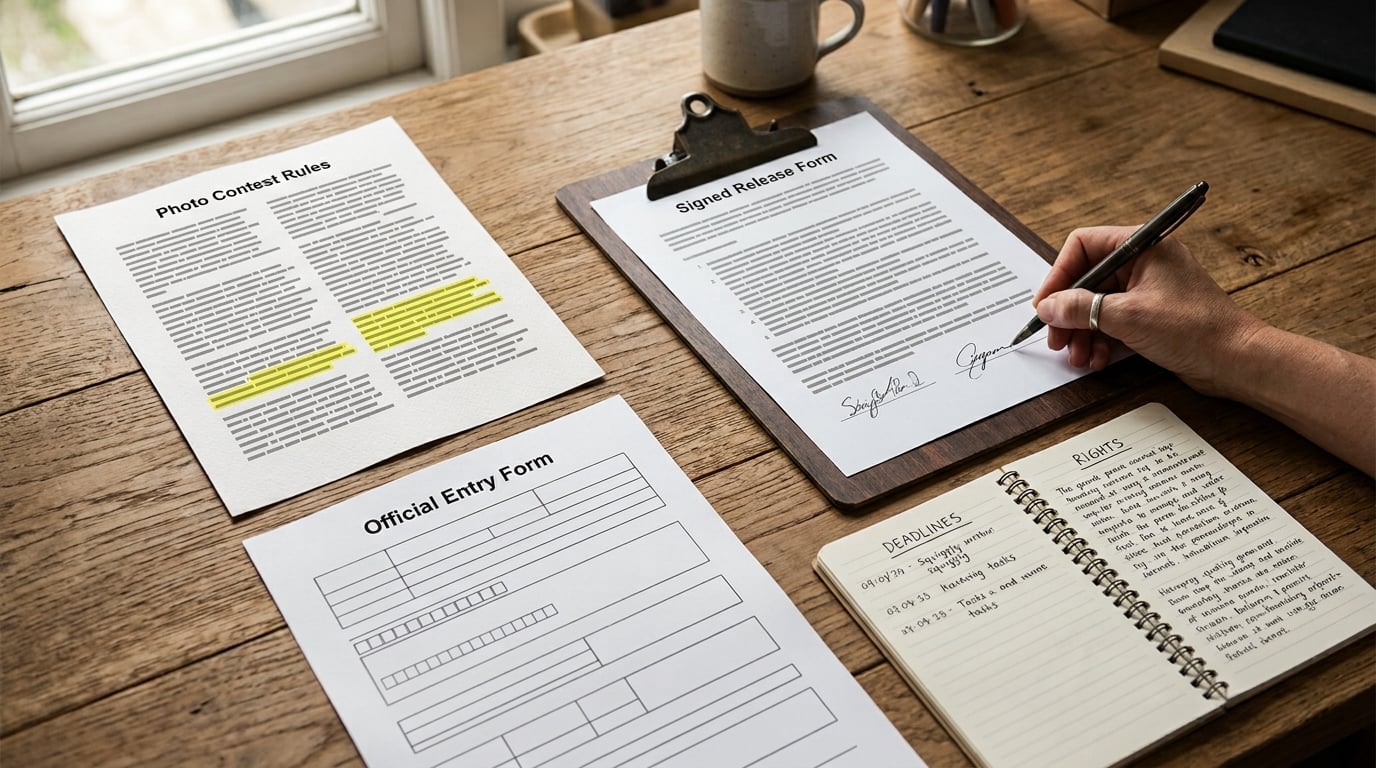
To read photo contest rules and rights properly, treat the terms and conditions page as a contract you are signing, not as fine print to skim. Work through it in a fixed order: who may enter, what the image must be, how it is judged, what happens when you submit, and what usage rights the organizer receives. Five minutes of clause-by-clause reading prevents almost every contest mistake, including the one people fear most, giving away copyright they meant to keep.
Most contests do not take your copyright. Plenty of them take a broad, perpetual, worldwide right to publish your picture, and they apply it to losing entries as readily as winners. That gap between what people assume and what the document actually says is where disputes start.
Table of Contents
- What You Need
- How to Read Photo Contest Rules and Rights Step by Step
- 1. Confirm the contest legitimacy and organizer
- 2. Check who is eligible to enter
- 3. Review the theme and judging criteria
- 4. Understand the submission and file requirements
- 5. Identify copyright, licensing, and promotion rights
- 6. Verify releases, privacy, and legal conflicts
- 7. Run a yes-or-no test of the photo contest rules and rights
- Common Mistakes
- Frequently Asked Questions
- What if a photo contest rule is unclear?
- Do photo contests usually own the winning image?
- Do I need a model release for a photo contest?
- Can I enter AI-generated or heavily edited photographs?
- How can I tell whether a photo contest is legitimate?
- What should I do if I discover a rules violation after submitting?
- Conclusion
What You Need
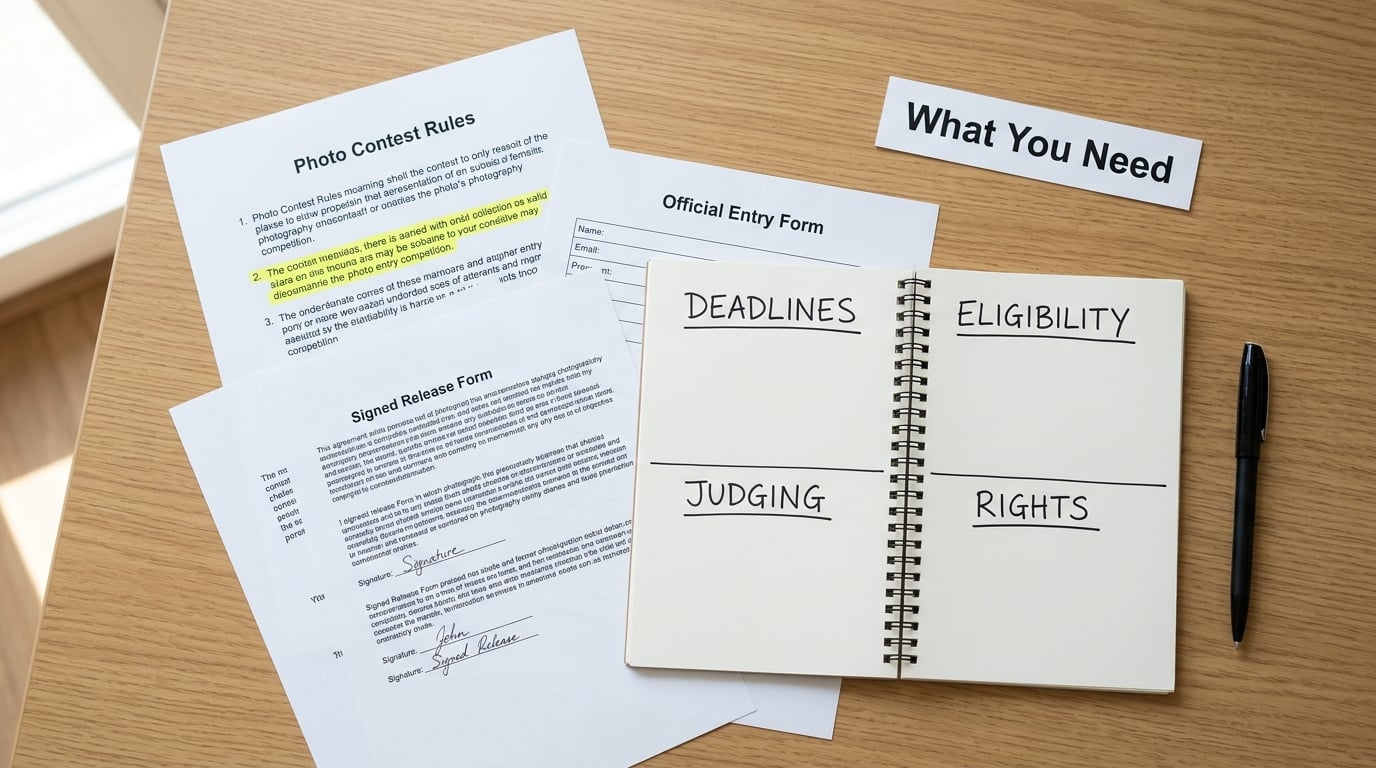
You need four documents and one notebook. Have the official rules open in a separate tab from the contest landing page, because the marketing page and the legal page often describe different contests.
- The official rules document. Look for links labelled Official Rules, Terms and Conditions, Release Form, or Waiver. If you cannot find one within a click or two of the entry page, that tells you something about how much the organizer wants you reading.
- The entry form itself. Read the field labels, not just the boxes. Fields asking about third-party content, model releases, or AI tools signal restrictions that also appear in the rules.
- Your image file details: pixel dimensions, aspect ratio, file size, color space, format, and whether metadata is preserved.
- Your copyright records. Any prior license, agency submission, gallery print release, or client contract covering the same frame.
- Releases for any recognizable person, private interior, private artwork, logo, or trademark in the frame.
- A notebook or spreadsheet with five columns: deadline, eligibility, technical specs, judging, rights.
Add a screenshot tool. Saving the rules page as a dated PDF costs you nothing and settles arguments later about what the terms said on submission day.
How to Read Photo Contest Rules and Rights Step by Step
Read the document in the same seven passes every time. Consistency matters more than speed, because the clauses are ordered by the lawyer who wrote them, not by the order you find interesting.
1. Confirm the contest legitimacy and organizer
Start with who is behind this and whether the rules are the current version. Check that the sponsoring organization has a real website on its own domain, a reachable contact address, a named jury, and a history of running the award. Look for a rules date or version number and confirm you are reading the version attached to the call you are entering.
Walk away when the entry flow asks for card details or a wire transfer under pressure, when the rules live only inside an image or a PDF with no page text, or when the domain differs by a single character from the brand it imitates. Promotional sweepstake campaigns often run real prizes with real marketing and thin terms, so treat vague eligibility and vague prize mechanics as a skip rather than a puzzle.
Go/no-go: proceed if the organizer, the rules version, and the prize terms are all traceable to the same domain.
2. Check who is eligible to enter
Eligibility rules quietly disqualify more entries than technical faults do. Look for age minimums and whether they are measured at entry or at the prize date, country or residency limits, professional status definitions, equipment requirements, and restrictions on images that have already won an award, been published, or been sold.
Two traps catch people out. A contest described as amateur often defines amateur as anyone not earning more than a stated income from photography, which can catch a part-time shooter. And an image that has been published in a magazine or uploaded to a portfolio site may already count as public, which disqualifies it under prior-publication rules.
Go/no-go: if the definition of eligible depends on a phrase like in good standing or at the discretion of the organizer, ask in writing before entering.
3. Review the theme and judging criteria
Compare the theme wording against the image you have in mind, word by word. Themes are usually written tightly, and a near miss is still a miss. A call for street life may exclude posed portraits shot outdoors; a call about craft may exclude documentary frames.
Then read the judging section. Note whether judging is by a named jury, by public voting, or by a mixed panel, and whether entries are judged blind. If judging is anonymous, any metadata that identifies you is a liability, and some rules ask for files exported without location data. Also check whether the jury weights categories such as technical quality, originality, and storytelling, because that tells you which of your frames to submit when you are allowed more than one.
Go/no-go: if you cannot quote the theme sentence that your image satisfies, you are guessing.
4. Understand the submission and file requirements
This is where the readable rules get specific, and it is where most disqualifications happen. Capture the deadline with its time zone and whether it is the upload time or the payment time. Note the entry limit per photographer, the entry fee, whether fees are refundable, and whether one image may be entered into several categories.
Then the file block: minimum and maximum pixel dimensions, required aspect ratio, maximum file size, accepted formats, color space, whether borders or watermarks are allowed, the file naming convention, and the caption limit. A file that misses one of these can be rejected automatically with no human review at all.
Before you upload, confirm five things:
- Dimensions and aspect ratio match the category, not just the camera.
- File size sits inside the limit with room to spare.
- Format is one of the accepted ones, not just a convertible one.
- No watermark, border, or template unless the rules mention it.
- Metadata is stripped or kept exactly as the rules require.
Save the confirmation screen or the emailed receipt. If the contest never confirms your entry, you cannot prove you entered it.
5. Identify copyright, licensing, and promotion rights
This is the section that decides what the contest can actually do with your photograph, and it comes near the end of the document precisely because organizers assume few entrants will read it. Four things to identify: who keeps copyright, what license the organizer receives, how long it lasts, and whether it is exclusive.
Non-exclusive means you may also license the same image elsewhere. Exclusive means nobody else may use it, including you, and contests sometimes impose exclusivity for a period. Perpetual means no end date. Irrevocable means it cannot be taken back even if you withdraw. Sublicensable means the organizer can pass the right to a third party, which is how a contest image ends up on an agency’s site or a partner’s campaign years later.
| Rights term | What the organizer can do | How long | Who keeps copyright |
|---|---|---|---|
| No license | Nothing beyond the contest itself | Contest period only | You, entirely |
| Non-exclusive license | Publish alongside your other licensing | Usually stated term, sometimes perpetual | You |
| Perpetual non-exclusive license | Publish forever in promotion, social, print, merchandise | Forever, non-revocable | You, but you cannot stop the usage |
| Exclusive license | Publish alone for the stated term | Stated term, often one to two years | You |
| Assignment of copyright | Own the photograph as if they made it | Permanent transfer | Them |
Read the license wording in the tense it is written. Granting the organizer a license to display entries on their site and social channels is narrow and easy to accept. Granting a perpetual, irrevocable, worldwide, sublicensable, royalty-free license for any purpose including commercial merchandise is a very different document.
Also separate three clauses that people merge. An editing clause lets the organizer crop or adjust your image. A promotion clause lets them use it in their own marketing. A license grant is the legal permission that makes both possible. Promotional use by the winner is separate again, and often more valuable to you than the prize, because it means your name on a campaign.
Note whether the license applies to all entries or only winners, and whether you can withdraw an entry and take the license with you. Rules that state the license survives withdrawal are the ones worth a pause.
Go/no-go: an assignment of copyright, a perpetual irrevocable exclusive license, or a license with no time limit and no withdrawal clause are all reasonable reasons to skip. A defined non-exclusive license tied to promotion is ordinary and normal.
6. Verify releases, privacy, and legal conflicts
Releases come up when someone recognizable appears, when private property or private art is visible, or when a logo or trademark is prominent. Read the requirement literally: some contests ask for a release only if the image is used commercially, others ask for one for any entry at all, and some ask for it from anyone whose image is reproduced in materials alongside yours, which is a much wider net.
Check your own prior agreements at the same time. If you have already licensed this frame to an image library, a client, or an agency, entering it may breach that agreement even though you own the copyright. Work-for-hire and model-released images from paid assignments frequently have a second layer of restrictions you did not write.
Two more checks. Privacy expectations differ by country and by setting, and a release signed by someone does not clear copyright held by a third party in the frame. And check whether the contest bans AI-generated or heavily altered work, whether alteration is limited to crops and tonal adjustments, and whether a disclosure form is required for any generative tooling.
Go/no-go: if you cannot produce a release that the rules ask for, submit a different frame.
7. Run a yes-or-no test of the photo contest rules and rights
Run a final verification pass using your five-column notes, then answer each of these out loud:
- Am I eligible under the written definition?
- Does the theme sentence in the rules cover this image?
- Does my file meet every technical spec?
- Do I have every required release?
- Do I keep copyright?
- Do I know exactly what license I granted and for how long?
- Can I still use this image commercially afterward?
- Did I get a submission confirmation?
Save proof once you pass: a dated PDF of the rules, a screenshot of the confirmation, and a copy of the exact file you submitted with its metadata intact. Then document the outcome in your own records.
Reviewers on photography forums keep returning to one worry, that a contest can use a picture permanently, and the pattern they describe is consistent: the grant is real, it is buried, and it usually applies to every entry rather than only the winner. Finding that sentence in five minutes is the entire point of reading the rules. It is general information about how these documents are usually written, not legal advice, and the terms that govern any single contest are that contest’s own rules.
Common Mistakes
These are the errors that cost entries every year, each with a direct fix.
Missing the deadline by reading the wrong one
The closing date for uploads is often earlier than the announced results date. Convert the deadline into your own time zone, set two reminders, and treat the earlier of any two dates as the real one.
Assuming the theme covers related subject matter
A call for nature photography does not automatically accept landscape images with a person in them. Find the sentence in the theme that your frame satisfies, and if none exists, submit something else.
Ignoring the AI and alteration clause
Contests differ widely on generative tooling, from a full ban to a disclosure requirement, and removing an object or adding sky is often treated as alteration even when it looks like ordinary post-production. Read the definition before you edit, not after.
Entering without required releases
A recognizable face without a model release is the most common rights-based disqualification. Sort the releases before choosing the frame, not once you have already picked the winner.
Misreading a license as a copyright transfer
You keep ownership unless the rules say in plain words that copyright is assigned, transferred, or sold. A broad license is not a transfer, and it is not dangerous on its own, but you should know which one you are signing.
Losing the submission confirmation
No receipt means no proof of entry and no way to correct a metadata mistake. Screenshot the confirmation page and check your email before you close the tab.
Trusting the landing page over the rules page
When a marketing page and the legal document describe different eligibility, prizes, or usage rights, the legal document governs. Screenshot the discrepancy and ask before entering if the gap is large.
Frequently Asked Questions
What if a photo contest rule is unclear?
Ask the organizer in writing before you submit, using the contact address on the official rules page, and keep the reply. A short email naming the clause and the situation gets a usable answer far more often than a comment or a direct message. If you get no answer, treat the ambiguity as the organizer’s problem and weigh entering at all, because the rules as written are what will be enforced.
Do photo contests usually own the winning image?
Usually you keep copyright, and the contest takes a license instead. What varies enormously is the scope: many grants are broad, perpetual, worldwide and royalty-free for promotion, and some apply to every entry rather than only winners. Look for the words assignment, transfer, or sell to find a genuine ownership transfer, and check whether the license survives withdrawal of your entry.
Do I need a model release for a photo contest?
You may, and the rules decide. A recognizable person in the frame often triggers a model release requirement, especially for commercial, advertising-related, or prize-promotion contests. Some rules ask for releases only if your image is actually used, others ask for one at entry. Read the exact wording, because a broadly worded clause can cover images reproduced in galleries or press material alongside yours.
Can I enter AI-generated or heavily edited photographs?
Only if the rules expressly allow it, and then only under their conditions. Many contests ban generated content entirely, others permit limited tools with disclosure, and some still say nothing at all. Altering a photograph in ways beyond cropping, exposure, and tonal adjustment is frequently treated as manipulation. If the rules are silent, ask in writing and get the answer saved before you submit.
How can I tell whether a photo contest is legitimate?
Check that the organizer operates a real website on its own domain, lists a jury and a contact address, and has run the award before. Confirm the rules carry a version or date and that the version matches the call you are entering. Be cautious with contests that advertise heavily, ask for card details or payment transfers outside a normal entry flow, or publish rules only as an unsearchable image.
What should I do if I discover a rules violation after submitting?
Contact the organizer right away with your entry number and a plain description of the issue, then ask whether the entry can be corrected or withdrawn. Many organizers will fix a file-spec problem or a missing release rather than disqualify outright. Keep copies of everything you send. If the contest has already judged and you were excluded, the appeal process and its deadline are almost always written into the rules themselves.
Conclusion
Open the official rules document, not the landing page, and read it in the order it was written. Pull out every deadline, entry limit, and technical spec into your notes. Find the rights paragraph and decide, in plain words, whether you keep copyright and what permission you are handing over. Sort your releases and your prior agreements. Then run the yes-or-no checklist once more and keep your confirmation receipt.
That first pass takes a few minutes, and it is the difference between entering a contest on your terms and entering it on someone else’s. It also applies as general information only, since contest terms and copyright law differ by country and by organizer.
Last updated: October 2026.