

Here is how to get honest feedback on your photography without months of guessing: post to a venue built for critique, write one line about what you were trying to achieve, and ask for one strength and one specific weakness. Praise tells you nothing, so the question does the work. Set-up takes about twenty minutes; the waiting is the hard part.
Most photographers asking this question have already tried the easy route. They post a finished image to Instagram, to a Facebook group, or into the comments of a friend’s photo, and get a wall of emoji. Nobody is lying to you. People are being polite, and politeness has no information in it.
Forum threads on r/photocritique, PhotoCommunity and photo.net keep circling the same complaint: the notes that do arrive are mostly preference dressed up as advice. Someone wants you to move the subject a few inches, crop out the empty space, or push more contrast into the midtones. That is their taste arriving through your file, not a defect in your picture.
Real critique reads differently. It names what the image is doing, connects that to what you said you wanted, and points at the specific place where the two part company. Getting that outcome takes preparation, the right venue, and a sorting routine for what comes back. Here is the whole process.
Table of Contents
- What You Need
- Step-by-Step
- How to get honest feedback on your photography by picking one area
- Choose a small, relevant set of photographs
- Ask reviewers the right questions
- Choose reviewers with relevant perspective
- Create a comfortable review process
- Separate observations from personal taste
- Compare feedback patterns before changing your work
- Turn useful feedback into specific revisions
- Ask for a follow-up review after revising
- Common mistakes that make feedback useless
- Frequently Asked Questions
- Conclusion
What You Need
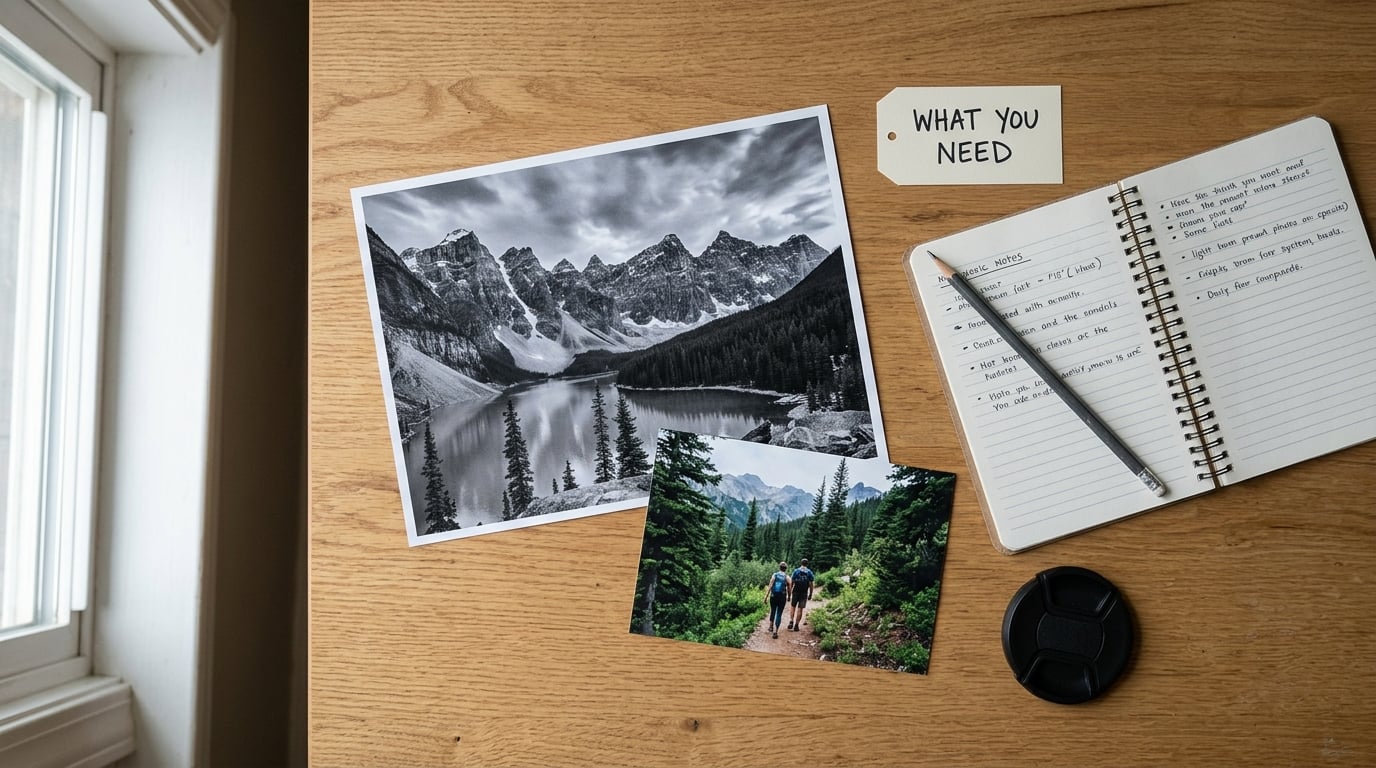
Four things, and you can assemble them in one sitting. Without them the process falls apart in predictable ways, usually at the point where someone asks what you were going for and you answer with a shrug.
- One image, or one small series. Two to five frames, or a single coherent body of work. Not a folder, not a drive link, not forty.
- A one-sentence intent statement. What did you want the viewer to feel or notice? If you cannot write that sentence, you do not yet have the thing reviewers are supposed to judge.
- One specific question. Composition, emotional impact, tonal range, storytelling, or technical execution. Pick one.
- Context notes. Lens and focal length, aperture, shutter speed, ISO, what you changed in the edit, and one sentence on the situation you were shooting.
- A place to log responses. A note on your phone or a page in a notebook. Reviewer names, what they said, and whether it was repeatable or personal.
The intent statement is the piece people skip and the piece that does the most. A photography adjunct who teaches a critique class described running sessions where the group tries to work out what the photographer was after before the photographer says a word. The notes get sharper when everyone is aiming at the same target.
One more thing worth having: a version of the file with no notes attached. Some people attach a contact sheet of an album they have already spent a week grading. You want a fairly raw version, because you are asking about the frame, not the diorama.
Step-by-Step
How to get honest feedback on your photography by picking one area
Name one area to test, because a request for “honest feedback” in general produces general observations and a lot of cheerleading. The five areas that get the most useful responses are composition, emotional impact, tonal range, storytelling, and technical execution.
Composition questions are the most common and the most easily ignored. Emotional impact questions surface whether anyone actually felt anything. Tonal range questions work well for landscape and low-light work. Storytelling questions are the sharpest for documentary and street frames, where the question is whether a viewer can tell what happened without a caption.
You know it worked when the responses concentrate on your chosen area instead of wandering into camera settings. If a third of the replies talk about your tripod, you did not actually ask for a tonal range review.
Choose a small, relevant set of photographs
Two to five photographs is the working range. A single frame gets a single opinion. A small set lets reviewers notice a pattern, which is the only way to see whether your problem repeats.
Pick frames that were made the same way. A wedding set shot across two lighting conditions will produce contradictory notes, and you will spend your energy explaining the difference instead of fixing the picture. A portfolio project works as a set, but cap it at five images plus a line about the rest.
Leave the weakest image in on purpose, and say nothing about it. Reviewers reliably point out the problem you hoped nobody would notice, and that note is often the most valuable one you get all week.
Ask reviewers the right questions
Neutral, specific prompts get specific answers. Ask what landed in the first three seconds, where the eye went first and second, whether anything pulled attention away from the subject, and whether the mood matched what you described. Then ask what you would change, and why.
A request that names your intent and asks one pointed question gets roughly the same quality of answer with none of the guessing. This is the step most write-ups skip, so here is wording you can copy and adapt:
“This is from a series about a market that shuts down at 4pm. I wanted the frame to feel like the light was leaving. One question: does the focal point land, or does the bright awning on the right steal it? I know the highlights are hot, and that was a choice, but I would like a second opinion. Critique is welcome on framing and tone as well.”
Two things make that work. It states intent first, so reviewers read the image against your goal instead of their own. It pre-empts the one thing you are deliberately not asking about, so you do not get nine people who all want to fix your highlights.
You know it worked when replies open with an observation about the image rather than a question about your gear.
Choose reviewers with relevant perspective
Match the reviewer to the note you need, then pick two or three people, not twelve. Artistic peers working in your genre will catch repetition. Working photographers will catch workflow mistakes you have stopped seeing. Editors and art directors will catch clarity problems. Subject matter experts will catch details a general viewer would never notice.
Check whether a reviewer shoots your kind of picture before you trust their eye. Someone who does product still life can tell you a great deal about light falloff on a face and almost nothing about a street frame at dusk.
Two or three reviewers is the sweet spot. One is an anecdote. Ten is noise, and the useful observation ends up buried under low-effort comments, which is what drives people out of these communities.
Create a comfortable review process
Decide the format before you ask, because the format decides who answers. A private message gets candor from people who would never post publicly, and it is the fastest route to a straight answer from someone whose eye you trust. A group session gets breadth and shows you where the consensus is. A portfolio review, whether in person or over a call, gets the most considered response and takes the longest to arrange.
Set the depth you want too. Ask for two observations and a question, or ask for a full walkthrough. A vague request produces vague replies, and then everybody feels slightly awkward about it.
Give a deadline and say whether you want one round of notes or a conversation. Tell people whether you would rather hear “I would crop this differently” or “something in the top third is pulling my eye.” Reviewers appreciate being told how blunt you can be, and most of them will go further than you expected.
Separate observations from personal taste
Sort every note into one of four buckets before you touch the file. This is the habit that keeps someone else’s portfolio out of your work.
| What came back | What it is | What to do |
|---|---|---|
| Your eye lands somewhere you did not intend | Observation, repeatable | Test a revision |
| Shadow detail is crushed on the right side | Technical correction | Fix it |
| I would shoot this in black and white | Personal taste | Decline politely |
| Beautiful, great shot, nice light | No information | Ask a follow-up question |
The test is repeatability. If two unrelated reviewers land on the same thing without being prompted, it is likely a property of the image. If one person wants a different genre, a different era, or a different color palette, that is a preference and it tells you about them.
Reviewers who name a trade-off instead of issuing a command are the ones worth keeping. “Cropping tighter would lose the context of the street” is useful. “Crop tighter” is not.
Compare feedback patterns before changing your work
Group the notes before you act on any of them. A recurring note across several reviewers is worth an experiment. A single note in a thread of thirty is an opinion you happened to read twice.
Compare each pattern against your stated intent. Recurring notes that contradict your goal are still notes, and you can decline all of them. A recurring note that explains why the image is not doing what you wanted is the one to act on first.
Watch for the second pattern: two people noticing opposite problems. That usually means the image is trying to do two things, and the fix is a decision about which one matters, not a compromise between the notes.
Turn useful feedback into specific revisions
Convert the notes into one or two concrete experiments, not a full re-edit. If the pattern was a distracting bright edge, try one crop. If the pattern was a mood that never landed, try one exposure or contrast change. Save both versions with the date in the filename so you can compare them properly later.
Keep the choices you made on purpose. Write down the two things you deliberately kept, so when a third round of notes arrives you do not quietly undo them.
Then put the original and the revision side by side at the size you will publish, not zoomed in on a monitor. Most of the time the difference is obvious and the revision wins. Some of the time it is not, and that is a useful answer too.
Ask for a follow-up review after revising
Go back to the same two or three reviewers, not a new audience. Tell them what you changed and what you deliberately left alone, then ask the original question again: is the focal point clearer now, or did something new pull your attention?
This is the step most people skip, and it is the one that turns feedback into a loop instead of a single data point. Reviewers remember the earlier version, which means their second answer has a baseline and yours has context.
Close the loop properly, and those people will answer next time without being asked. Reply to every note, even the useless ones, with a short thank-you that names what you took from it. That habit is the reason some photographers get replies the same day and others get silence.
Common mistakes that make feedback useless
- Asking whether they like it. “Do you like this?” gets you a yes or a compliment. “What lands first, and where did your eye go second?” gets you information.
- Fishing for compliments. Post your work in a general feed and the politeness bias takes over. Post in a critique venue and the norm is already set.
- Sending everything. A folder of forty images produces a folder of forty one-line comments. Five images produce five paragraphs.
- Treating every opinion as a verdict. Three people asking you to crop tighter is three preferences, not a rule. A third of the reviewers saying the whites look cool and slightly flat is a signal.
- Leading the reviewer. If you say the backlighting is tricky, half the replies will skip past it. If you say the backlighting is the point, you will find out whether it works.
- Getting defensive in the thread. Answering a note with an explanation of why you did it that way ends the conversation. Answer with a thank-you and a question instead.
- Posting in the wrong room. Beginner channels are gentler, and dedicated critique channels are blunter. Neither is broken; they are calibrated differently.
Frequently Asked Questions
How do I ask for photo critique without sounding insecure?
You sound prepared, not insecure, when you name the frame, state what you were trying to achieve, and ask one pointed question. Saying this is the second image from a market series and I wanted the light to feel like it was leaving is a stronger opening than any of my friends like it. A specific question forces a specific answer, which is exactly what a vague request never gets.
Can ChatGPT critique photos?
Useful as a first pass, unreliable as a final word. Image models are good at naming obvious things: a blown highlight, a tilted horizon, a subject lost against a busy background. They are poor at judging whether a frame is emotionally successful, because they cannot read intent. Use one to catch the mechanical notes you already half know about, then take the real critique to a human.
Is photography criticism mostly just taste?
More than most photographers admit, and that is the reason the sorting step matters. A note becomes useful when a reviewer points at something repeatable in the image, names a reason, and shows their own work in the same genre. The moment a note turns into a preference for a different look, it stops being critique and starts being someone else handing you their portfolio.
Why do people only say my photos are nice?
Because you posted somewhere politeness is the norm, or because your request invited it. General feeds are built around encouragement. Even in critique communities, vague posts get vague replies. Ask for one strength and one weakness in the same sentence, and most people will oblige, because you have made it easy to be specific. Learning how to get honest feedback on your photography is mostly about the request, not the community.
How do I know if feedback on my photo is useful?
Check three things. Did the reviewer anchor the note to something you said about your intent? Did they point at a specific place rather than a general impression? Did they give a reason? If the answer to all three is yes, act on it. If a note only tells you what they would have done, and cannot explain why, treat it as taste.
Should I revise a finished photograph based on feedback?
Only after you have sorted the notes, and only for patterns you saw in more than one review. Make the change as a test version rather than a replacement, and compare the two at the size you will publish. If the revision fixes a real problem and does not cost you something you valued, keep it. Otherwise you have learned what the image is, which was worth the ask.
Conclusion
Start small. Pick one image, write down the effect you wanted, and ask two people two specific questions: where did your eye land first, and what pulled it away from the subject? Read the answers, sort them into corrections and preferences, and change one thing. Then go back to the same two people and ask whether it worked. That loop, repeated on a single frame, is how to get honest feedback on your photography without burning out on a whole shoot.