
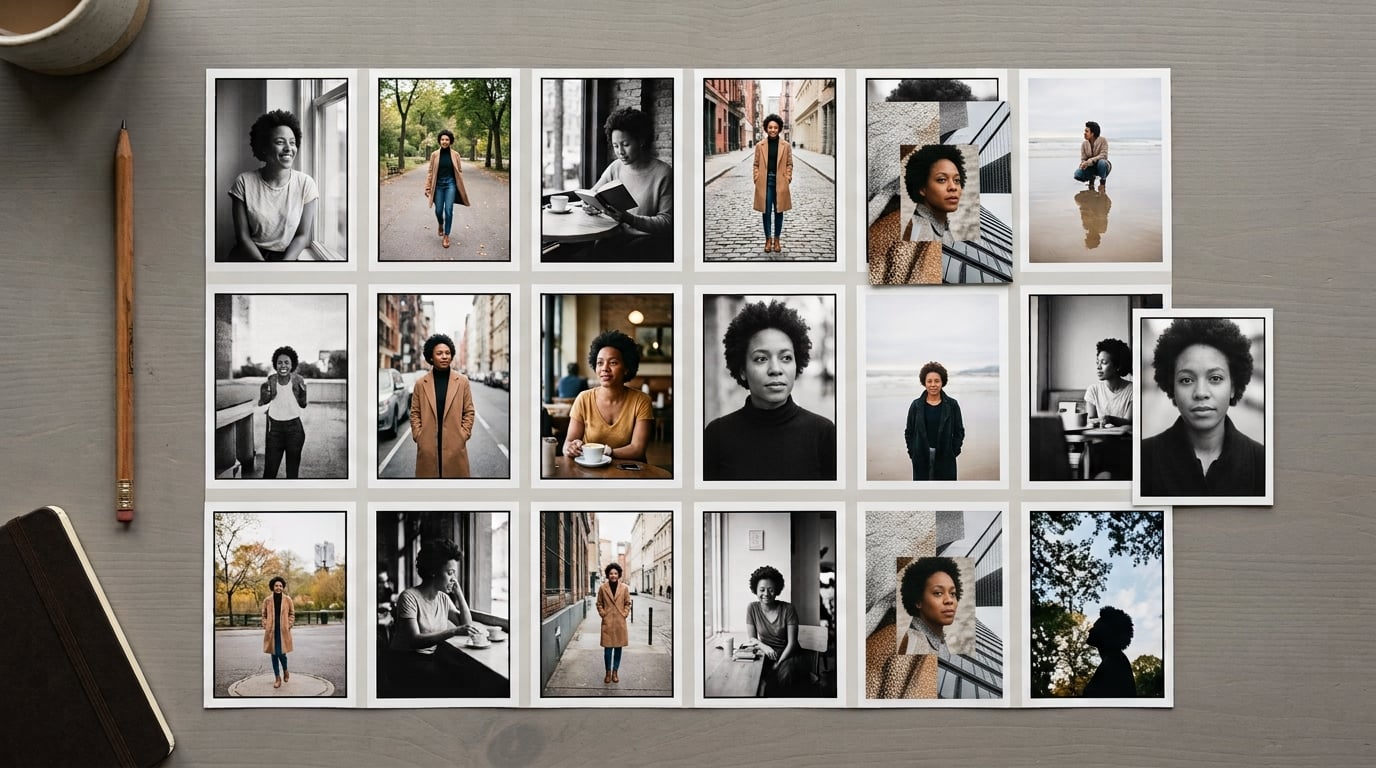
Most professional portfolios run on 12 to 30 carefully selected images, and no single number fits every format. A homepage wants 5 to 10. A single gallery page holds 12 to 24. The whole site should stay under about 40 to 50. That is the short answer to how many photos should a portfolio have, and the rest of this guide explains where each number comes from and how to cut your own library down to it.
Before I explain the counts, the number worth remembering is this: your portfolio is only as strong as its weakest image. A large set of good photographs reads worse than a small set of excellent ones, because the average of what you show becomes your reputation.
Table of Contents
- How Many Photos Should a Portfolio Have?
- How Many Photos Do Different Portfolio Formats Need?
- How Do You Choose the Right Number for Your Photography?
- How Many Photos Should Be in a Portfolio Showcase?
- How Do You Organize a Portfolio Without Making It Feel Repetitive?
- What Factors Should You Avoid When Choosing Portfolio Photos?
- Frequently Asked Questions
- Start With a Small, Cohesive Portfolio
How Many Photos Should a Portfolio Have?
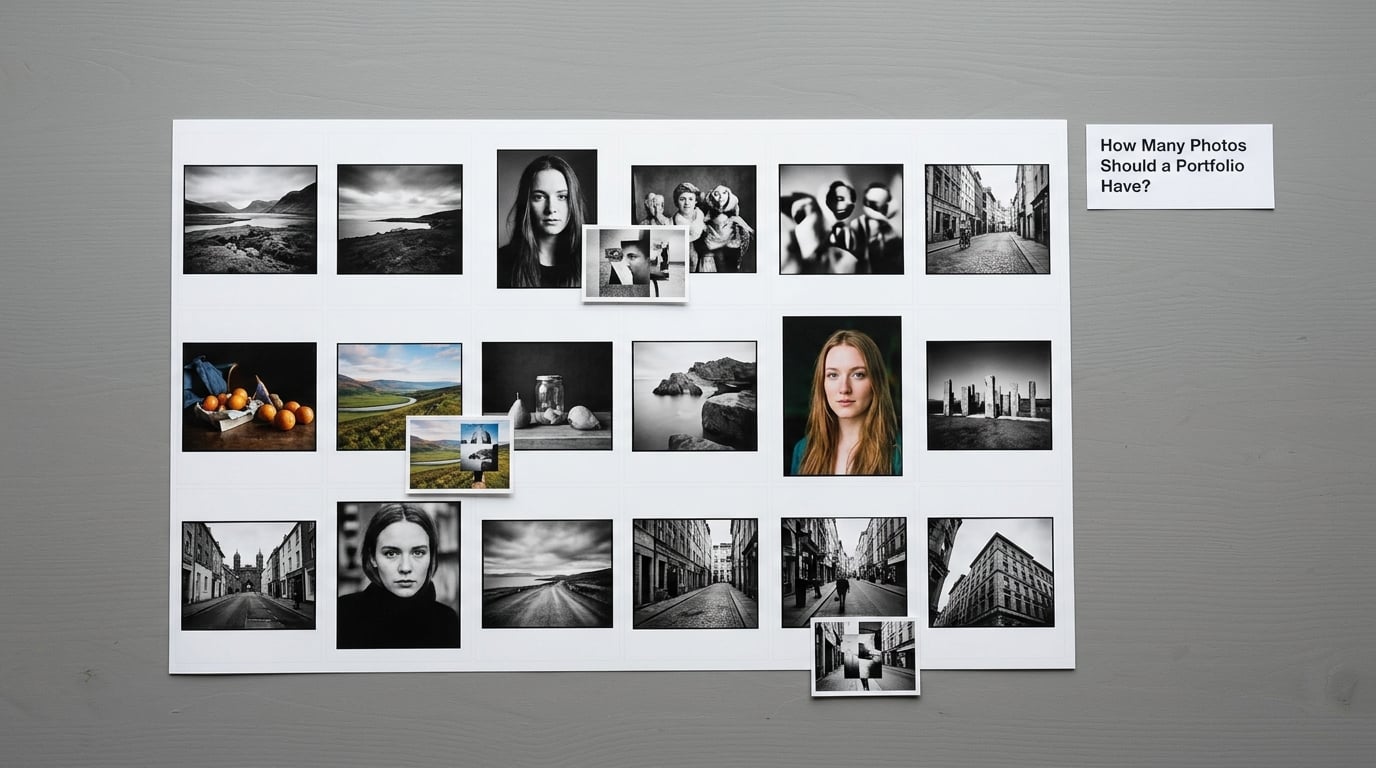
Here are the counts that hold up across most working photographer portfolios. They are starting targets, not laws, and each one comes with a reason attached.
| Portfolio element | Recommended count | Why that number |
|---|---|---|
| Homepage grid or hero | 5 to 10 images | Most visitors form an impression before they scroll |
| Single gallery page | 12 to 24 images | Enough to show range, few enough to finish a session |
| Gallery pages per site | 3 to 5 pages | More than that and the menu stops guiding anyone |
| Total across the whole site | Under 40 to 50 images | A ceiling, not a target to fill |
| Narrative case study | 8 images | Enough to carry a full story from start to finish |
| PDF sent to an art director | 15 to 20 images | A hiring manager rarely scrolls past the first screenful |
| Printed portfolio book | 24 to 36 photographs | Comfortable reading time, roughly 15 minutes |
| Social profile grid | 9 to 12 recent posts | A landing page, not an archive |
Two things are worth separating here. The number of images you have available is a storage problem. The number a visitor should see first is a curation problem. They are rarely the same, and confusing them is the most common reason a portfolio feels too big.
How Many Photos Do Different Portfolio Formats Need?
Different formats ask different amounts of the viewer’s attention, so the same set of work gets trimmed differently depending on where it is going.
Website homepage
Five to ten images. A homepage is a hook, not an archive. If someone opens nine tabs in twenty minutes, you are competing for the one where the images look best side by side and the style is obvious within a glance.
Full online portfolio
Three to five gallery pages with 12 to 24 images each, capped at roughly 40 to 50 images in total. That figure comes up consistently in published guidance, and it is generous. If you need a hundred images to make your case, the argument is about categories, not count.
PDF or email submission
Fifteen to twenty images, and put your three best ones on the first page. A PDF gets opened on a phone as often as a laptop, so keep pages light and captions short. Sending a 90-image deck usually reads as indecision rather than range.
Printed photobook
Twenty-four to 36 photographs for a working portfolio, with 15 to 20 spreads. Prints reward slow looking, so you can hold more, but only if every image earns the ink. Leave a spread breathing rather than cramming six small frames onto a page.
Exhibition or gallery submission
Ten to 20 images, arranged in a sequence with a clear argument. Curators read the sequence, not the thumbnails, and a submission that repeats the same idea five different ways reads as an unfinished thought.
Why the published ranges all disagree
Search for this question and you will find 10 to 20, 12 to 24, 15 to 20, 15 to 30 and 25 to 50 in the same breath. They are not all wrong; they are answering different questions.
| Range you will see | What it actually refers to |
|---|---|
| 5 to 10 | Homepage display |
| 12 to 24 | Photos per gallery page, per the SlickPic expert panel |
| 15 to 20 | The Rule of 20, a per-gallery ceiling promoted by Portfoliobox |
| 15 | Images for a long narrative story, per Canon’s portfolio guide |
| 7 to 12 | Images for a shorter story, same Canon guide |
| At least 20 | Minimum credible size for a new photographer, per Kevin Landwer-Johan |
| 25 to 50 | Launch size for a digital portfolio, per Equinet Academy |
| 15 to 30 | The general consensus for a working site today |
Once you notice each number refers to a different format, the disagreement dissolves. Pick the format first, then the number follows.
How Do You Choose the Right Number for Your Photography?
Most photographers should not decide the number first. They should answer four questions, and the count takes care of itself.
What is the portfolio for?
Winning wedding clients and landing an editorial staff job are different jobs. A couple scrolls for emotion and a warm gallery. An art director scrolls for range, precision and evidence you can hit a brief. Ask which one you are building for, because a single portfolio usually cannot do both at full strength.
How consistent is the work right now?
Consistency is the honest test. A black-and-white street series can carry 30 images if every frame shares a vocabulary of light, grain and distance. A personal set that mixes studio colour work, landscape experiments and heavy compositing will feel scattered at 12 and incoherent at 40, no matter how strong each individual photograph is.
How much context does the viewer need?
A portrait needs no explanation. A full day of documentary work does. If your work only lands when someone reads a caption, either write the caption or cut the image. The reverse also holds: when a project genuinely needs room to unfold, cutting it to six images hurts more than showing fifteen.
How fast will anyone actually look?
On a phone, during a commute, a visitor gives a homepage a few seconds. On a large screen with a client leaning in, they will spend minutes. Build for the first situation and let the deeper pages serve the second.
Once those four answers are written down, the range you need usually falls out of them clearly. A wedding photographer with a consistent look lands at 20 to 30 images across three projects. A career-changer with three unrelated bodies of work lands at 12, split across three separate sites.
How Many Photos Should Be in a Portfolio Showcase?
A showcase portfolio is the trimmed set you send to a specific person, as opposed to the full site they browse. Eight to 15 images is the working range, and that is fewer than most people expect.
Build it in three roles. The hero image earns the click, so it should be your most confident work rather than your most recent. The supporting images prove the hero was not a fluke, usually five to eight of them. The closing image decides how the viewer feels at the end, so pick something with a sense of resolution.
One practical test: view the set in a single column, full frame, with no other distraction. If your attention wanders around image six, the problem is the sequence, not the count. Fix the order before adding anything.
How Do You Organize a Portfolio Without Making It Feel Repetitive?
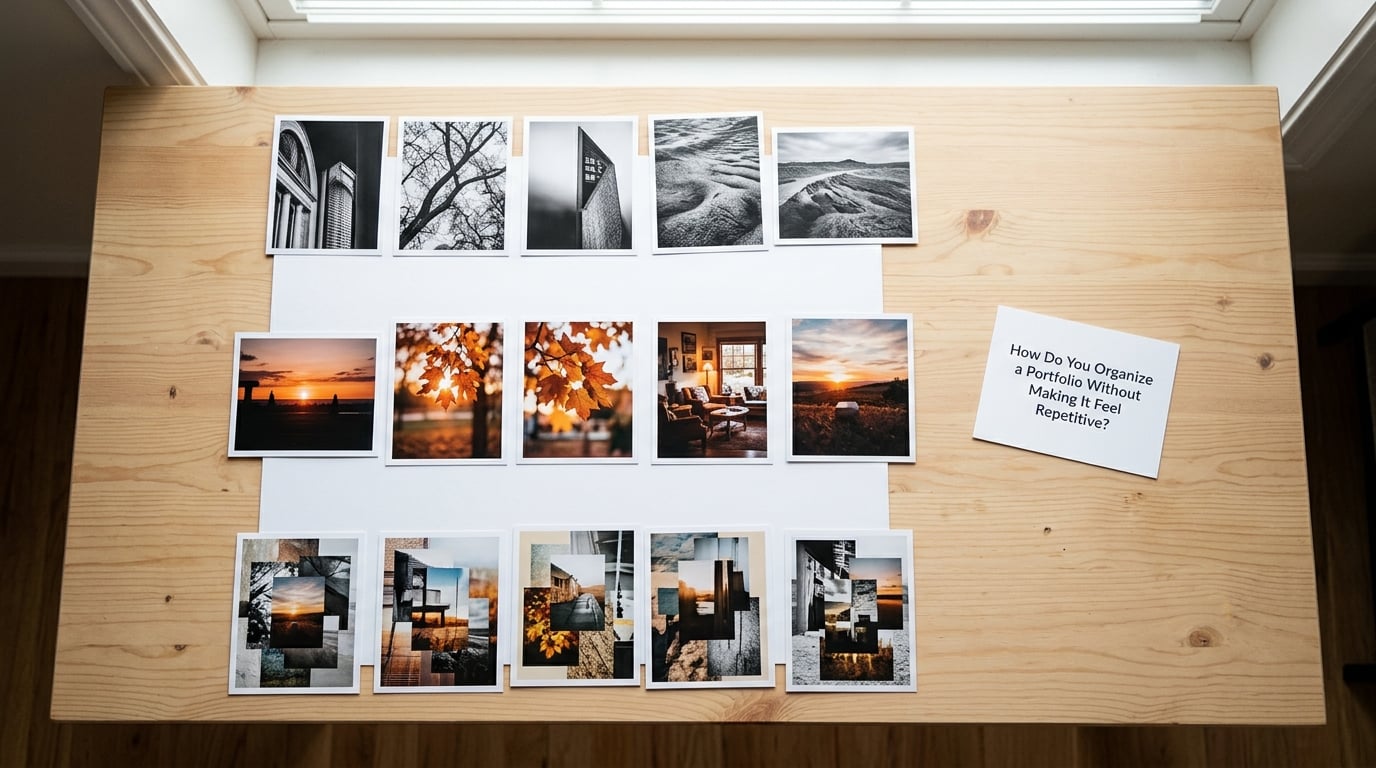
Repetition is not the same as boring. A run of similar frames creates rhythm, which is what tells a viewer they are inside one body of work. The problem comes from repetition without progression.
Start with an opening image that states the style. Then group the rest into two to four thematic sections, and order each one so something changes. A sequence might move from wide to tight, or from empty to crowded, or from colour to black-and-white as an ending.
Use transitions deliberately. A noticeably different image between two related ones works as a full stop. Captions should be one line each, and reserved for facts a viewer cannot see: the year, the location, the commission.
A workable structure for a mixed creative portfolio: five black-and-white frames that establish the eye, six colour frames that widen it, then four photomontages that show what you do with an image afterwards. Fifteen images, three ideas, no filler.
Leave white space between images and between sections. On a screen, empty margin is what tells the eye where one photograph ends and the next begins. A dense grid makes even excellent work look like a stock library.
What Factors Should You Avoid When Choosing Portfolio Photos?
Five habits cause most oversized portfolios. Each has a straightforward correction.
- Including every favourite. Correction: apply a cut rule. Start from your target count, then add back only images that beat something already in the set.
- Choosing on technical perfection alone. Correction: ask whether the image holds attention for two seconds, not whether it is sharp. A technically flawless empty frame loses to a slightly rough photograph with tension.
- Repeating near-identical compositions. Correction: if two frames make the same point, keep one. A photographer working on one idea needs five frames; a photographer working on fifteen needs one.
- Mixing unrelated styles in one portfolio. Correction: split into separate sites. The number of pages rises, but each page gets stronger, and the visitor stops being confused.
- Making the first viewing too long. Correction: put your best ten on the homepage and let the rest earn its place deeper in. If nobody clicks through, the extra images were never going to work.
A useful discipline is a quarterly review. Add one strong new image and take one down, keeping the count flat. Photographers on critique threads say the same thing in different words: edit the set tighter, keep the favourites, cut the rest.
Frequently Asked Questions
How many photos should be in a photographer’s portfolio?
Most working photographer portfolios land between 12 and 30 images in total, with 5 to 10 on the homepage and 12 to 24 on a single gallery page across three to five gallery pages. Keep the whole site under about 40 to 50. The count matters less than consistency: a cohesive set of twenty beats a scattered set of sixty every time.
Is 50 photos too many for a portfolio?
Fifty is too many for a homepage and about right for a total site ceiling, depending on layout. If those 50 images are spread across four or five gallery pages of 10 to 12 each, it works. If they all sit on one page, you are asking a visitor to evaluate 50 frames at once, and most will leave instead.
What is the rule of 20 in photography portfolios?
The Rule of 20 is a guideline from Portfoliobox: keep your main galleries to 15 to 20 images maximum. It is not a law, and it is not a total-site cap. Use it as a per-gallery ceiling so each project stays tight, then let your total reach 40 to 50 across three to five galleries.
How many photos should a beginner photographer have?
At least 20 photographs is a workable minimum, and Kevin Landwer-Johan makes that point when advising new photographers: once you have twenty, you can show them with confidence. A set of 20 honest images from personal projects is far stronger than a padded 60. Quality and a clear voice beat volume when you have no clients yet.
How many pieces of art should be in a portfolio?
Fine art portfolios run larger than commercial ones because a series needs room to develop, so 20 to 30 pieces across two or three coherent series is normal. Some curators and gallery applicants prefer a handful of large-format works, so read the submission guidelines before you build. Consistency of series matters far more than the total count.
What are the 20/60/20, 2/3 and 3:1 rules in photography?
These are composition and editing rules, not portfolio-sizing rules. The 20/60/20 idea suggests roughly 20 percent of your shots in colour, 60 percent desaturated and 20 percent left alone. The 2/3 rule fills about two-thirds of the frame with the subject. The 3:1 rule uses a wide 3:1 aspect ratio for panoramas. None of them tells you how many images belong in a portfolio.
Start With a Small, Cohesive Portfolio
Pick your 12 to 20 strongest images today, remove anything that repeats a point another frame already makes, and arrange them in a single column to check the sequence. Then show it to someone who has not seen your work before and ask what kind of photography you make. Their answer tells you more than any count.
Once that works, expand to 12 to 24 per gallery across three to five galleries and stop there. For how many photos should a portfolio have, the honest answer is that the count is the easy part. Cohesion is what earns the enquiry, and you can only protect it by cutting early and cutting often.