
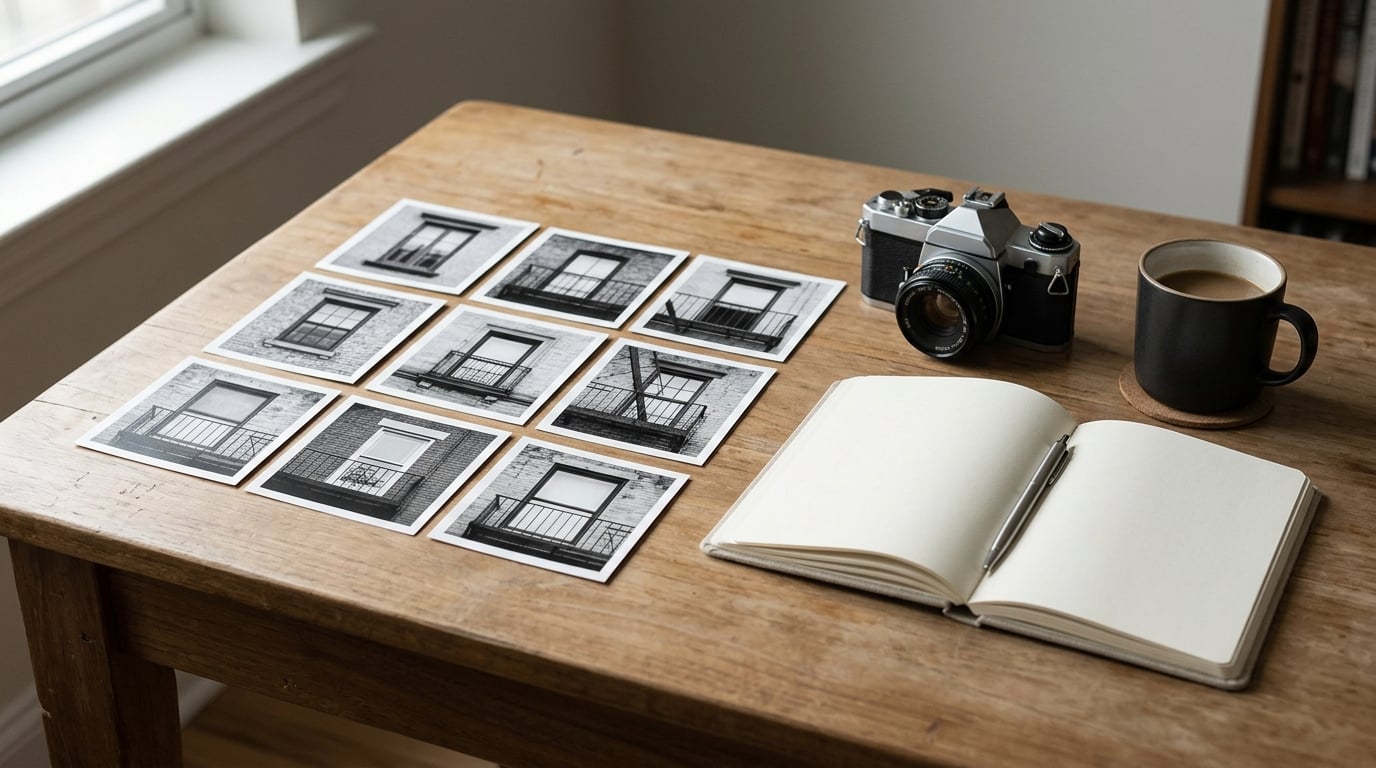
Your photographic voice is the set of choices you repeat: what you point the camera at, how close you stand, the light you wait for, and how you process the file. You find it by making those choices on purpose, many times, and keeping the ones you keep making. Most people get there in three months of deliberate work, and it usually feels slower than that in the middle.
The complaint I hear most often goes like this: the photographs are fine, technically, but they read as random tourist shots with no identity attached. Someone in a r/PhotographyAdvice thread put it exactly that way and admitted they had been staring at their own archive trying to work out what was missing.
Nothing was missing from the technical side. What was missing was a pattern, and a pattern only becomes visible when you make it deliberately enough times to see it. Here is the process that works, roughly in order.
Table of Contents
- What You Need
- Step-by-Step: How to Find Your Photographic Voice
- 1. Look at Your Archive Without Judging Technique
- 2. Identify the Visual Decisions You Make Instinctively
- 3. Copy the Work of Three Photographers You Admire
- 4. Give Yourself Useful Constraints
- 5. Photograph a Small Themed Series
- 6. Edit for Coherence, Not Uniformity
- 7. Get Feedback and Make One Clear Change
- Common Mistakes
- Frequently Asked Questions
- Conclusion
What You Need
Very little. A camera or a phone that shoots RAW, an editing application you are willing to learn properly, and one folder where your keepers live. That is the whole kit.
Beyond the gear, you need a private place to review work, which mostly means a screen you can sit with for an hour without an audience. Soundproofing is optional. Enthusiasm is not required, though it helps on the days the light refuses to cooperate.
Expensive equipment does not produce a voice. A prime lens, a nicer sensor, a specific camera system: none of them decide what you notice. Gear changes what is convenient, and convenience shapes some of your habits, but the photograph is made by your attention. A phone shot on a Tuesday evening can be as distinctive as a studio setup, and usually is, because the constraint is doing the work for you.
Step-by-Step: How to Find Your Photographic Voice
Voice is not discovered by picking a style label. It is assembled from repeated observation, narrow experiments, honest selection, consistent editing, and reflection. The seven stages below run in that order because each one gives you the raw material for the next.
1. Look at Your Archive Without Judging Technique
Open the folder and pick 20 to 30 photographs that hold your attention. Judge them on attention alone, not on focus or exposure. If a blurry frame of a stranger’s back still interests you more than a sharp one of a skyline, that is data.
Write down what they share. Not in aesthetic language, in plain notes: subjects you returned to, how close you stood, what time of day, whether people or buildings dominated, whether the frame was crowded or almost empty, what the light was doing, and what you felt looking at each one.
Most people discover three or four repeats inside thirty images. That is the raw material of how to find your photographic voice, and it is already there before you buy anything or change a setting.
2. Identify the Visual Decisions You Make Instinctively
Instinct is fast and quiet, which is why it disappears without being written down. Convert each reflex into something you could tell another person: you seek shadows, or you isolate one detail and throw the rest away, or you keep figures at the edge of the frame instead of the centre, or you only shoot when the light is flat and grey.
Then separate those preferences from your equipment and your training. Shallow depth of field because you like it is a voice. Shallow depth of field because a fast lens was the only one you owned is a habit of circumstance, and it will evaporate the day you buy another lens.
Ask one honest question about each choice: would I still make it with a different camera on a different street? The ones that survive are the start of your visual language.
3. Copy the Work of Three Photographers You Admire
Pick three photographers whose work differs from each other, not three variations of the same look. One might work in hard midday sun and dense crowds, one in soft window light and empty rooms, one in long exposures and heavy contrast. Comparing them is what teaches you that a visual language is a set of choices, not a mood.
For each one, write down how they handle framing, subject, light, colour, timing, editing, and sequence. Then go out and make one photograph that solves the same problem with your own subject. A rain-slicked pavement, not their puddle.
That is controlled borrowing, and it teaches you what you genuinely value, because you discover where your response starts to diverge. On a r/photography thread about building a style, the repeated advice was to shoot what you love and compare yourself against work you admire, not to replicate a single photographer’s frames. Replicating the frame gives you their archive. Replicating the problem gives you practice.
4. Give Yourself Useful Constraints
Constraints turn taste into action. Pick one and hold it long enough to get somewhere: one street for a fortnight, one light source such as a single window, five frames per subject, one colour family, one prime lens for a month, or a full day with no post-processing at all.
Restrictions force decisions you would normally postpone, and they expose the habits you did not know you had. The five-frame limit is the harshest and the most useful, because it kills the instinct to spray and keep hoping.
Write the assignment down with a date on it. An unwritten constraint is a preference, and preferences dissolve in the first week of a busy month.
5. Photograph a Small Themed Series
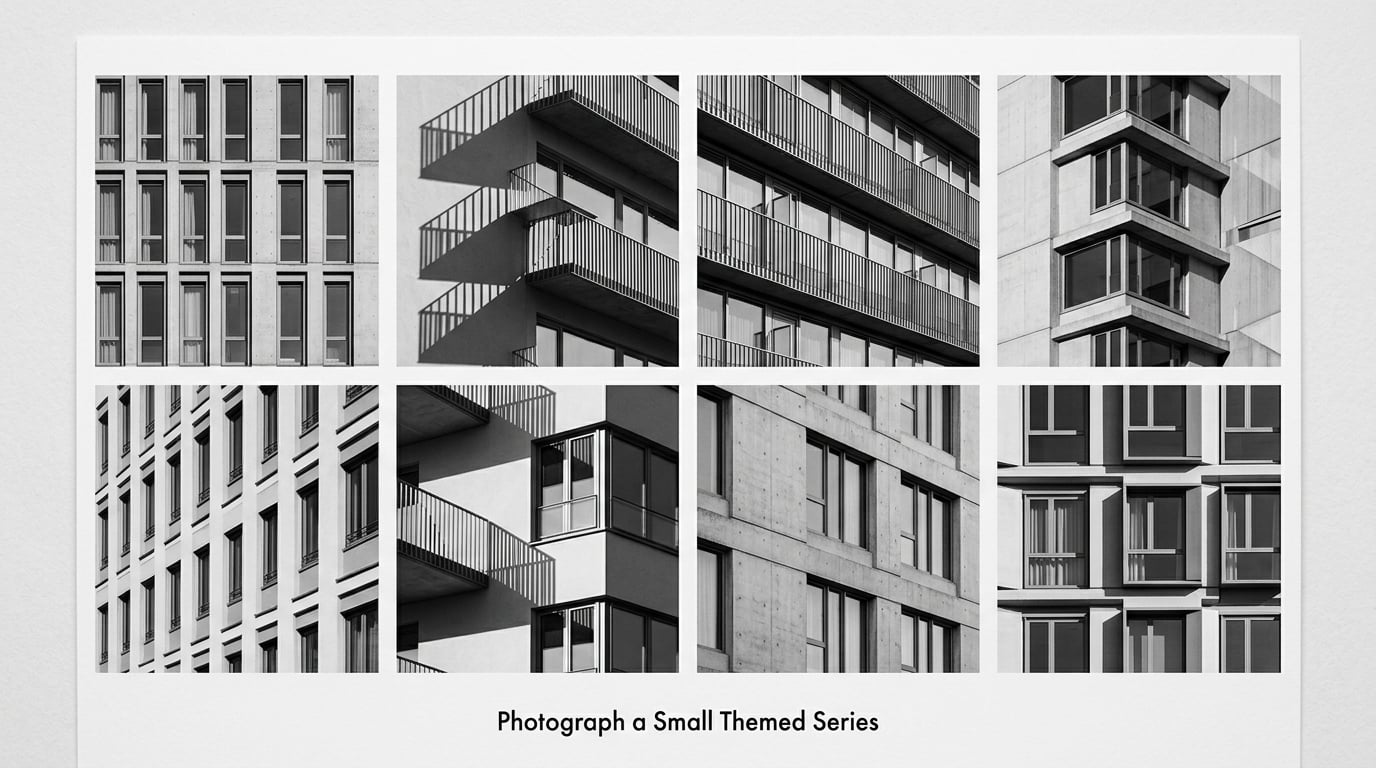
One subject, one visual idea, eight to twelve related frames. A series is the only reliable test of a voice, because a single strong image can be luck and twelve related ones cannot.
Look across them for viewpoint, recurring motifs, tonal relationships, and whether the emotional register holds. A series that mixes three moods tells you the idea was not clear enough when you started. Fix the idea, not the individual frames.
6. Edit for Coherence, Not Uniformity
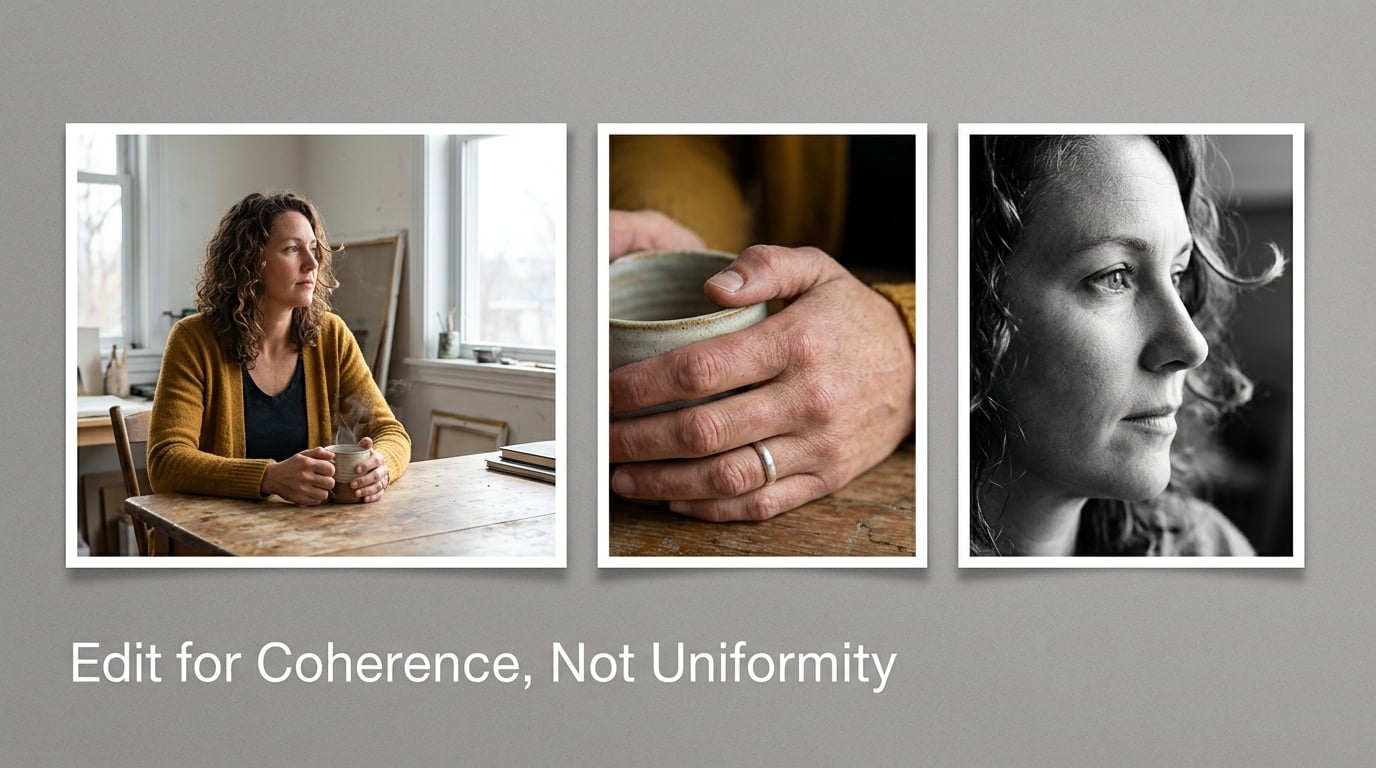
Edit the series as one collection sitting side by side on your screen, not one image at a time in isolation. Check colour, contrast, crop, density, and how the subject is treated across the group. Some difference is good; a difference with no reason behind it is what makes a set look like a mood board.
Then make two versions of one frame, as different as you can stand, and put them next to each other. This is the fastest diagnostic in editing. The version that feels more like you on a good day is telling you something about the whole set.
Save that version as your starting point and reuse it. A consistent edit applied honestly across a series builds recognition faster than any amount of new shooting, and it is the layer beginners can develop in a fortnight.
7. Get Feedback and Make One Clear Change
Show the series to several people before you explain any of it. Ask what they notice first, what they feel, and which image they remember. Their first answer, before you frame the intention, is the closest thing to a test you will get.
Sort what you hear into two piles. Comments about clarity, such as not knowing where to look or being unsure what the subject is, are useful and usually mean a compositional fix. Comments about taste, such as a preference for a different colour, tell you about them, not about your work.
Choose the one observation that appeared more than once, make that single change to the series, and define your next assignment before you close the laptop. One change, applied to everything, teaches more than five opinions applied selectively.
Common Mistakes
Chasing a trend or a named look. Asking how to reproduce a light and airy aesthetic, or whatever look is currently filling your feed, produces a borrowed preset rather than a voice. The fix is to ask what those images make you notice, then go find that thing in your own neighbourhood this week.
Changing direction every few weeks. A new genre every month means you never accumulate enough frames in one register to see a pattern. Pick one constraint for a full month before you evaluate anything.
Copying a portfolio superficially. Matching mood without method produces work that looks borrowed the moment it is next to the original. Borrow the problem they solved, never the frame, as described in step 3.
Treating technical perfection as voice. Sharp focus, clean files, and a level horizon are table stakes. A frame with breathing space, a clear subject, and few distractions reads as deliberate, and that is closer to a voice than any amount of sharpness.
Asking vague questions for feedback. Do not ask whether someone likes the photos. Ask what they looked at first and which one they would remember, then wait for the answer instead of filling the silence with your own explanation.
Tips for Keeping Your Voice Visible
Keep a short visual journal, whether that is a notes file listing your five best frames each month with a line on why, or a private folder of images you saved with no intention of publishing. Reviewing it quarterly is how you catch drift before it becomes habit.
Revisit your older work. Editing a photograph from two years ago with your current settings shows you exactly how far you have moved, and it is a cheap, honest measure of progress.
Make variations rather than reinventions. Photographing the same subject with a different distance, or a different hour, explores your range without abandoning what you already know how to do.
Study photographers outside the platform you post on. Following one feed teaches you its tastes, and a voice needs a wider input diet than that.
Hold a stable editing starting point and let it flex per image. A saved preset applied as a base, then adjusted by hand, keeps your colour signature steady without flattening every frame into the same look.
Frequently Asked Questions
How long does it take to find your photographic voice?
For most photographers the first recognisable pattern appears after three to six months of deliberate work, measured in series rather than days. The first month usually only reveals what you already prefer. A repeatable edit and a coherent series tend to land in month two or three. Ten years of shooting without constraint rarely produces one on its own, because the signal never gets repeated enough to show.
Should every photographer have one consistent visual style?
No. Consistency is a tool, not a rule, and it works best applied to one kind of work at a time. Shooting two very different projects, such as documentation and landscape, with two different looks is normal and often good. What matters is that a body of work is internally legible. If a portfolio of thirty related images reads as one photographer, the voice is working.
How do I know whether my photographs have a distinct style?
Three tests. First, shuffle a series of your own images and show them to someone without context: if they describe a consistent subject and mood, a voice exists. Second, place your best frame next to a stranger’s and ask whether both could come from the same person. Third, look for repeated decisions in subject, distance, light, and colour. Three or more repeats is a voice, and a single repeat is coincidence.
What if my favorite genre does not match my best work?
Follow the work for now, and photograph the favourite genre on the side without judging it as portfolio material. Your best images usually reveal a decision you make naturally, such as how close you stand or which light you wait for, and that decision transfers across subjects. Give it a year of both, then decide which one to build on. Many photographers end up with a voice defined by a way of looking rather than by a genre.
How do I find my voice without copying another photographer?
Separate the method from the result. You can adopt a working habit, such as shooting only in overcast light or refusing to crop a horizon, and make it your own, without adopting someone’s finished images. The line is simple: if your photograph depends on finding the same subject in the same place at the same angle, you have copied a frame. If it depends on a decision you would still defend in a different street, you have a method.
Conclusion
Start with the first action tonight. Open your archive, choose the 20 photographs you like most, write down what they have in common, and turn those three or four repeats into one constrained assignment with a date on it.
How to find your photographic voice is not a single discovery moment. It is a loop of noticing, restricting, shooting, editing as a set, and adjusting, and your voice shifts as your subjects and your life shift. Give the loop three months of honest repetitions and you will have something far more useful than a style label: work a stranger could recognise as yours.