

To approach a gallery with your work, research galleries whose program genuinely fits what you make, check whether they accept unsolicited submissions, and contact them exactly the way they ask — usually a short, personalized email with a link to a clean online portfolio. One finished series presented with a short statement, a resume, and clear prices will do more than a folder of fifty unrelated images.
It takes most artists two to three months to prepare properly, then a few weeks to send a first batch of inquiries. The work of walking through the process is emotional as much as administrative, so it helps to know the shape of it in advance. Updated for 2026, this guide covers the whole route: research, preparation, contact, pitch copy, follow-up, pricing, and what to do with a no.
A gallery is a sales channel with a specific group of collectors attached to it. When a gallerist reads your inquiry, the first question is not “how talented are you” but “can I sell this to my clients.” Answer that question clearly and the rest of the pitch writes itself.
Table of Contents
What You Need Before You Contact Anyone
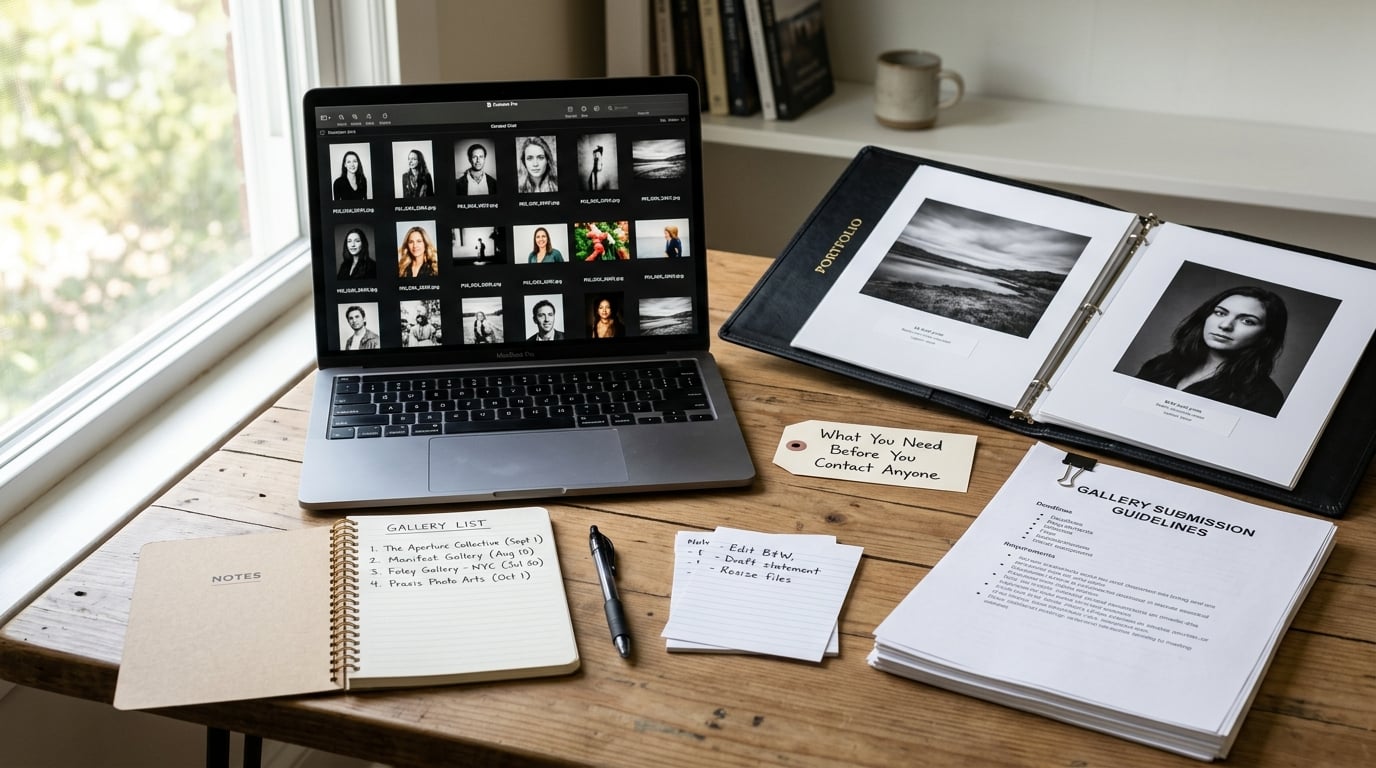
You need eight things ready, and most artists who fail at this stage are missing three or four of them. Gathering these first means every inquiry you send takes ten minutes instead of two hours.
- A unified body of work. One series, or a group of related bodies of work, edited consistently. Not your whole archive.
- An artist statement that a busy person can finish in about 30 seconds.
- A short biography — three to five sentences covering training, where you live, and what you make.
- An artist resume with exhibitions, awards, collections, and press. One page unless you have group shows and teaching to list.
- A reliable artist website that loads fast on a phone and shows good work at full size.
- An image list with title, medium, dimensions, year, edition information, and price for each piece.
- A price list that is consistent across every place your work appears.
- A target list of 8 to 10 aligned galleries, each with a named contact and a note on why it fits.
Prints matter less than most emerging artists assume. Gallery programs have moved online and most galleries will ask for a link rather than a roll of prints, so the physical portfolio is now a secondary format rather than the first thing you reach for.
Step-by-Step: How to Approach a Gallery With Your Work
1. Research galleries that actually fit your work
Fit is the whole game, and it is the step people rush. Spend real time on a gallery’s exhibitions over the last three years, its roster, and its curatorial focus before you decide it is a target.
Look at five things: who they show now, what they showed in the past year, whether those artists work in your medium and at your scale, whether they handle your subject matter, and what their stated submission policy is. A gallery showing only large-scale abstract painting is not a fit for a body of small silverpoint drawings, however good those drawings are.
Then find the policy. Some galleries have a submissions page with explicit instructions and file specifications. Some put a visible notice up saying they are not accepting new artists. Some post open calls with a deadline. Finding that notice before you email saves you from the most embarrassing possible first line.
Build a short list of 8 to 10 genuinely appropriate galleries rather than a list of 60. Artists who treat this as a mass-email exercise get filtered almost immediately, because gallerists can spot a generic message instantly — the ones in r/ArtistLounge describe this over and over, and the fix is always the same: fewer targets, real personalization.
2. Prepare a cohesive body of work
One finished series, edited consistently, is what a gallery can program and sell. The most useful number circulating among gallery owners is 20 to 25 gallery-ready pieces from a single body of work — enough to hold a solo exhibition and enough depth to sell into without running dry in four months.
“Gallery-ready” is a real standard. It means the work is physically finished, properly presented, consistently framed or mounted, photographed well, and ready to hang or ship. It does not mean it has to be flawless, and variety within a series is fine — the mistake is showing six unrelated practices and hoping one of them lands.
For photographers specifically, that means one project rather than your best 40 images across a decade. Choose the set where the lighting, colour, and subject logic hold together, then cut anything that only works because it is different. The gallerist is checking whether you are a consistent artist with a clear vision, not whether you can produce variety on demand.
3. Build a professional presentation package
Your package is what a gallerist forwards to a colleague when they are unsure. It has to stand alone without you in the room explaining anything.
Here is the full list, in the order it should read:
- Subject line that names the work, not “Artist inquiry” or “Opportunity.”
- Three to five sentence opening naming who you are and which specific body of work you are sending.
- One paragraph on why this gallery, referencing a named exhibition, a specific artist on the roster, or a stated program focus.
- A two to three sentence description of the work — subject, process, scale, what the series is doing.
- A portfolio link — a single stable PDF or a clean website page, both under about 10 MB.
- An image list with title, medium, dimensions, year, edition details, and price for each piece shown.
- A one-line ask — a conversation, a look, or permission to follow up. Nothing bigger.
Your statement deserves its own test. Read it out loud to someone who knows nothing about your work; if they cannot summarize what you make after one hearing, rewrite it. Simple, short, honest, and straightforward beats ambitious every time, because a gallery has roughly 30 seconds to decide whether it is paying attention.
Keep your bio and resume as separate documents from your statement. The statement is about the work, the bio is about you as a professional, and the resume is a list of verifiable dates. Mixing all three into one wall of text is the most common packaging error.
4. Find the correct contact and submission route
Route matters as much as content. Knowing which person to address is a small thing that separates a reply from silence.
A gallerist or gallery director makes the final call on what gets shown and can take a direct pitch. A curator shapes the program and is often the person who actually reads submissions carefully, though at small galleries one person wears all three hats. An art director focuses on the visual identity of the space rather than the roster. For a non-profit space or a project room, the equivalent contact is usually a program director or board chair.
Whichever person you write to, use the route they published. If there is a submissions form with a required format, use the form. If the site says “no unsolicited submissions,” believe it. If nothing is published, a short email asking how they accept work is entirely normal — calling to ask is fine, cold-calling to pitch is not.
Now the part that saves you the most grief. There are specific moments to avoid:
- Walking in cold with a physical portfolio. Artists and gallerists both describe unsolicited portfolio visits as an intrusion. It reads as pressure on someone with an open gallery to sell.
- A gallerist’s booth at an art fair. They are there to sell to collectors who already chose to spend money. A pitch costs them a sale.
- A private view or opening night. The room is full of other guests and the gallerist is hosting. Attention is the scarcest thing in the building.
- The ten minutes before a gallery talk. They are setting up or about to be introduced to an audience, not reading submissions.
- Repeated follow-ups with no reply. One follow-up is persistence. Three is noise, and it gets you blocked.
The same research turns up a good answer to a question most artists never ask: do galleries need to be in my city? No. Sales still happen locally at a higher rate, and many galleries ship anywhere, but location is a preference rather than a requirement. Mention your city once if you are willing to travel, then let the work carry the approach.
5. Write a specific and respectful inquiry
This is the actual moment of approach, and it is where most first attempts fail. A gallerist can tell within three lines whether a message was written for them or blasted to 200 addresses.
Keep it under 150 words. Reference something specific about the gallery. Name the exact body of work. Attach nothing except a link. Close with a small, clear ask.
Cold pitch template
Subject: Submission — [Series title], [medium]
Dear [Name],
I make [one line: what you make and how]. My current series, [series title], is a body of [number] [medium] pieces shot across [place or period]. It explores [two or three sentences on the concept, not the technique].
I saw your exhibition of [named artist] at

The full series and image list, including dimensions and prices, is here: [link]
Would you be open to a short conversation about whether this is a fit for your program?
Thank you for your time,
[Name]
[City] | [website] | [email]
Warm introduction template — when someone offered to introduce you, accept and let them do it. If they have not actually sent it, a brief nudge is fine.
Hi [Name], [Mutual contact] mentioned she thought my [series title] work might suit your program, and I would be glad if you had a look. The series and image list are here: [link]. No rush at all — if it is not a fit I would genuinely rather know.
Six-month check-back template
Subject: Following up — [Series title] (you suggested [month])
Dear [Name],
When we spoke in [month] you mentioned the program was full until about [month] and to check back then. I have been working since — the follow-up series is [one line description], installed and priced.
Is now a reasonable time to send it over, or would [later month] suit you better?
Best,
[Name]
6. Follow up once, professionally
Wait 10 to 14 days, then send one short follow-up that adds something rather than repeating the pitch. “Just checking in” gives a gallerist nothing to answer.
A useful follow-up names the work again in one line, mentions something new if there is something new — an installation view, a print release, a review, a new series — and asks a simple question. Then you stop. Two contacts total is the professional limit for a cold approach.
Silence is the most common outcome and it is genuinely ambiguous. Galleries receive hundreds of submissions a week and a single staff member triages them. A follow-up at six months on the same body of work is normal and welcome; the same follow-up weekly is not.
The reply that trips people up is “we are not currently accepting new artists, but check back in six months.” Forum threads treat this as a delayed yes, and in practice it usually is — the gallery has a program gap coming and has told you exactly when. Put a calendar reminder for that month and send one line then.
7. Review the response and keep developing
There are four realistic answers, and only one of them is a real yes.
Yes, they want to show or represent you. Slow down here. Ask for a consignment agreement in writing before anything moves, and read what percentage the gallery takes, whether that applies to the sale price or your listed price, what happens if a work does not sell after a set period, and who owns the work when it comes back.
They love the work but have no space now. This is a good outcome. Ask when their program reopens, note the date, and stay in contact without pitching every month.
They are not accepting submissions. Follow their process exactly — many will take a work for a group show, an off-site or online program, or an open call. A referral to another gallery is normal and worth taking; it is not a brush-off.
Nothing at all. Silence after one follow-up means no. Do not read it as a judgement of the work; read it as a capacity limit.
On expectations: one painter writing about how he got into his first gallery describes sending to ten galleries at a time and getting roughly one response per batch, which he repeated across several years. That is the honest arithmetic — treat ten submissions as the unit of effort, not one. Galleries also need your help to sell you, so an audience matters: a mailing list, a real Instagram following in your subject matter, a track record of showing outside the gallery, and visible sold-work photographs all strengthen the case.
Artists often call this pattern “artist syndrome” — the conviction that everyone else is selling while you are stuck. It usually has a practical cause, and the practical fixes are unglamorous: consistent pricing, a finished body of work, a real sending rhythm, and other routes to visibility while gallery representation takes months.
Common Mistakes to Avoid
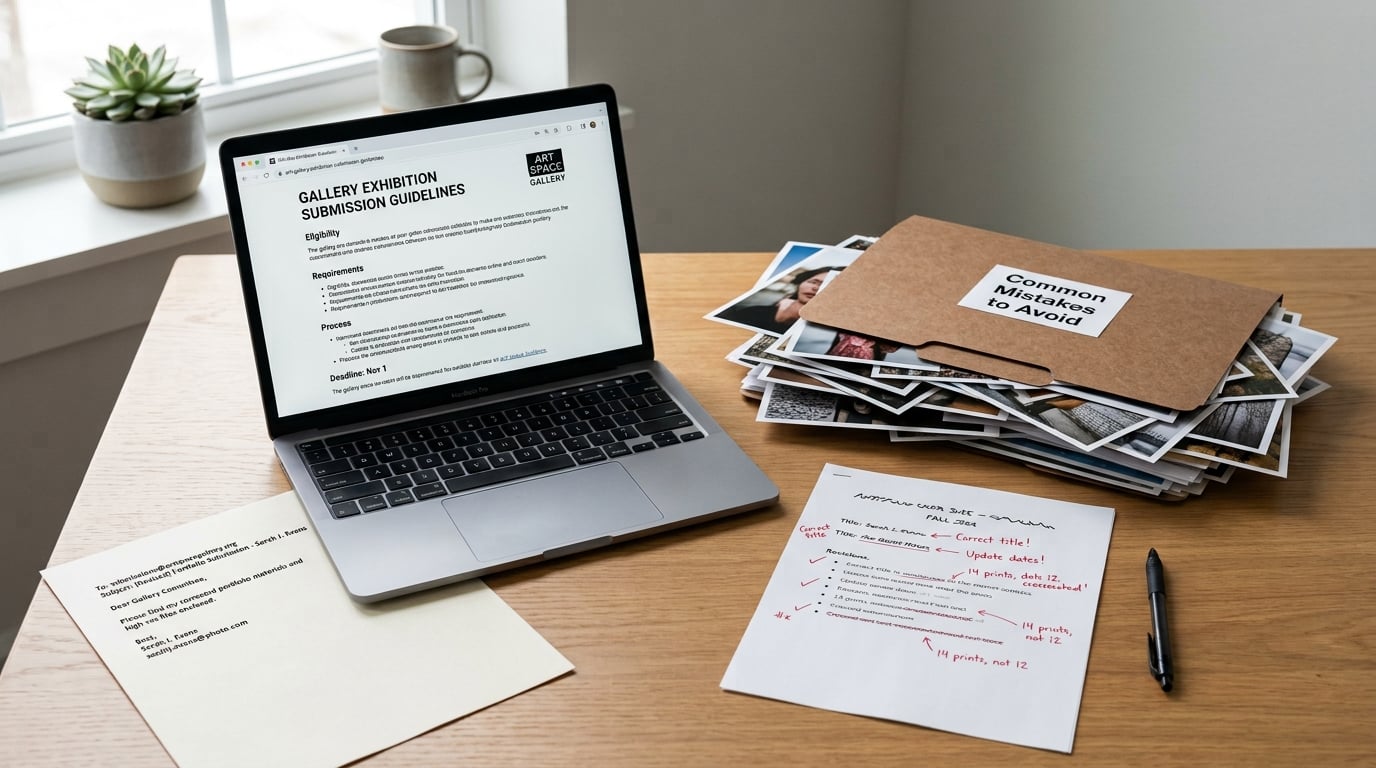
These eight come up repeatedly in gallery-owner interviews, and each has a simple fix.
Sending an unstructured image dump. Fifteen or twenty unrelated images read as indecision. Fix: one series, edited, and every image with metadata beside it.
Approaching the wrong person. Pitching an art director about representation, or emailing a curator with sales expectations, wastes the contact. Fix: read the about page and address the person whose job this actually is.
Ignoring published submission guidelines. Wrong file format, wrong size, missing required documents. Fix: follow the specification to the letter, even when it feels fussy.
Inconsistent pricing. Different numbers on your website, your price list, and your email. Gallerists notice this immediately and it reads as inexperience or as an attempt to work around them. Fix: one price list, one set of prices, and never undercut a gallery you are working with.
Claiming things with no evidence. “My work is sold out” or “I have a strong following” with nothing to show. Fix: show the sold-work images, the newsletter numbers, the exhibition history.
Attaching oversized files. Ten full-resolution JPEGs at 40 MB get filtered as spam. Fix: one link to a PDF under about 10 MB, or a website page.
Chasing a silent gallery. Fix: one follow-up at two weeks, one check-back at six months if they asked for it, then stop.
Pitching at booths and openings. The gallerist is working. Fix: admire the work, introduce yourself in one sentence, and follow up by email a few days later.
Two more worth knowing. Walking in cold with a portfolio is the single most-cited taboo among working artists — you can look at the work as a visitor, but the portfolio stays home unless asked for. And paying an exhibition or booth fee to be shown is a red flag: legitimate commercial galleries take a commission on sales rather than charging you to hang a show, so any upfront fee deserves scrutiny before you send anything.
Frequently Asked Questions
What should I send a gallery in the first email?
Send a link to one clean portfolio showing a single finished series, plus an image list with title, medium, dimensions, year, edition details, and price for each piece. Keep the email itself under 150 words, name one specific reason you are writing to that gallery, and end with a small, clear ask. Attach nothing large — galleries prefer a link or a PDF under about 10 MB.
Do I need a portfolio before approaching a gallery?
You need a coherent, gallery-ready body of work, but you do not need a bound book. Most galleries now ask for a website link or a PDF, and many prefer to browse online before asking for anything physical. What matters is that the images are consistent, professionally presented, and that every piece has its title, medium, dimensions, year, and price listed clearly.
How do I follow up when a gallery never replies?
Send one short follow-up 10 to 14 days after your inquiry, mentioning the work by name and adding something new if you have it. After that, stop. If the gallery specifically asked you to check back in six months, do exactly that on the date they gave. Artists who keep contacting weekly are the ones who get blocked; one follow-up reads as persistence, several read as noise.
Is it normal to pay a gallery to show my work?
No. Commercial galleries generally take a commission on sales rather than charging you to hang a show, and upfront exhibition or booth fees are a common warning sign in the art world. Non-profit spaces, juried group shows, art fair booths, and some rental programs do charge legitimate fees, so check the terms, the contract, and the refund policy before paying anything.
What are the 70/30 and 80/20 rules in art?
Both are time-allocation guides rather than laws. The 80/20 version, often attributed to gallerist Sadie Coles, suggests roughly 80 percent of an artist’s effort belongs to networking and promotion and 20 percent to making. The 70/30 version flips the emphasis for a period of intensive studio production. Artists use them at different stages, and neither replaces a real sending schedule.
What is artist syndrome?
Artist syndrome is the recurring belief that other artists are selling steadily while you are stuck and getting nowhere. Forum discussions treat it as a mood rather than a diagnosis, and its usual causes are practical: inconsistent pricing, work that is not finished, or a slow, irregular submission schedule. Fixing the routine tends to fix the feeling faster than waiting for reassurance.
Conclusion
Learning how to approach a gallery with your work comes down to four habits: research before you write, present one finished body of work, send a short message that names the gallery specifically, and follow up exactly once. Do those things ten times and the odds work in your favour.
Start today by picking three galleries whose programs genuinely fit your work, then finish one series properly. When the images, statement, resume, and prices are ready, send those three inquiries today rather than waiting for a batch of ten — the first one teaches you more than the rest of the list combined.