
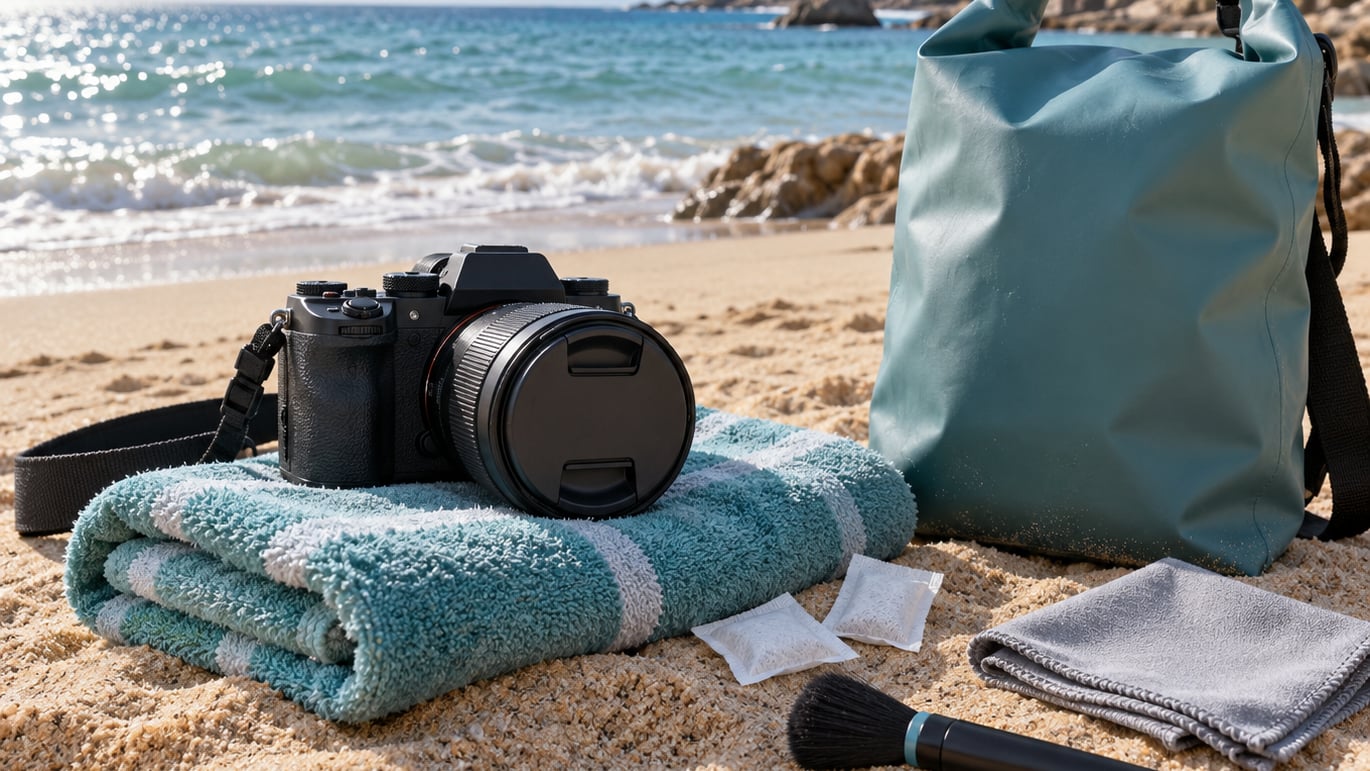
Protecting a camera at the beach comes down to four predictable enemies — blowing sand, salt spray, direct sun and heat, and sudden water — plus one habit: keep the body covered, keep the lens capped, and rinse everything with fresh water as soon as you get back. Ten minutes of preparation at home prevents almost all of it.
The routine runs in three blocks: prepare before you leave, protect while you shoot, rinse afterwards. None of it needs expensive kit. A capped lens, a bag you can wipe clean, and fresh water do most of the work.
Table of Contents
- What You Need
- Step-by-Step
- How to protect a camera at the beach before you go
- Keep sand away during transport and setup
- Shoot from a safe distance from the water
- Protect the camera from salt, spray, and humidity
- Limit strong sun and wind exposure
- Handle splashes and sudden moisture safely
- Clean and store the camera after the beach
- Common mistakes
- Tips for long beach days
- Frequently Asked Questions
- Can I use a regular camera at the beach if it is not waterproof?
- What should I do if saltwater or seawater splashes my camera?
- Is putting a camera in a plastic bag enough protection from sand and moisture?
- Can I change lenses at the beach?
- How long should I let a camera dry after it gets wet?
- Do silica-gel packets actually help protect camera gear at the beach?
- Conclusion
What You Need
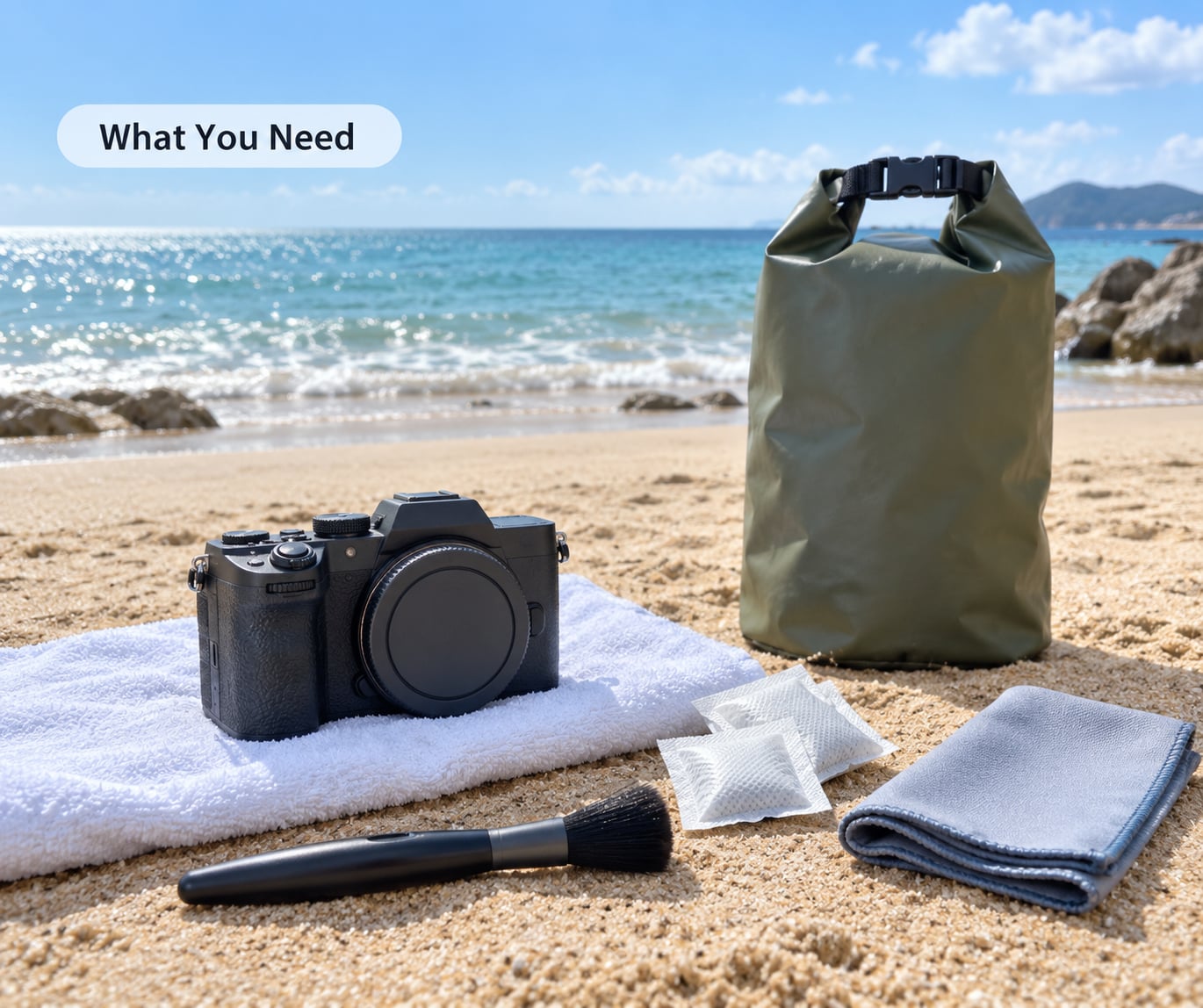
- A camera bag that wipes clean. A covered all-weather sling bag holds up better than an open fabric backpack, because salt and sunscreen wipe off a smooth surface instead of soaking in.
- A lens cloth and a soft brush. A clean microfiber cloth for the front element, a soft-bristled brush for grit off the body. Keep both in a pocket of the bag, not loose.
- A sealed dry bag or hard container. This is where the camera lives between shots, between locations, and while you swim. Roll the top down twice and clip it so it stays shut.
- Silica gel packs. Two or three loose packets, not the scented kind. They pull humidity out of a closed bag overnight.
- Fresh water and a towel. A bottle you can pour and a towel you can wrap. The towel doubles as shade for the camera in hard sun.
- A front filter or lens hood. A clear UV filter takes the abuse instead of the front element, and a hood keeps spray and grit off the glass at angles.
- A shaded, dry place to work. A café table, an umbrella, the back seat. Changing cards in full sun and full wind is how grit gets in.
If your bag is still a mystery of loose items, work through 12 must-pack items for a camera bag first so the essentials are already sorted before you leave.
Step-by-Step
How to protect a camera at the beach before you go
Start at home, where you have clean surfaces and time. Check the weather and the tide table — an incoming tide changes where you can safely stand, and a wind forecast tells you whether sand will be blowing.
Clean the lens and body first. Dust already on the front element is what sand ends up grinding into when the two mix. Charge every battery and format your memory cards in the shade, so you never have to swap either one outdoors.
Empty the camera bag and shake it out indoors. Sand that rode home in a bag last trip is sitting at the bottom right now. Refill it with the short list above and nothing extra.
Keep sand away during transport and setup
The camera stays in its closed bag until the moment you raise it. Every open minute on a windy beach is a chance for grit to land on the mount, the sensor, or an exposed filter.
When you do set up, work with your back to the wind, and never place gear on bare sand — grit gets under the tripod feet and works into the leg locks. A folded towel or a small mat gives you a clean surface anywhere.
Keep the zip closed between shots rather than holding the flap open with a thumb. Long lenses go on with the cap fitted if the wind is up, and lens caps stay on whenever the camera is not aimed at something.
Shoot from a safe distance from the water
Stand further back than feels necessary and use a longer lens to fill the frame. Wave sets run further up the beach than people expect, and a camera on a tripod is far easier to abandon than one around your neck.
Watch the water for a while before you set up. Sneaker waves arrive without warning and pull people and gear backwards into the surf, and wet sand underfoot is a slip risk on its own.
Rocky shorelines are worse than open sand. Wet rock is slick, sharp, and full of crevices where grit hides, so keep the tripod feet high and the body close to your chest.
Protect the camera from salt, spray, and humidity
Salt is the quiet one. Spray lands as invisible residue and keeps corroding contacts, dials, and mount surfaces for days after you get home, which is why a camera can fail a fortnight later rather than on the beach.
Break the line of sight between your gear and breaking waves, and put a rain cover or protective sleeve over the body when the wind is onshore. Work with dry hands — handling a body with wet or sandy fingers transfers grit straight onto the controls.
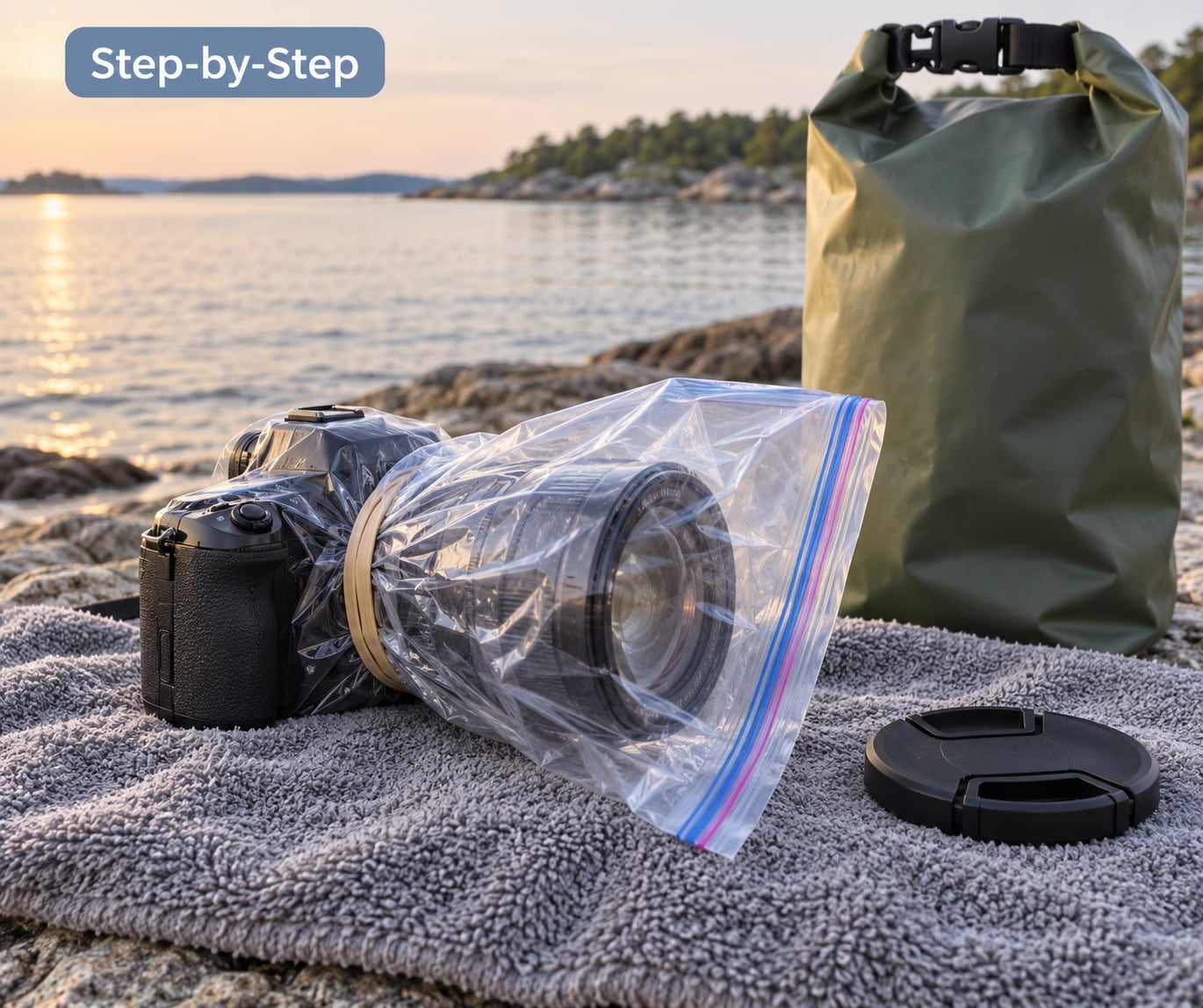
When the air turns damp or salty, put the camera back in the dry bag and seal it. If you are moving around a lot, the cheap DIY version works: stretch a large zip-lock or thin plastic bag over the lens to the mount, secure it with a rubber band, then open the zip to shoot.
Limit strong sun and wind exposure
Midday sun cooks the LCD and drains batteries faster than most people budget for. Shade the body with your own shadow or a towel between setups, and keep the camera out of a hot parked car, where interior temperatures climb past what the electronics enjoy.
A lens hood or clear UV filter cuts direct UV exposure on the front element and, just as usefully, blocks spray arriving at an angle. Clean the filter during the session, because salt film builds up into a hazy blur long before you notice it in a file.
Wind is the other half of the problem. Take breaks in a sheltered, dry spot rather than pushing through a squall, and expect the small parts of the bag — strap buckles, zips, cable clips — to collect sand faster than the camera does.
Handle splashes and sudden moisture safely
If spray hits the camera, stop shooting and move to a dry place. Do not shake it and do not blow into the lens — that drives moisture and grit further into the barrel.
Power the body down. Remove the battery only if the interior is not wet and the camera has not just been running hot, since opening a warm, damp body traps vapour inside. Card and lens doors stay shut until everything is dry.
Wipe the outside with a fresh cloth, then let the camera sit open in moving air at room temperature. Never point a hairdryer or a heat gun at it; heat cooks the sensor and the adhesives around it.
Clean and store the camera after the beach
This is the step everyone skips, and it is the one that decides whether salt damage ever happens. Work in this order.
- Get out of the wind. Stand somewhere sheltered with fresh water before you open anything.
- Brush loose grit off the body first, gently, with the soft brush. Do this before any cloth touches the camera, so you are not grinding sand across the finish.
- Rinse salt off. Pour fresh water over the body, the lens, the tripod legs, and any metal the sea touched. Salt is what causes the damage; fresh water is what removes it.
- Wipe with a clean microfiber cloth in straight strokes, not circles, so grit is pushed off rather than rubbed around.
- Never use compressed air on a body with grit still on or in it. Air drives particles into the dials, buttons, and card slot.
- Let the gear air-dry completely at room temperature before replacing lenses or sealing anything. Overnight in a dry bag with silica gel packets is ideal.
- Only once dry, put the camera back in the dry bag with fresh silica gel and close it.
If your gear has already seen cold weather before a trip, the cold-weather protection routine in how to protect gear in cold weather covers the condensation side of the same problem.
Common mistakes
- Changing lenses at the beach. Every mount change outdoors is an open door for wind-driven sand. Shoot with one body and one lens, or bring a second body already configured.
- Blowing sand out of the lens with your mouth. This pushes grit deeper and adds moisture. Brush and rinse instead.
- Wiping dry grit across the front element. Dry sand scratches coatings. Rinse or brush first, then wipe.
- Setting the camera on sand or wet rock. Grit gets into leg locks and the baseplate, and salt soaks upward into the feet.
- Walking into an air-conditioned room with cold, damp gear. The temperature swing condenses water inside the body. Put gear in a sealed bag first and let it warm up slowly before opening it.
- Leaving batteries or cards in a hot, closed bag. Heat shortens battery life and can damage cells. Carry spares in a pocket close to your body, not in the case.
- Taping over ports or openings. Tape traps grit and salt against the seal and makes the next clean harder than the original problem.
Tips for long beach days
Rotate cards and batteries on a schedule rather than when you run out. A spare battery in a shirt pocket stays closer to body temperature and lasts noticeably longer than one sitting in a warm bag.
Pack in two stages. A small working kit holds the body, one lens, a spare battery and a card; the rest stays in the dry bag at base. Less gear out on the sand means less gear exposed to it.
Label loose items. Sand-coloured bits of a cable release or a lens cap are genuinely hard to find later, and a strip of bright tape solves it in ten seconds at home.
Keep a small emergency kit in the vehicle — dry bag, spare microfiber cloth, silica gel, a sealed bottle of fresh water. Salt spray is heaviest right at the shoreline, which is exactly where your car is parked.
Do not leave gear unattended on a towel while you swim, and do not leave it visible in a parked car. If you want tips on keeping your images safe once they are off the card, read how to protect photos from being stolen online.
Frequently Asked Questions
Can I use a regular camera at the beach if it is not waterproof?
Yes. Most photographers shoot surf and sand for years without damage. Weather sealing helps, but the habits matter more: lens capped, body in a closed bag between shots, one lens for the whole session, and a fresh-water rinse before you pack it away. Sand only becomes a real problem when it is left on the body or ground into a damp surface.
What should I do if saltwater or seawater splashes my camera?
Stop shooting, move into shelter, and power the camera off. Do not shake it or blow into the lens. Leave the card and lens doors closed, wipe the outside with a fresh cloth, then let it air-dry at room temperature with the doors open. Do not use a hairdryer or heater. Expect a service afterwards if seawater reached the body.
Is putting a camera in a plastic bag enough protection from sand and moisture?
For sand, mostly. A large zip-lock or thin plastic bag stretched over the lens and secured at the mount with a rubber band stops wind-driven grit reaching the glass, and you can open the zip to shoot. It does not stop saltwater, which soaks straight through thin plastic, and a drop of sand trapped inside the bag is worse than none. Use a real dry bag for anything involving water.
Can I change lenses at the beach?
You can, but you should avoid it. Every lens swap exposes the mount, sensor, and rear element to wind-driven sand, and the grit that lands there often does not get removed before the next shoot. Shoot the whole session with one lens, or bring a second body already set up so nothing needs swapping while you are standing on the sand.
How long should I let a camera dry after it gets wet?
Give it at least 24 hours at room temperature with the doors open, away from any heat source. Saltwater cases are longer still: 48 to 72 hours before you power it on or fit another lens, and a service afterwards is sensible because corrosion often continues for weeks after the body looks and works fine. Rinsing with fresh water first removes the salt that causes most of the later damage.
Do silica-gel packets actually help protect camera gear at the beach?
They help with humidity, not with sand or salt. Silica gel pulls moisture out of a sealed bag, which is what you want overnight after a damp evening or when bringing gear into a cool room from a warm one. Keep two or three loose packets with the gear, replace them when they stop absorbing, and never heat them to regenerate them while they are near your equipment.
Conclusion
If you only remember one sequence, make it this: seal the kit before you leave, keep the camera capped and bagged while you are around sand and spray, stop and air-dry it the moment it gets wet, and give it a fresh-water rinse before you pack it into the dry bag at the end of the day.
Everything else on this list is detail. Those four habits cover the five threats — sand, salt, sun, water, and wind — and they take about ten minutes of setup in total.