
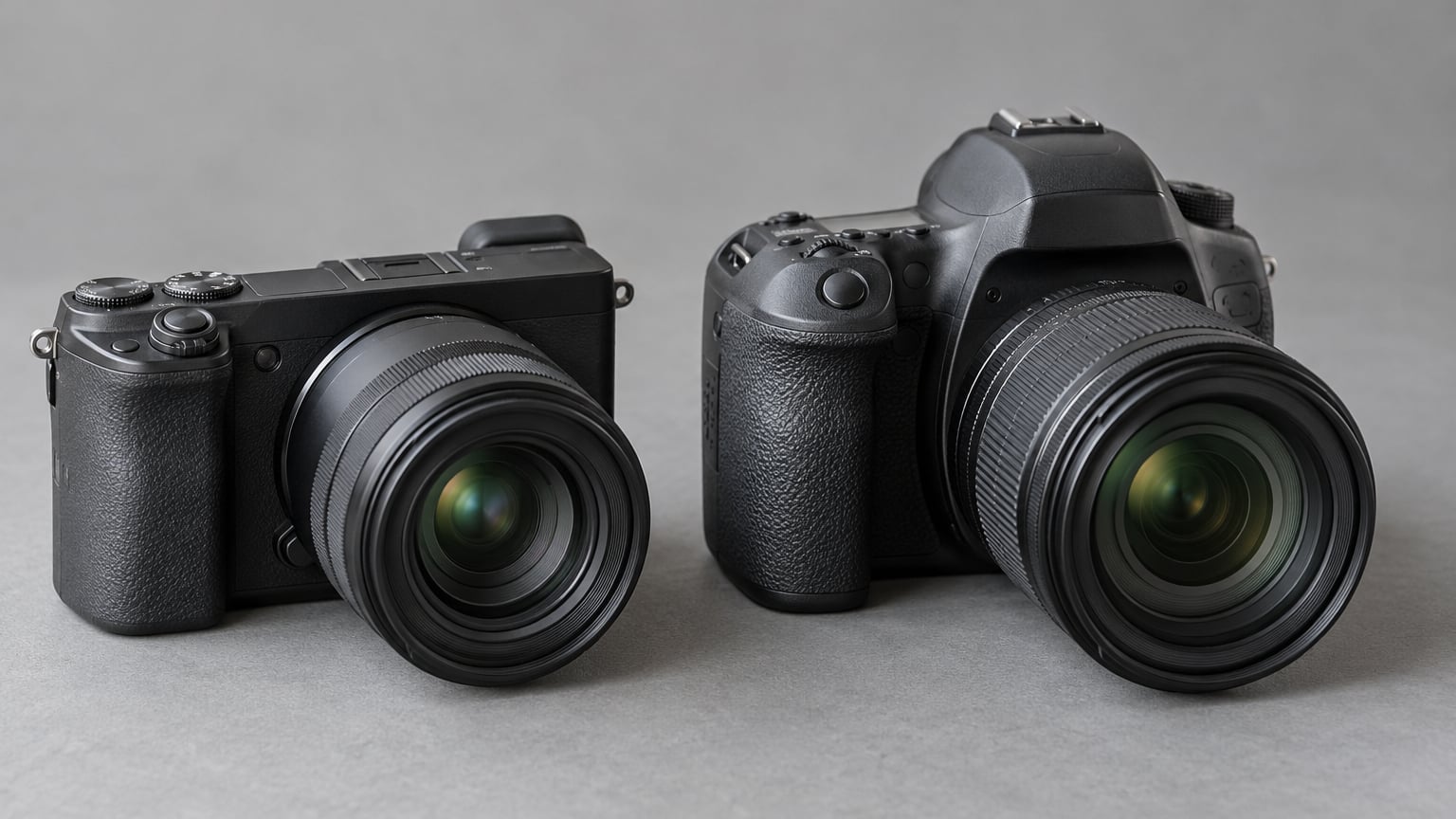
Short version: mirrorless cameras win on video, tracking autofocus, stabilisation and how small the whole kit is, while DSLRs win on battery life, cheaper lenses and an optical viewfinder that never runs out of power. If you shoot video or travel light, mirrorless is the better buy in 2026. If you already own DSLR glass, work long days without spares, or shoot tethered in a studio, a DSLR body may suit you better for years.
That is the honest answer to the mirrorless vs dslr explained question, and it is not as simple as the sales pages make it sound. The difference between the two camera types is mechanical, not photographic. Both put the same kind of sensor behind the same kind of lens mount, so the photos come out equally good.
What actually changed when the mirror came out is everything around the sensor: how you frame the shot, how the camera finds focus, how long the battery lasts, and how much video you can record. This guide walks through each of those differences, then tells you which one matches the way you actually shoot.
Table of Contents
- Mirrorless vs DSLR Explained at a Glance
- How Mirrorless and DSLR Cameras Work
- Image Quality and Sensor Performance
- Autofocus, Burst Shooting, and Tracking
- Video Capabilities
- Battery Life, Size, and Weather Handling
- Lens Availability and Total System Cost
- Which Camera Is Better for Creative Photography?
- Which Should You Choose?
- Frequently Asked Questions
- Conclusion
Mirrorless vs DSLR Explained at a Glance
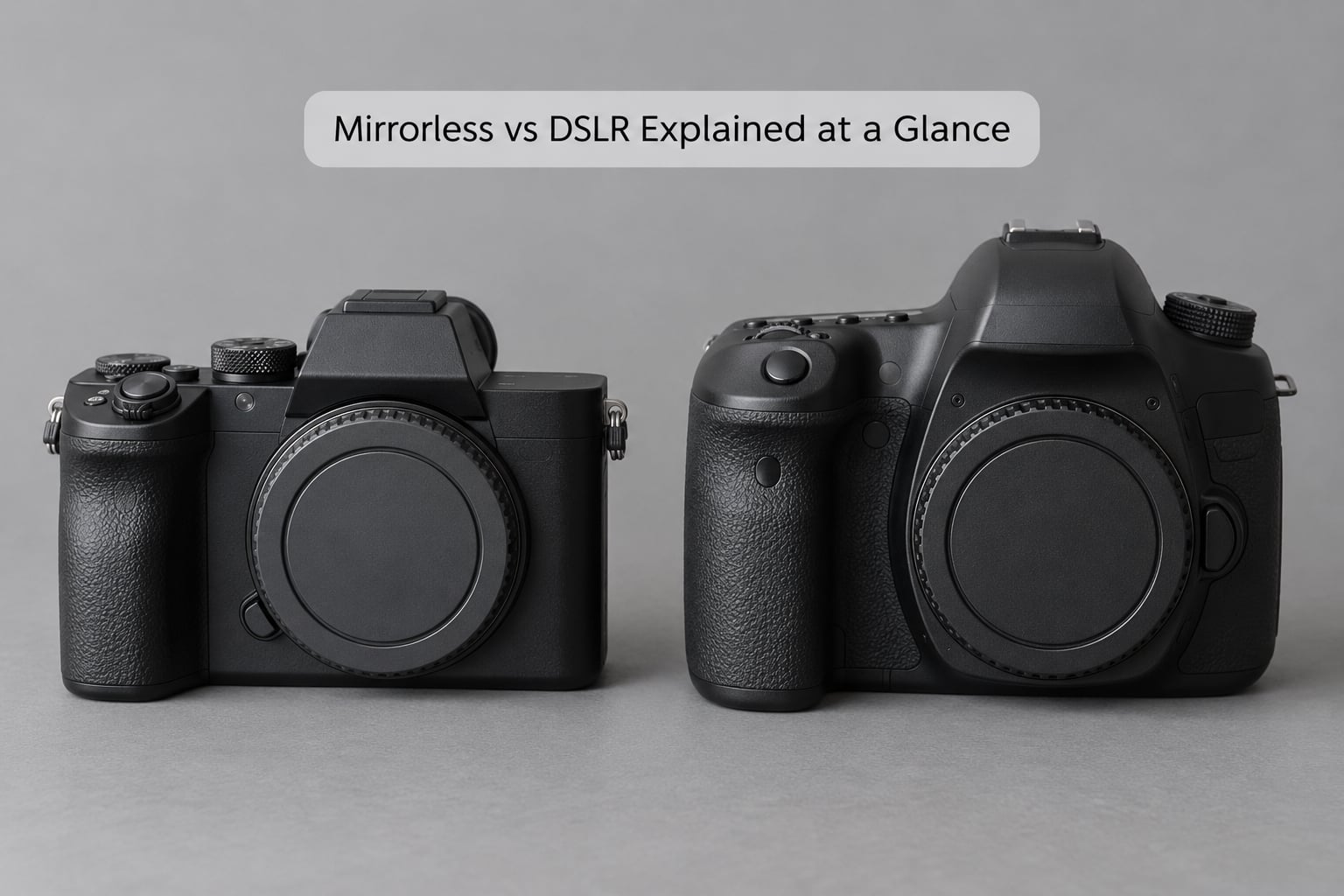
The table below is the whole comparison in one place. Read it first, then read the sections that matter for your own photography.
| Criterion | Mirrorless camera | DSLR |
|---|---|---|
| Light path | Straight from lens to sensor | Reflex mirror flips up to expose the sensor |
| Viewfinder | Electronic (a live screen, EVF) | Optical (a mirror and prism, OVF) |
| Continuous autofocus | Always on, no mirror interruption | Pause briefly while the mirror resets |
| Subject and eye detection | Standard on most bodies | Available on newer models only |
| Burst rate | Commonly 10-20+ frames per second | Commonly 5-8 frames per second |
| Battery life per charge | Roughly 300-700 shots, more on recent bodies | Roughly 600-2,000 shots depending on model |
| Silent shooting | Fully silent electronic shutter | Silent options are limited or absent |
| In-body stabilisation | Common, works with almost any lens | Rare, relies on stabilised lenses instead |
| Video | 4K, full-sensor readout, overheating limits | 1080p on most, 4K only on recent models |
| Body size | Smaller and lighter, varies by brand | Larger, deeper grip |
| Native lenses | Newer mounts, fewer options, higher cost | Decades of mature glass, wide choice |
| Best for | Travel, video, wildlife, tracking subjects | Owners of existing lenses, long days, studio work |
What a DSLR actually is
A DSLR, short for digital single-lens reflex, uses a mirror angled at 45 degrees inside the body. Light from the lens hits that mirror and is bounced upward into a pentaprism, which redirects it into your eye through an optical viewfinder. When you press the shutter, the mirror swings up out of the way so light can reach the sensor.
That is the whole trick, and it is also the source of nearly every difference people argue about. The mirror has to move, so it takes time, it interrupts autofocus, and it eats battery power.
What a mirrorless camera actually is
A mirrorless camera removes the mirror box entirely. Light travels from the lens straight through to the image sensor, and the sensor feeds a live image to a screen behind the eyepiece. That screen is the electronic viewfinder, or EVF, and it is why you see exactly what the camera sees, including exposure preview and any picture profile you have chosen.
Some people also call these cameras EVIL cameras, which stands for electronic viewfinder interchangeable lens. It is an old nickname, but it does describe the design accurately.
How Mirrorless and DSLR Cameras Work
The mechanism difference sounds dramatic, but it does not decide who takes better photographs. It decides what the camera feels like in your hands and what it can do while you are shooting.
With the mirror gone, a mirrorless body loses the weight, thickness and moving parts that a DSLR body carries around. It also means nothing has to interrupt the image stream. Focus, exposure and preview all run continuously, which is why a mirrorless camera does not blink and stop when you take a picture.
The Live View question that confuses everyone
Older explainers claimed that DSLRs were slow because they had to flip a mirror. That is out of date. Any DSLR made in the last decade has a live view mode that bypasses the mirror entirely and shows a live electronic image on the rear screen, with autofocus that works while you compose.
In live view, a modern DSLR behaves much like a mirrorless camera, which is exactly the point photographers on the dpreview forums raise when they say DSLR autofocus is unfairly criticised. Bodies like the Canon 90D use Dual Pixel AF in live view and focus well. What a DSLR cannot do is run that continuous, mirror-free mode through its viewfinder.
Image Quality and Sensor Performance
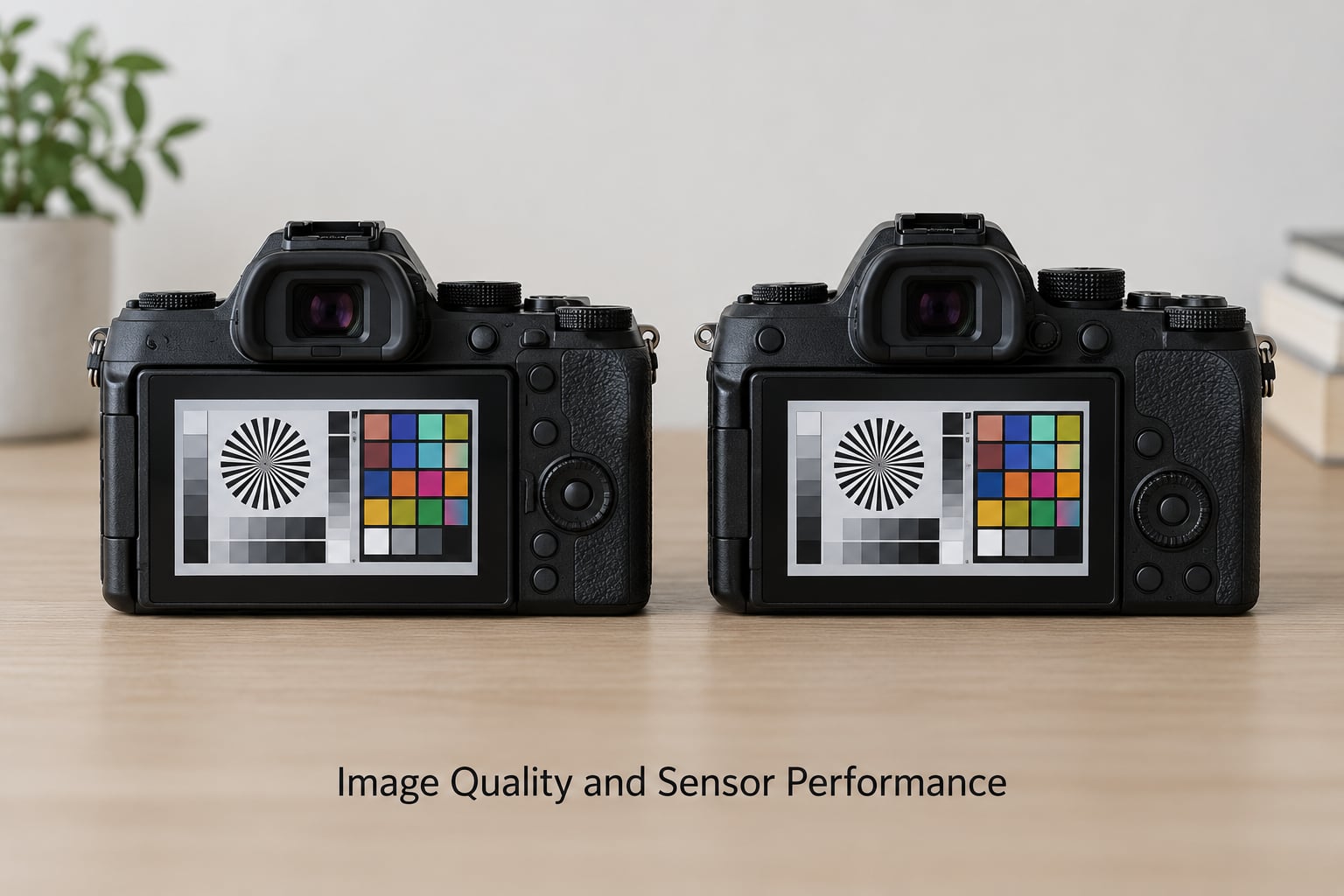
Image quality depends on sensor size and processing, not on whether a mirror is present inside the body. A full-frame DSLR and a full-frame mirrorless camera with the same sensor size will produce files you genuinely cannot tell apart at 100% view.
That covers resolution, dynamic range and high-ISO noise, the three things buyers worry about most. It also covers colour, because both systems ship the same kinds of picture styles and none of them is inherently more accurate than the other.
Where the two differ on pictures
Three things still separate the systems photographically. Stacked sensors in newer mirrorless bodies read out faster, which enables flash-free shooting at higher frame rates and reduces the rolling-shutter distortion you get panning with fast glass. Mirrorless bodies more often include in-body stabilisation, so you can stop the camera shaking by a few stops with any lens. And older DSLR sensors are long out of production, so a cheap used DSLR body is often paired with an older sensor generation too.
Depth of field has nothing to do with the mirror. A 50mm lens gives the same background blur on either system at the same aperture and distance.
Which file format should you shoot
RAW gives you the most room to recover shadows and adjust colour after the fact, and both systems record RAW in broadly compatible formats. If you are deciding how to process those files, our guide to RAW vs JPEG explained walks through the practical differences.
Black and white shooters get something extra from an electronic viewfinder: peaking, magnification and an instant preview of a monochrome profile. We cover how that works in camera picture styles and monochrome mode explained.
Autofocus, Burst Shooting, and Tracking
Modern mirrorless cameras focus better in the situations that actually fail on a DSLR. That is the single biggest technical reason most working photographers moved systems, and it is worth more than any specification list.
The old argument was that DSLRs use fast phase detection through the viewfinder while mirrorless uses slow contrast detection. That has not been true for years. Current mirrorless bodies place phase-detection pixels directly on the sensor, so focus is fast and accurate in live view, on the screen and through the viewfinder, all at the same time.
Where autofocus still matters most
Eye detection and subject tracking are the practical wins. Set a face or eye and the camera keeps it as the person moves, which turns wedding ceremonies, street moments, concerts and children into frames you keep instead of frames you delete.
DSLRs with phase detection in the optical viewfinder still focus fast and predictably, and for a tracked subject moving across the frame the difference has narrowed a lot. The gap that remains is focus acquisition while the scene changes around the subject, plus what the camera can do without you touching anything.
Burst rates and the mirror flip
Burst shooting favours mirrorless for a mechanical reason. A DSLR pauses between frames while the mirror returns, and that pause is why burst rates typically sit between five and eight frames per second. Mirrorless bodies commonly run ten to twenty frames per second, and electronic shutter modes on stacked sensors go higher still with no mechanical noise at all.
Rates are not everything. A very fast burst fills a buffer faster, so the frame count before it slows depends on the buffer and the card. Check the sustained rate rather than the headline number.
Video Capabilities
Video is where the choice becomes obvious. If you shoot any video at all, the gap between the systems is wide enough that the decision usually makes itself.
Most DSLR bodies record 1080p and, if they offer 4K at all, usually limit it, crop it and cap the recording length. Mirrorless bodies record 4K across the full sensor width, expose properly in log profiles for grading, and run frame rates high enough for slow motion. Video autofocus on a modern mirrorless body also holds a face through a walking shot without you touching the screen.
The catch with mirrorless video
Recording video drains batteries hard, and long records on small bodies can generate enough heat to trigger a shutdown. Recording limits vary model by model rather than system by system, so check the specification for the exact camera rather than assuming. The same goes for microphone input, headphone output and HDMI clean-feed options, which matter more to video makers than any stills specification.
An articulating touchscreen is now standard on most mirrorless bodies and rare on DSLRs, which makes filming yourself or shooting from a low angle much simpler.
Battery Life, Size, and Weather Handling
Battery life is the most honest difference between these two systems, and it is the one that decides weddings, field sports and multi-day trips.
Published field figures put a DSLR at roughly 600 to 2,000 shots per charge depending on the model and how much of the time you spend in live view, and a mirrorless body at roughly 300 to 700, with newer bodies pushing higher. One wedding photographer’s own figures put a DSLR at 600 to 800 shots typically and a mirrorless body at 300 to 400, and reported experiences of a fall from thousands of shots to a few hundred are common on the photography forums.
Why the mirrorless drains faster
Three things drive the drain: the EVF is a live screen running all the time, image stabilisation holds the sensor in constant motion, and subject tracking keeps the processor busy. People on Reddit also report standby behaviour quietly costing them a battery that looked full in the morning.
The practical fix is simple: carry more batteries than you think you need, and a USB-C power bank will rescue a long day. A vertical grip on either system roughly doubles the endurance and adds a shutter button for vertical frames.
Size, grip and small hands
Mirrorless bodies are smaller because there is no mirror box, but the difference narrows with professional models that need room for grips and cooling. And size cuts both ways: photographers with smaller hands frequently report that a DSLR’s deeper grip is more comfortable to hold all day, while some people find a small mirrorless body too cramped to control with a full hand.
Viewfinder behaviour, sealing and flicker
An optical viewfinder draws no power, shows a real image with no processing and stays legible in direct sun, which is why it still wins for sports and bright outdoor work. An EVF shows your exposure settings, previews profiles, and gives manual focus aids a DSLR cannot offer, but it can lose brightness in low light and drain power even when you are not looking through it.
Both systems offer weather sealing on higher-end bodies, so check the specific model and its lens rather than the system name. Electronic shutters can also misread sodium or fluorescent lighting, so anti-flicker detection matters if you shoot under artificial light at fast shutter speeds.
Lens Availability and Total System Cost
This is where the cheapest body stops being the cheapest system. Two decades of DSLR lenses are already in drawers across the country, and deciding what to do with that glass usually matters more than the body choice.
Adapters work because the distance between the lens mount and the sensor, the flange focal distance, is short on mirrorless mounts. An adapter places the DSLR lens at the correct distance in front of a shorter mount, which is why one small adapter can fit a whole family of old glass onto a new body.
What happens when you adapt a DSLR lens
Autofocus usually works, but it depends on the adapter. Some adapters add the electronics needed to drive autofocus and stabilisation from the mirrorless body; others simply hold the lens in place and you focus manually. Adaptor behaviour with electronic contacts also affects how fast autofocus drives and whether lens EXIF is recorded, and older screw-drive lenses can lose functions entirely.
Stabilisation is the other variable. In-body stabilisation on the mirrorless body can steady adapted lenses with no stabilisation of their own, which turns an old prime into a usable low-light lens. If you shoot mostly primes, that combination is a genuine reason to switch without buying new glass.
Where the money really goes
Native lenses for newer mirrorless mounts are consistently more expensive than the DSLR glass they replace, and they start at the wide, fast end where system buyers concentrate. Used DSLR bodies and lenses remain among the cheapest complete systems available, and they hold value better than most electronics.
Owners also buy extra batteries, cards and adapters more often on mirrorless. If you already own a decent DSLR kit and have no plan for the glass, a new mirrorless body plus a replacement lens set can cost several times what the body did.
Which Camera Is Better for Creative Photography?
Neither system constrains how you photograph. The differences show up in the workflow around the picture rather than the picture itself, which is worth knowing if you are choosing on creative grounds rather than technical ones.
For black and white and fine art work, an EVF is a real advantage: peaking highlights, viewfinder magnification and instant preview of a monochrome profile let you judge focus and tone before leaving the frame. For post-processing, both systems record RAW, and a camera purchased for editing still has to survive your computer and your storage budget. Our guide to sRGB vs Adobe RGB explained covers the colour-space half of that decision.
For tethered studio work, opinions split honestly. Live view plus tethering drains batteries quickly and adds cable clutter, which is one of the reasons some working photographers keep a DSLR body for studio jobs and a mirrorless body for everything else. Others rely on USB-C power delivery and never see the issue.
For photomontage and multi-frame work, what matters is file flexibility and a dependable tripod interface, which both systems provide in some form. The practical question is whether your editing software handles the RAW format the camera writes.
Which Should You Choose?
Choose by the work you plan to do this year, not by which system is winning a decade of awards.
Pick mirrorless if you travel and want a small kit, shoot video, photograph children, pets or wildlife where tracking autofocus earns its keep, need silent shooting for ceremonies or performances, or expect to keep upgrading bodies over the next five years.
Pick a DSLR if you already own Canon EF, Nikon F or Sony A-mount lenses and want to keep them, work long days without spare batteries, shoot tethered, need a viewfinder that stays readable in harsh sun, or are buying strictly on a budget where a used body and lens kit is the sensible route.
Mirrorless vs DSLR for beginners
For a beginner, mirrorless wins on almost every axis that matters at the start: the viewfinder shows what you will get, the manual focus aids make old manual glass usable, and the small body is easier to carry on the days you actually take it out. A DSLR only makes more sense for a beginner who already has lenses or a very tight budget.
By photography type
- Street: either, depending on whether you prefer an unprocessed optical view or silent shooting.
- Weddings: mirrorless for tracking and silent operation, DSLR for battery endurance on long days.
- Sports: mirrorless for burst rate and eye detection, DSLR if you shoot outdoors in bright sun all day.
- Wildlife and nature: mirrorless, particularly for long telephoto options and tracking.
- Travel: mirrorless for size and weight, with weather sealing matched to where you are going.
- Portraits and studio: either system, decided mainly by your lens kit and tethering habits.
- Video: mirrorless, without much debate.
- Low light and astro: mirrorless for stabilisation, DSLR for how long you can stay out shooting.
A last practical point: plenty of working photographers keep both. A DSLR for the long optical-viewfinder days and the glass they already own, a mirrorless body for everything else. Treating the question as a permanent one-system decision is usually the mistake.
Frequently Asked Questions
Do mirrorless cameras produce better images than DSLRs?
No, not on image quality alone. With the same sensor size, both systems record files that are hard to tell apart at 100% view. Mirrorless tends to win on in-body stabilisation and faster sensor readout for flash-free high-speed shooting. Judge the sensor size and the lens, not the camera type.
Are mirrorless cameras always smaller and lighter than DSLRs?
Not always. Compact mirrorless bodies are much smaller, but professional mirrorless bodies need room for grips, cooling and large sensors, so the gap narrows. Hand size matters more than the spec: photographers with smaller hands often find a DSLR’s deeper grip more comfortable over a long day.
Is a used DSLR better than a new mirrorless camera?
It depends on your lenses. If you already own Canon EF, Nikon F or Sony A-mount glass, a used DSLR body and a second-hand lens can cost less than a new mirrorless body with one native lens. If you own no lenses at all and want modern autofocus and video, a new entry-level mirrorless body is usually the better starting point.
Can you use DSLR lenses on a mirrorless camera?
Usually, through an adapter. Because mirrorless mounts have a shorter flange focal distance, a small adapter can place a DSLR lens at the correct distance from the sensor. Autofocus and stabilisation depend on the adapter and the lens, some functions can be lost, and bodies with in-body stabilisation can steady lenses that have no stabilisation of their own.
Should beginners buy their first camera as mirrorless or DSLR?
Mirrorless, unless you already own DSLR lenses or your budget rules out new glass. The electronic viewfinder shows exposure and profile changes before you shoot, focus peaking and magnification make manual lenses usable, and silent shooting is available. A DSLR only makes more sense when your existing lenses and budget settle the question first.
Conclusion
The mirrorless vs DSLR explained decision comes down to a short list: your lenses, your battery budget and your subject matter. Mirrorless for video, tracking focus and a small kit; DSLR for optical-viewfinder preference, long days and existing glass.
Start by pricing complete body and lens packages for the subjects you actually photograph, not by comparing two bodies on a shelf. The lens list is where the real cost and the real capability live, and it is the part most people get wrong. Once you know which lenses you need, the camera type usually decides itself.