

The short answer to how to price fine art prints is about 3.5 times your full per-copy production cost, then adjusted for size, edition size and where the sale happens. A 16×20 giclée that costs you USD 22 all in lands somewhere near USD 75 to USD 110 unframed, and considerably more once the edition is small and the buyer wants it framed.
That multiplier is a starting point, not a law. It is the answer most search engines surface because it is easy to state, and it works well when your costs are real and your selling is direct. It breaks the moment a gallery takes half the sale or a marketplace takes a fifth of it, which is why this guide spends most of its room on the arithmetic you do before you pick a number.
You will find worked examples, size bands, an edition ladder and a channel-by-channel adjustment table. All figures are typical US ranges, they vary by region and they change over time, so treat every table here as a reference to check against your own supplier’s current rates rather than a price list to copy.
Table of Contents
- Fine Art Print Price Ranges by Size and Type
- What Affects the Price
- Start with the true per-copy cost
- The 3.5x rule and where it stops being enough
- Edition size is your strongest pricing lever
- Worked example one: an edition of 25 at 16×20
- Worked example two: a 24×36 through a gallery
- Worked example three: an open edition at 8×10
- Your labour is a cost line, not a gift
- Build a comp set before you commit
- Adjust for the channel, not for the hope
- Ways to Save on Costs When You Price Fine Art Prints
- Quote framing separately
- Tier your sizes instead of applying one flat markup
- Batch and amortize
- Charge shipping at actual cost by size
- Run a print drop with a stated release time
- Reprice your last five sales
- Raise prices on new work only
- Answer discounts with options, not money
- Compare two or three labs on landed cost
- Make friend and family pricing a separate line
- Frequently Asked Questions
- Conclusion
Fine Art Print Price Ranges by Size and Type
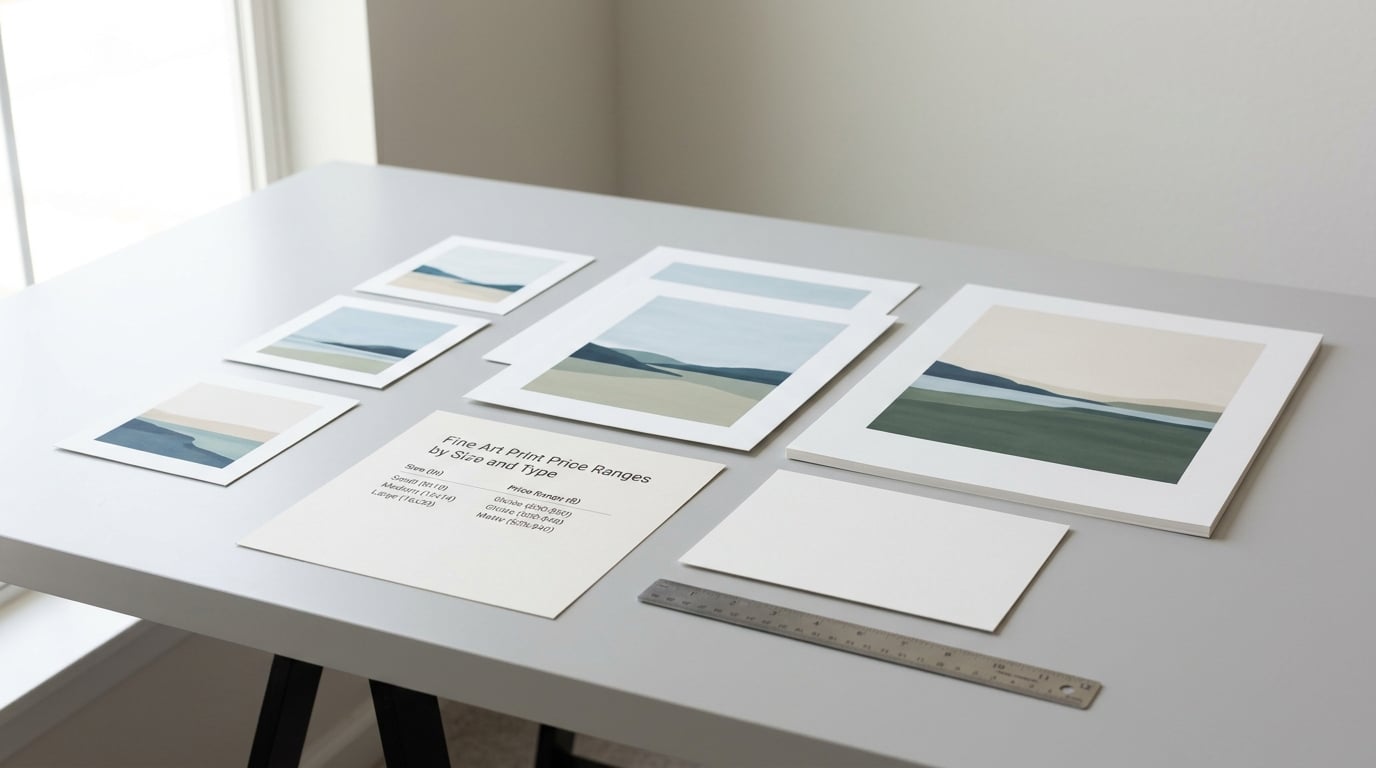
Fine art print pricing scales with the two variables buyers care about most: how big the print is, and how many copies exist. Everything else is adjustment. Get those two right and the rest of the formula is arithmetic.
How to price fine art prints by size: the reference bands
The table below gives typical unframed US retail for archival pigment and giclée prints sold direct to collectors. The middle columns assume a signed and numbered edition; a gallery will need roughly double the edition-of-10 number to leave you the same money after commission.
| Print size | Your per-copy cost | Open edition | Edition of 25 | Edition of 10 |
|---|---|---|---|---|
| 8×10 | USD 3-6 | USD 25-45 | USD 70-130 | USD 110-190 |
| 11×14 | USD 5-9 | USD 35-65 | USD 100-175 | USD 150-250 |
| 16×20 | USD 12-22 | USD 65-110 | USD 160-260 | USD 250-400 |
| 18×24 | USD 16-28 | USD 85-140 | USD 200-330 | USD 320-500 |
| 20×28 | USD 20-34 | USD 105-170 | USD 250-400 | USD 380-600 |
| 24×36 | USD 30-58 | USD 150-240 | USD 380-620 | USD 600-950 |
| 30×40 | USD 45-85 | USD 225-360 | USD 560-900 | USD 900-1400 |
| 36×48 | USD 70-130 | USD 350-560 | USD 900-1400 | USD 1400-2200 |
| 40×60 and up | USD 110-220 | USD 550-900 | USD 1400-2200 | USD 2200-3400 |
An 8×10 is where most first-time sellers stall, because the correct answer feels too low. At USD 25 to USD 45 you are competing with mass-market wall art, and buyers will read it that way. If your work is not mass-market wall art, price the 8×10 above that floor and let the smaller sizes serve as an entry point rather than your headline number.
Print type changes your cost, not your whole price
Buyers pay for permanence and for process. Pigment ink on cotton rag reads as archival; dye sublimation on polyester reads as a gift item. That gap in perception is worth more than the gap in your production cost, which is why print type changes the price floor more than the multiplier.
| Print type | Where it fits | Typical cost at 16×20 | How buyers read it |
|---|---|---|---|
| Giclée on 100% cotton rag | Fine art photography, numbered editions | USD 12-22 | The archive standard |
| Giclée on aluminium or acrylic | Modern interiors, corporate walls | USD 45-95 | Premium and contemporary |
| Canvas wrap | Painterly work, hospitality, retail | USD 30-70 | Decor-leaning |
| Dye sublimation on polyester | Gifts, event runs, high volume | USD 15-35 | Warm tone shift, not archival |
What Affects the Price
Ten things move a fine art print price. Some are costs you can measure. Some are judgements buyers make in about four seconds at thumbnail size. Both belong in the formula, but you should keep them in separate columns so you know which one you are adjusting.
Start with the true per-copy cost
Cost of goods sold, or COGS, is what one copy costs you to exist as a shipped object. Most underpricing happens here, not at the markup step. People count the lab fee and forget the sleeve, the tube, the file prep, the payment fee and the one print in twenty that arrives creased.
| Cost line | Share of per-copy cost | Easy to miss? |
|---|---|---|
| Paper or substrate | 20-35% | No |
| Printing or lab fee | 30-45% | No |
| Packaging, sleeve, rigid mailer | 5-12% | Yes |
| Shipping, if you absorb it | 8-20% | Yes |
| Payment processing, about 3% of sale | 2-4% | Yes |
| File prep, profiling, colour correction | 2-6% | Yes |
| Returns, damage and shrinkage reserve | 2-5% | Yes |
For a 16×20 giclée on cotton rag, the whole stack usually lands between USD 18 and USD 26 per copy. Print in batches of ten or twenty and amortize the fixed prep work across the run; the per-copy share of colour profiling drops sharply and that difference goes straight into your margin.
The 3.5x rule and where it stops being enough
Here is the formula in one line: retail price = total per-copy cost x multiplier, where the multiplier starts at 3.5 and rises with edition scarcity, size and labour. It is called cost-plus pricing and it has one enormous advantage over guessing: you can defend the number. When someone asks why a print is USD 160, you can show the arithmetic instead of saying it felt right.
The weakness is equally clear. A 3.5x multiplier on a USD 22 print gives you USD 77, which is a fair direct-sale price and a losing number in a gallery that takes 50%. Multipliers do not know about your channel, which is why the channel adjustment is a separate step and not an afterthought.
Edition size is your strongest pricing lever
Scarcity does the work that adjectives cannot. Cutting an edition from 100 to 25 should not change your cost by a single cent, yet it can legitimately triple the price. Buyers read the edition size as a signal about how many people wanted the image.
| Edition tier | Copies | Multiplier on per-copy cost | Notes |
|---|---|---|---|
| Open edition | Unlimited | 3.5-4x | Hold a price floor and never sign these |
| Large edition | 100 | 4x | Good for volume and gifting |
| Standard limited | 50 | 4.5x | The most common collector tier |
| Mid limited | 25 | 5.5-6x | Where most artists land |
| Tight limited | 15 | 6.5x | Needs a signed certificate |
| Small limited | 10 | 7-8x | Strong for statement images |
| Very small | 5 | 9-10x | Only if the work carries the edition |
| Artist proof | 2-5 | 10-20% above the edition price | Usually unnumbered, marked AP |
Two rules keep editions honest. Print only what you have sold, because unsold numbered copies still depress the market for the ones that did sell. And do not sign and number casual reproductions, since a signature is what tells a buyer the original is still available somewhere else.
Worked example one: an edition of 25 at 16×20
Per-copy cost: lab fee USD 18, sleeve and rigid mailer USD 2.50, file prep and colour correction amortized across a 25-copy run USD 1.50. Total USD 22. At 3.5x that is USD 77, which is right for an open edition of this image.
Signed and numbered to an edition of 25, apply a 6x multiplier instead: USD 22 x 6 = USD 132. Add the certificate, the signature and the packaging upgrade, and you can sit at USD 150 to USD 175 without straining. A print-on-demand listing would have cleared USD 77 and paid you roughly USD 45 after platform margin, which is the comparison that makes the choice obvious.
Worked example two: a 24×36 through a gallery
Per-copy cost: lab fee USD 52, packaging USD 4.50, amortized prep USD 3. Total USD 59.50. Direct-sale price at 3.5x is USD 208. A gallery taking 50% would leave you USD 104, which is less than twice your cost. You are busy.
Do the math in reverse instead. Decide the net you want, roughly USD 210, then divide by the share you keep. USD 210 divided by 0.5 gives a retail price of USD 420. Round to USD 450 for the edition-of-25 tier, and your gallery sale lands you exactly where a direct sale would have.
Worked example three: an open edition at 8×10
Per-copy cost USD 4.50, packaging USD 0.75, total USD 5.25. At 3.5x that is USD 18, below any floor worth defending. Two fixes: move to a 4.5x multiplier for a USD 24 floor, or stop selling the smallest size as a standalone item and offer it as a two-print set where the set carries the margin.
If you sell through a marketplace that takes 20%, divide instead of multiplying. USD 5.25 x 3.5 is USD 18.40, and USD 18.40 divided by 0.80 is USD 23. That single division is the whole difference between pricing a channel correctly and quietly losing money on your best-selling listings.
Your labour is a cost line, not a gift
Editing 400 images, prepping files, colour matching to your monitor, packing at midnight and answering the same question forty times is real time. Artists consistently exclude it because charging for it feels self-indulgent.
It does not have to go into the per-copy formula. Add it as an annual overhead, divide by your realistic annual copy count, and add that per-copy figure before the multiplier. On many studios this is the difference between a sustainable price and a hobby price that funds ink but not rent.
Build a comp set before you commit
Pull twelve comparable works: same medium, similar size, similar edition size, similar career stage. Record the asking price, whether the edition sold through, and whether the artist is represented. Then adjust.
Adjust in one direction only. A gallery in an expensive city, a nationally known name, or a print that sold out at the asking price all justify a higher number for you. A discounted storefront listing that has been sitting for two years justifies a lower one. Do not average the comp set; do not average anything when pricing. Pick the two or three closest matches and trust those.
Adjust for the channel, not for the hope
The same print has a different correct price in every channel. This table assumes a per-copy cost of USD 22 and a direct-sale target of USD 77.
| Channel | What comes off the top | Correct approach | Price to land near |
|---|---|---|---|
| Your own site | About 3% payment fees | Multiply, then add fees into the number | USD 77-82 |
| Art fair or consignment | 20-40% of sale | Reverse math from your target net | USD 96-129 |
| Gallery | 40-60% of sale | Reverse math from your target net | USD 128-193 |
| Marketplace | 15-20% plus payment fees | Divide your target by the share you keep | USD 92-96 |
| Print-on-demand platform | 30-50% of retail | Use the platform calculator, then verify locally | USD 110-200 |
One more variable rides along with all of this. If you ship across state lines or borders, sales tax and VAT rules apply on top of your price and change by destination. They are not part of your margin, and pricing without accounting for them makes international sales look more profitable than they are.
Ways to Save on Costs When You Price Fine Art Prints
Improving margin is not the same as cutting quality. The moves below protect what a buyer sees while changing what you keep.
Quote framing separately
Sell the print unframed and let the buyer add framing at a quoted price. Frame and mat materials carry healthy margin, and separating them keeps your print price comparable with the comp set while still capturing the money a framed sale would have earned. Quote it per size, not as a vague “framing available on request”.
Tier your sizes instead of applying one flat markup
A single 3.5x across 8×10 and 40×60 leaves money on the table at one end. Use 3.5x on small sizes to drive traffic and 6x or more on large pieces where the perceived value gap is widest. Publish the ladder so buyers see why the bigger piece costs more.
Batch and amortize
Print a run of twenty rather than twenty singles and the fixed prep cost spreads across every copy. This is the point that comes up most often in printmaking forums: volume genuinely changes your per-copy cost, so batch whenever your edition size allows.
Charge shipping at actual cost by size
Set a flat shipping rate per size bracket and let the buyer see it before checkout. Absorbing shipping hides a real cost inside your markup and quietly makes every print look unprofitable when it is not.
Run a print drop with a stated release time
A release window with a fixed count creates urgency without discounting anything. You get the marketing value of scarcity at an open edition multiplier, and buyers accept it because the deadline is real.
Reprice your last five sales
Pull your five most recent orders and divide what you kept by what each one cost you. Anything under 3x total cost is not a verdict on your talent, it is a data point about your setup. Fix the pricing on the new print rather than apologising for the old one.
Raise prices on new work only
Keep the existing catalogue at its old price and price everything new at the correct number. Your old buyers feel grandfathered rather than gouged, and your revenue per print climbs as the catalogue turns over. Update your commission and print-on-demand listings on the same schedule.
Answer discounts with options, not money
When someone asks for 20% off, offer a smaller size, an unframed version, or an open edition copy instead of a reduced limited edition. The limited edition number stays intact and the buyer still leaves with something.
Compare two or three labs on landed cost
Compare the delivered cost to your door, not the print fee. A supplier that is USD 4 cheaper per print but charges USD 9 more to ship it is more expensive. Paper, ink and lab rates move every year, so this comparison goes stale fast and is worth redoing twice a year.
Make friend and family pricing a separate line
Create a discounted edition tier for personal sales and never mix it with your public catalogue. It keeps your pricing legible and stops a well-meaning discount from becoming the number a collector expects to pay.
Frequently Asked Questions
How can I calculate the price of an art print?
Add up every per-copy cost first: printing, substrate, packaging, shipping you absorb, payment fees and an amortized share of file prep. Multiply that total by 3.5 for a direct sale, then adjust up for a small signed edition and down for an open edition. If a gallery takes 50%, divide your target net by 0.5 to find the retail number.
How much should I charge for an 8×10 print?
A typical unframed 8×10 archival print sells for USD 25 to USD 45 open edition, USD 70 to USD 130 as a signed edition of 25, and USD 110 to USD 190 as an edition of 10. Your own per-copy cost usually runs USD 3 to USD 6, so a 3.5x multiplier alone lands too low to be worth publishing. Set a floor and treat the smallest size as an entry point.
Should I price prints by size or by edition size?
Price by both, applied in sequence. Size sets the base because it drives your actual cost, and edition size sets the multiplier because it drives perceived scarcity. A 16×20 at an edition of 25 lands well above an 11×14 at an edition of 25, and both land well above the same images as open editions.
How do editions change a print’s value?
A smaller edition justifies a higher price only if buyers can see it. Publish the edition size, number every copy, issue a certificate of authenticity and keep your records so you can prove what sold and what did not. An edition of 25 that nobody knows about is worth the same as an open edition, and an edition of 25 with a certificate is worth several times more.
Should framing be included in the print price?
Usually not. Sell the print unframed and quote framing as a separately itemised option per size. It keeps your print price comparable with comparable work, and frame and mat materials carry better margin than prints do. The exception is a buyer asking for a turnkey piece, where you quote the frame as a line item on the same order.
What is the 70/30 rule in art?
The 70/30 rule is a studio practice, not a pricing formula: artists often split their time roughly 70% making work and 30% selling, handling invoicing, shipping and admin. Others reverse it early on. Neither number is correct for everyone, but the point stands, because the selling and admin hours are a real cost that belongs in your overhead calculation.
Conclusion
Knowing how to price fine art prints is a sequence, not a mood. Calculate the true per-copy cost, choose the edition promise, pick a multiplier that matches the scarcity, then correct for the channel before you publish anything.
Do this first: total up the cost of one copy including packaging and fees, decide whether the image gets an open edition or a numbered run of 25, set a target margin of at least 3.5x, and compare the resulting retail price against three or four works that actually sold. Then price your next print and see what happens. Review the numbers again once you have real orders, because the only pricing data that has ever meant anything comes from your own sales history.