
Learning how to shoot candid portraits comes down to removing the reason to perform. Keep the camera out of the subject’s eyeline, stay far enough away, keep the shutter silent, and give people something to do with their hands and eyes. Most of the rest is patience and shooting more frames than you think you need.
A candid portrait is a photograph of a person in an unguarded, unposed moment. The expression is genuine because the subject is not performing for you, which is exactly what makes these images feel alive next to a row of stiff family photos.
The difficulty is that the moment you raise a camera, people react to it. They straighten up, they ask which angle they prefer, they hold a smile that looks carved from wood. Photographers on photography forums describe the same transition over and over: the fun ends the instant the shutter comes up, and it can take several minutes of ordinary conversation to get it back.
So the craft is less about gear and more about behaviour, with enough technical control that you can still get a sharp, well-exposed frame in bad light. The eight steps below cover both halves. Whether you use a mirrorless body, a phone, or a ten-year-old DSLR, the sequence works the same way.
Table of Contents
- What You Need
- Step-by-Step
- Step 1: Choose a Setting Where Interaction Is Natural
- Step 2: Set the Camera for Unobtrusive Shots
- Step 3: Build Trust Before You Raise the Camera
- Step 4: Use Small Prompts Instead of Strict Posing
- Step 5: How to Shoot Candid Portraits in Public Without Making Anyone Uncomfortable
- Step 6: Watch for Expressions, Hands, and Direction of Light
- Step 7: Focus on the Nearest Eye and Keep Shooting
- Step 8: Review, Select, and Edit with Restraint
- Common Mistakes
- Frequently Asked Questions
- Conclusion
What You Need
Strictly speaking, you need a camera and a subject who has agreed to be photographed. Everything else is a matter of degree.
A camera with continuous autofocus and a decent quiet shutter mode does more for your candid frames than an expensive lens. A 35mm or 50mm prime gives you a natural-looking field of view and wide aperture for soft backgrounds, but a 70-200mm zoom keeps you further away, and distance is the single biggest reason people stay relaxed around you. A tilt or flip screen lets you shoot low or high angles without announcing yourself.
Other useful things: fast memory cards, a spare battery, a lens cloth, and somewhere to sit. You are going to be standing around longer than you expect, and comfortable feet make patience possible.
Working from a phone? Tap the face to lock exposure and focus on it, use burst mode with a finger swipe along the volume button, and cover the lens with a hand or a scarf when you are not shooting so nobody is being recorded without knowing. Modern phone portraits are genuinely fine for social use, and the behavioural side of this guide matters more than the sensor.
Step-by-Step
Step 1: Choose a Setting Where Interaction Is Natural
Pick a place where people already have a reason to be doing something. A kitchen during dinner preparation, a café table where two friends are mid-conversation, a park where a dog is being argued over, a school corridor between periods.
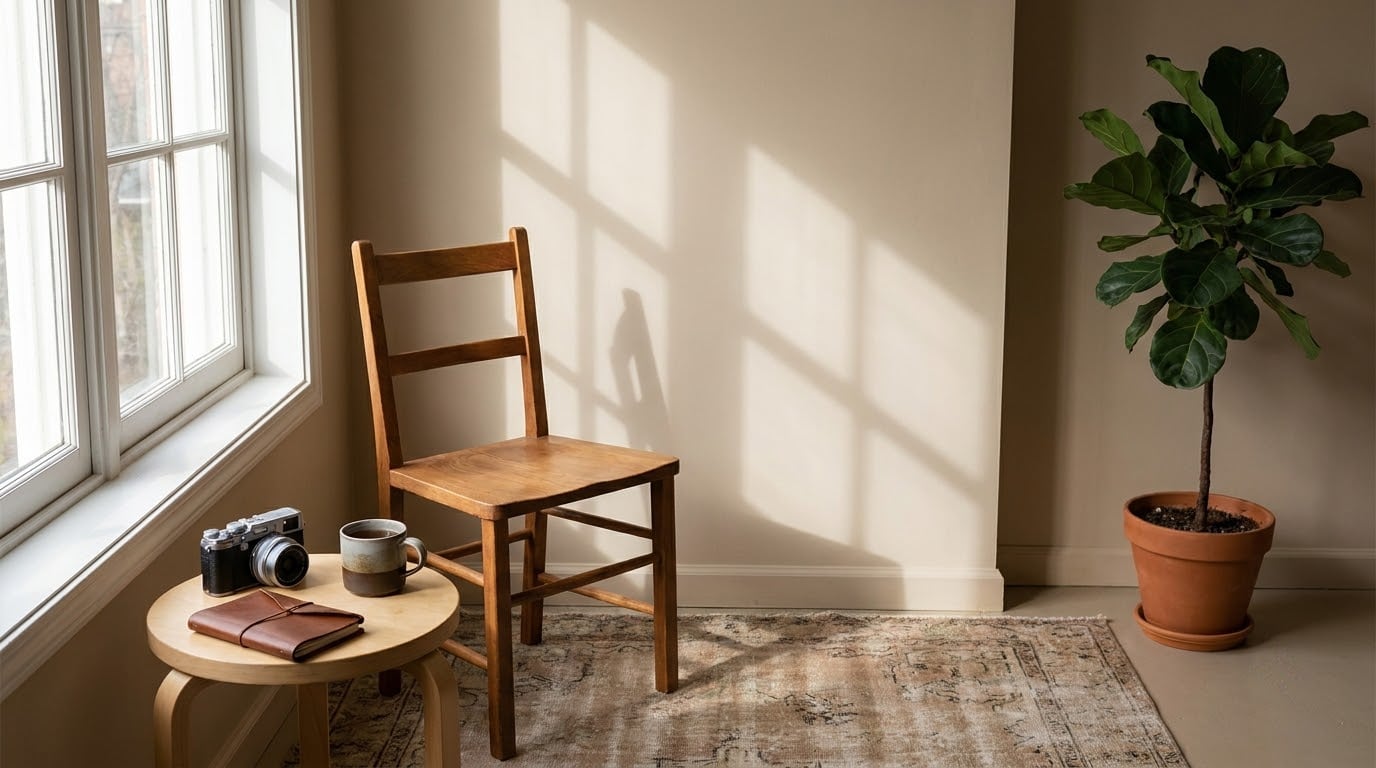
Check three things before you settle: where the light falls, how much room you have to move, and whether there is believable activity. A big window with a wooden chair in front of it, a puddle for reflections, and a task that takes two minutes will carry you a long way.
You know it worked when you can stand there for five minutes without photographing anything and still have frames you would have taken. A location that only produces one good pose is the wrong location.
Step 2: Set the Camera for Unobtrusive Shots
Start at 1/250 second, f/2.8 to f/4, Auto ISO, continuous autofocus, and the fastest burst your camera offers. That combination freezes small hand movements without needing a flash, and it leaves ISO to do the work when the room gets dim.
| Situation | Shutter | Aperture | ISO | Focus and drive |
|---|---|---|---|---|
| One adult, indoors, window light | 1/250s | f/2.8 | Auto, 400 to 1600 | AF-C, eye detect, 5 fps burst |
| Children playing | 1/1000s | f/2.8 or f/4 | Auto, up to 3200 | AF-C, wide or zone area, 10 fps burst |
| Group of four or more | 1/500s | f/4 | Auto | AF-C, single point, short bursts of 3 to 4 |
| Outdoors, open shade | 1/500s | f/2.8 | 100 to 400 | AF-C, eye detect, low burst |
| Golden hour, subject moving | 1/1000s | f/2.8 | 100 to 800 | AF-C, animal or eye detect, 5 fps burst |
| Dim room, no window | 1/160s, hold still | f/1.8 | 3200 to 6400 | AF-C, watch the shutter and brace |
Turn the flash off. A flash fires a contract: the subject knows the photo has been taken, and the next three frames are lost. A silent electronic shutter reduces the clack, and if your body does not have one, shoot at the quietest moment in the conversation rather than at the most exciting one.
You know the setup is right when you can lift the camera, fire eight frames, and all eight are sharp, correctly exposed and free of blinking. If they are not, change one setting and test again.
Step 3: Build Trust Before You Raise the Camera
The thirty seconds after the camera comes up decide most of the session. Put the camera down first, talk for a few minutes, and let the subject get used to you being a person in the room rather than a lens pointed at their face.
Then ask, plainly and once: is it all right if I take some pictures? Consent costs nothing, it takes ten seconds, and it removes the awkwardness that follows later when you realise you photographed someone who did not know.
Ask what they dislike, whether they hate being photographed from the left side, whether they would rather be alone or with their kids. Then shoot the first twenty frames quickly, show nothing, and keep going. Reviewers who practise on a partner who is camera-tired report that volume and repetition break the stiffness faster than any clever prompt.
You know trust is established when the subject forgets to check their posture and starts adjusting their own hair instead of asking you where to stand.
Step 4: Use Small Prompts Instead of Strict Posing
Posing freezes people because it gives them a single instruction to obey. Prompts give them something to do, and a person mid-task is a person whose face is doing something real.
Try: show me the thing you made last week. Walk to the window and tell me what you see. Make tea and I will photograph the steam. Show your grandmother the new phone. Ask your brother a question you already know the answer to.
Prompts should create motion or decision-making. Anything that returns a body to a neutral standing pose has wasted the shot, so keep the task short and let the subject move toward it rather than arranging them in front of it.
You know a prompt worked when the subject talks with their hands. Watch for the moment the gesture opens up, because that is usually one or two frames before the expression changes.
Step 5: How to Shoot Candid Portraits in Public Without Making Anyone Uncomfortable
Public space is where candid work gets ethically difficult, and the line is simpler than most people fear. Photographing people who are doing something in public is generally fine where you are. Photographing individuals at close range, publishing their faces prominently, or shooting into private spaces, changing rooms or children at school is where problems start. Rules vary by country and venue, so if you plan to shoot in a workplace, a mall, or anywhere with posted restrictions, ask first and shoot only what you are permitted to keep.
For groups: ask the group to stand in roughly the right area, then do something that involves all of them, such as handing someone a cup or pointing at something off to one side. Photograph the interaction, not the lineup. Nobody switches to photo face when they are mid-argument about where the cat is, and wide frames with breathing room are far more forgiving of blink timing than tight headshots.
For strangers, distance does the work. Stay back, use the longest focal length you can, and never fill the frame with a stranger’s face at two metres. If someone notices you and looks uncomfortable, put the camera down and smile. If you are a guest, photographing guests is not automatic either; a quick permission check protects you and them.
You know you have crossed a line only when someone asks you to stop. There is no version of candids where that request is unreasonable, and deleting the frame is cheaper than the argument.
Step 6: Watch for Expressions, Hands, and Direction of Light
The best candid frames are usually two frames wide. Something shifts in the face, the hands stop fidgeting, and the light does something useful at the same time. Your job is to notice the sequence rather than the single moment.
Hands ruin more unposed portraits than expressions do. Watch for fingers disappearing into pockets, wrists crossing the body, or a hand gripping a strap at mid-chest. A small reframing, usually stepping back a little and letting the hands drop out of the bottom of the frame, fixes it without asking the subject to move.
For light, use a window or open shade. Turn the subject so the brightest window falls about 45 degrees to the side of their face, which gives shape without harsh shadows under the eyes. Backlight is the other option and it is very forgiving of timing errors, provided you expose for the face and let the background go bright.
You know a frame is promising when the eyes are catching light, the hands are doing something unforced, and the background has one clean area of colour behind the head. Shoot those moments in short bursts and move on.
Step 7: Focus on the Nearest Eye and Keep Shooting
Use continuous autofocus with eye detection, or a single AF point placed on the near eye. Half-press to confirm focus before committing, and check that the focus indicator sits on the eye rather than the ear or the background behind it.
One-focal-plane check: take a test frame, zoom to 100 percent, and look at the eyelashes. If they are soft, the issue is almost always that the point landed on the brow or that the subject moved toward you during the shot. Move the point down and slightly back.
Burst mode is not cheating; it is how you buy selection in a situation that will not repeat. Five to ten frames is plenty. A fifty-frame burst tells the subject you are there, and after the tenth frame the sequence is usually four good frames buried in identical ones.
You know focus is working when you review three frames from the same burst and all three are sharp on the same eye. If not, drop to one point and stay with it rather than trusting a wide-area mode near a busy background.
Step 8: Review, Select, and Edit with Restraint
Shoot RAW. Candids are unpredictable and underexposed frames are normal; raw files give you the room to lift a face two stops later without dragging the noise into it.
To choose, compare frames on expression first, then focus, then hands, then background. The frame where the expression peaked is usually not the one where the eyes are sharpest, so pick a compromise and accept it. You are choosing the most alive frame, not the technically perfect one.
For editing, start with crop and white balance, then adjust exposure on the face only using a mask. Add a small amount of contrast, moderate noise reduction on the high-ISO indoor frames, and a selective dodge on the eyes. If a shot still looks fake after heavy editing, the problem was the original moment, not the sliders.
You know the edit is done when nobody can tell you changed anything. That restraint is what separates a photograph that looks captured from one that looks manufactured.
Common Mistakes
Shooting too close is the most common failure. A 50mm lens at 1.5 metres fills the frame with a face, and a face that fills the frame gets performed for. Back up until the composition stops feeling like an ID photo, and the body language relaxes on its own.
Using a shutter speed that is too slow turns a laugh into a smear. Below 1/250 second for a seated adult, brace yourself or raise ISO. Beginners coming from sports or landscape work often forget that people move constantly, and the fix is almost always the ISO dial rather than the aperture ring.
Relying on awkward poses creates the rictus smile. If the subject is standing still with a chin forward, you have already lost the frame. Give a task, then wait.
Ignoring the background wastes sharp, well-exposed images. Move two steps left or right before you change any camera setting. A clean wall or a patch of shade behind the head fixes more problems than any amount of processing.
Over-bursting makes the session less comfortable and the culling harder. Short bursts at the right moment beat long ones fired on hope.
Heavy editing turns a natural moment into a plastic one. Mask your adjustments and keep the skin texture intact.
Not asking permission is the fastest way to ruin a shoot. A ten-second question protects everyone, and if the answer is no, that is the end of that frame.
Two field tips that pay off more than any lens. Carry the camera and use it constantly, so people stop registering you as someone with a camera, and never check the screen after each shot, because watching the display breaks the conversation you were relying on.
Frequently Asked Questions
What focus mode is best for candid portraits?
Continuous autofocus with eye detection, backed by a single AF point placed on the nearest eye. Continuous AF tracks small head turns and blinks, and eye detection handles the part you cannot control, which is where a stranger or a child looks. If your camera has a reliable back-button focus or a flexible spot, put it there. Confirm focus with a test frame at 100 percent before the real moment arrives, because a focus point sitting on the brow is the usual cause of a soft unposed portrait.
How do you get natural expressions without asking the subject to pose?
Give the subject something to do rather than something to hold. Ask them to show you an object, read a passage aloud, make something, or walk with you while they talk about a real memory. Motion and decision-making pull attention away from the camera, and the face settles into itself. Keep the prompt short, let them start moving before you lift the camera, and expect the first twenty frames to be a warm-up. Volume does more for natural expression than prompt wording.
What camera settings work best when photographing candid portraits?
Start at 1/250 second, f/2.8, Auto ISO, continuous autofocus and burst mode, then adjust one setting at a time. Go to 1/1000 second for children and fast movement, and to 1/500 second for groups. In dim rooms, hold 1/160 second and raise ISO to 3200 or more rather than opening the aperture past f/1.8. Leave the flash off, shoot RAW, and keep the shutter speed high enough that a hand gesture stays sharp. The full per-situation table above covers the common cases.
Can I take candid portraits with a smartphone camera?
Yes, with a different technique. Tap the face to lock focus and exposure on it, use the burst control with a finger swipe along the volume button, and hold still rather than panning, since phone sensors struggle at slow shutter speeds. Cover the lens with a hand or a scarf between shots so nobody is recorded without knowing. Skip portrait mode for moving people because the edge detection fakes blur. Shot selection matters more on a phone, so shoot more frames and cull harder afterwards.
How do I choose the best frame from a burst sequence?
Compare frames in this order: expression, focus on the eyes, hands, then background. Open the whole sequence at thumbnails first and pick the two or three candidates, then judge them at full size. The frame where the expression peaked is often one frame before the sharpest one, so decide which flaw you can live with rather than searching for a perfect frame that does not exist. If nothing in the sequence works, the problem was timing or position, not selection.
Conclusion
How to shoot candid portraits comes down to four things in order: choose a location where people already have something to do, earn enough trust that the camera stops mattering, set 1/250 second at f/2.8 with Auto ISO before the moment arrives, and watch for one good gesture rather than waiting for a perfect pose. Then shoot more frames than feels necessary and edit them gently. The skill is mostly repetition, and it improves fastest when you carry the camera every day until nobody reacts to it.