
Copyright basics for photographers come down to one rule: the moment you take an original photograph, you own the copyright in it, free, automatically, with no form to file and no notice to post. Everything after that is about proving it, writing it down, and knowing which permissions you actually have to ask for. This guide walks through ownership, licensing, prints and digital files, model and property releases, fair use, documentation, registration, and what to do when someone uses your work without asking. It is general information about US law, not legal advice for your specific situation.
Photographers rarely lose a copyright in a courtroom. They lose it in an email, a contract, or a social media post where they handed over more than they meant to. Read the whole thing before you send the files.
Table of Contents
- Copyright Basics for Photographers: What Does the Law Protect?
- Who Owns the Copyright in a Photograph?
- How Do Copyright Basics for Photographers Apply to Prints and Digital Files?
- What Permissions Do Clients, Models, and Other People Need?
- How Can Fair Use Apply to Photography?
- How Do You Document and Register Your Creative Work?
- What Should You Do If Someone Uses Your Photograph Without Permission?
- Frequently Asked Questions
- Do photographers need a copyright symbol or notice for photos to be protected?
- Can a photographer use copyrighted music, fonts, or artwork in a commercial photo?
- If a client pays for a photo shoot, who owns the copyright?
- Does posting a photograph on Instagram or another social platform give the platform copyright ownership?
- Can a photographer stop someone from using a photo under fair use?
- Is a watermark enough to protect a photograph from unauthorized use?
Copyright Basics for Photographers: What Does the Law Protect?
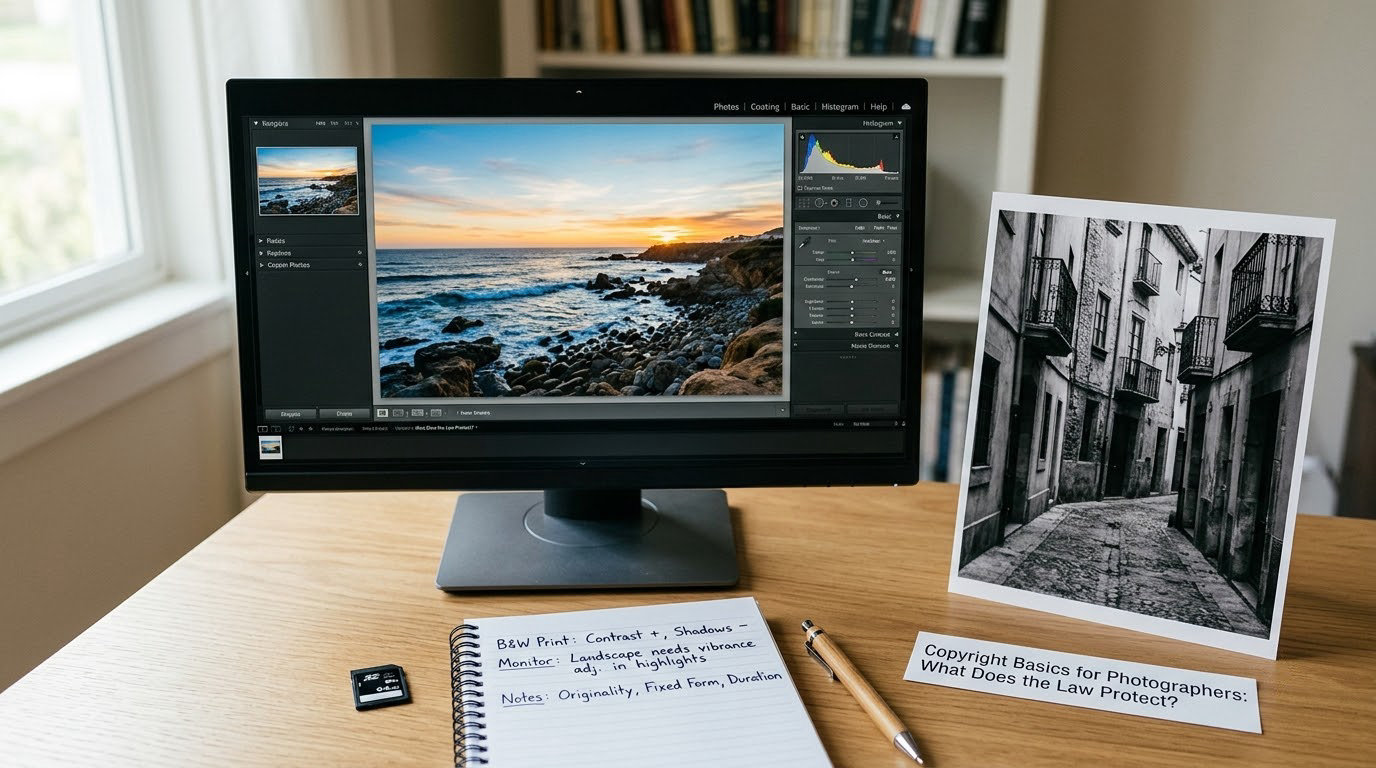
Copyright is a bundle of exclusive legal rights that attaches to an original work the instant that work is fixed in some tangible form. For a photographer, “fixed” simply means the image exists somewhere: a memory card, a laptop drive, a published website, a print on a wall.
What the law protects is your creative expression: the choice of angle, the light, the composition, the timing, the pose, the moment you caught. What it does not protect is the idea behind the image, the technique, the style, the name or title, or the facts of whatever was in the frame.
The bar for originality is low, which surprises people. A quick snapshot of a friend laughing in a parking lot can qualify if you made creative choices about how you took it. Courts look for some minimal creative input, not gallery-level craft. What does not qualify is a pure record of a scene, such as a photograph of a wall used purely to document its condition.
Your rights are specific. Copyright in a photograph gives you exclusive control over reproducing it, preparing derivative works, distributing copies, and publicly displaying it. For still images the practical list is usually reproduce, distribute, display, and adapt. Public display covers showing an image in a gallery or on a website, whether or not you charge for it.
Two other things fall under the same heading. A photomanipulation you build from your own capture is a derivative work, and it carries its own copyright that you own. A digital artwork you make from scratch is protected the same way a photograph is, since the law does not care which tool produced the image, only whether a human created original expression.
One thing to know about timing: publishing is not the same as displaying. Posting to a public blog or a public social account is generally publication. Showing an image inside a private, login-gated portfolio is usually treated as display rather than publication, and that distinction changes some of the deadlines and options discussed further down.
Who Owns the Copyright in a Photograph?
You own it, by default, if you took the photo yourself outside an employment or commissioned arrangement. Paying a photographer buys you a service and usually a license to use the results. It does not hand over ownership of the copyright, and that is the single most common misunderstanding between photographers and the people who hire them.
There are three situations that change the default, and all three of them should be settled in writing before the shoot rather than after delivery.
- Work made for hire. Under US law this applies mainly to work by an employee within the scope of employment, and to photographs specially commissioned for use in a publication such as a magazine or an ad, where the parties sign a written agreement saying it is a work made for hire. Without that written agreement, a commissioned photo is not a work for hire by default.
- Employment. If a studio pays you a salary and the images fall within your job description, the employer is normally the copyright owner. Your brand, not you, holds the rights.
- Joint authorship. When two people make creative contributions that cannot be separated, they are joint authors and they share ownership. A photographer and a retoucher who jointly create a finished composite can both qualify, which means both must agree before licensing.
Here is how ownership usually lands in practice, and what each written agreement should settle.
| Scenario | Who usually owns the copyright | What the written agreement should clarify |
|---|---|---|
| Self-assigned work, published on your site | You | Nothing to assign; keep your source files and license terms posted |
| Freelance brand session, no work-for-hire language | You | Exact usage rights: channels, duration, territory, whether ads are included, whether cropping and retouching are allowed |
| Same session, with a signed work-for-hire clause | The client | Your payment, credit line, and whether you keep the right to show the images in your portfolio |
| Salaried in-house or studio employee | The employer | What you may keep as portfolio samples, and whether off-duty work stays yours |
| Co-created composite with a retoucher or second shooter | Shared as joint authors | Who holds and grants licenses, and who pays for enforcement |
| Images submitted to an image library or agency | Contributors commonly retain copyright and grant the agency an exclusive or non-exclusive license | Read the contributor agreement: exclusivity, duration, territory, who may register and enforce, and what happens to your claim if the agency dissolves |
| Copyright sold outright in a buyout | The buyer | A written transfer signed by you; you can no longer license, enforce, or reuse the image |
Contest entries deserve their own note. Most photography contests take a non-exclusive license to publish entries, and the rules often say you may not register the image or enforce the copyright yourself while the entry is in play. That is how the situation gets confusing for people who want to register before submitting, so check the rules first and register after the results if you need to.
Copyright Basics for Photographers: Exclusive and Non-Exclusive Licenses
A license is a permission. It lets someone use your image within limits you set, while you keep the copyright. A transfer gives up the copyright itself, and once you sign it you cannot license, enforce, or reuse the work. Licensing is almost always the better trade for a working photographer.
The difference between the two license types is simple. A non-exclusive license lets anyone else hold the same permission, so you may sell the image to two magazines. An exclusive license locks the image to one licensee in a defined scope, and you would normally promise not to license it to anyone else in that scope during the term.
These are the permissions you can grant, and each one belongs in writing:
- Reproduction — making copies, prints, or files.
- Distribution — handing copies to others, such as a magazine printing 5,000.
- Public display — showing it publicly, including on a website or in a paid campaign.
- Adaptation — cropping, retouching, compositing, or building a derivative work.
- Sublicensing — whether the licensee may pass the permission to a third party, for example an agency subcontracting production.
- Media, territory and duration — social only or all channels, one country or worldwide, one year or five.
- Commercial versus editorial use. Editorial covers news and commentary. Commercial covers advertising, packaging, and anything that sells a product.
Common real uses: your own portfolio is display plus promotion by you, so no one else needs permission. Licensing to a magazine is a limited license to one publication for print and its website, non-exclusive, for one year. Selling a print is a sale of a physical object, described in detail further down. Submitting to an image library grants that agency permission to license the image to others. Delivering a client session is a license tied to the uses you listed, plus a statement about what they may not do.
The most useful clause I have seen in a session agreement is a short plain-language line: final images may be shared on the client’s website and social accounts, for non-paid promotion of the client only. No paid advertising, no third-party resale, no commercial use without a written add-on fee. That one sentence prevents most of the arguments I have heard about.
How Do Copyright Basics for Photographers Apply to Prints and Digital Files?
Buying a print or a digital file gives you the object, not the copyright. Those are separate things, and the gap between them causes most of the confusion in print sales and client delivery.
When someone buys a physical print, they own that piece of paper and the frame on their wall. They do not get the right to scan it, enlarge it, put it on a tote bag, or offer it as wallpaper. The sale of a physical copy is a first sale, and that first-sale rule applies to the particular copy that was sold, not to the image as a whole. Every extra print they order is a new sale, which is why print prices and reprint rules belong in your terms.
When someone buys a digital file, what they really purchase is a license, and the scope depends on what you wrote. A low-resolution file sized for social posting and a full-resolution file for large-format printing are different licenses, and it is entirely normal to sell both. The bigger question is whether the license is personal or commercial, whether the buyer can use it in paid advertising, and whether it can be passed to a third party such as a print lab or a designer.
| What the buyer gets | Copyright | Practical rights |
|---|---|---|
| A signed print | Stays with you | Display the copy they own; no scanning, resizing, merchandising or resale |
| A low-resolution digital file | Stays with you | Personal and social use at the delivered resolution, as your license states |
| A digital file with a commercial license | Stays with you | Specified advertising, web and print uses, usually limited in duration, territory and media |
| A full buyout with a written transfer | Transfers to them | They control reproduction, distribution and licensing, including sublicensing to others |
That is why I would rather sell a license than a print outright transfer for any image with commercial value. It keeps the copyright, and the copyright is the asset that keeps earning after the delivery day.
What Permissions Do Clients, Models, and Other People Need?
Copyright belongs to you, but it is only half of what a commercial photograph needs. A second set of rights belongs to the people and places in the frame, and those are cleared with releases, not copyright notices. Conflating the two is the most common error in photography contracts, so keep them clearly separated in your paperwork.
| Permission | What it covers | When you want it |
|---|---|---|
| Model release | The subject’s consent to photograph and use images of them, and to waive rights of publicity in commercial advertising | Any recognizable person in a commercial or advertising context; a parent or guardian release for minors |
| Property or location release | Permission to photograph private interiors, and sometimes the owner’s agreement on how the images can be used | Private homes, businesses, client premises, restricted interiors |
| Location scout or venue agreement | What a venue or event organizer allows, and whether organized-event rules restrict commercial or professional shooting | Concert venues, racetracks, conferences, private events with posted restrictions |
| Artwork and trademark clearance | Separate rights in paintings, posters, murals, logos and product designs that appear inside your frame | Gallery walls, street art, branded products, interiors with signage |
A release gives you permission; it does not transfer copyright. The photographer keeps the copyright in every one of these cases, and a client cannot claim your image because you signed a model release.
Two situations need extra care. Editorial work, where a photograph accompanies a news story, generally does not need a model release, but the same photograph cannot then be used to sell a product, so keep editorial and commercial files separate in your workflow. And minors, recognizable private interiors, and sensitive or medical contexts deserve a written release even when the location feels public, because consent from a person in a vulnerable situation is the part that gets challenged later.
Taking a photograph is usually not restricted. Publishing it is where copyright, privacy and contractual restrictions all apply at once, and a venue’s rules generally govern whether you may photograph commercially on their property, not who owns the picture afterward.
How Can Fair Use Apply to Photography?
Fair use is a US legal doctrine that can excuse certain uses of your copyrighted image without permission or payment, and it is decided case by case. It is not an automatic exemption for news, commentary or education, and nobody can honestly tell you in advance that a use is fair.
Courts weigh four factors from the US Copyright Act. No single factor decides the outcome, and the analysis is always weighed together.
| Factor | What it asks | What tends to lean toward fair use | What tends to lean against fair use |
|---|---|---|---|
| 1. Purpose and character | Is the use for commentary, criticism, teaching, scholarship or news reporting, or is it commercial? | Review, teaching, parody, transformative commentary, reporting | Advertising a product, decorative background, blog traffic generation, using the whole image unmodified |
| 2. Nature of the work | Is it published or unpublished, factual or creative? | Factual or news images, or unpublished works used in a relevant way | Highly creative or published work, where the market for licensing is established |
| 3. Amount used | How much of the work is taken, and is it the heart of it? | A small portion, or a portion sufficient for the criticism to land | The whole image, or the most recognizable and valuable part of it |
| 4. Effect on the market | Does the use substitute for a purchase, or undercut a licensing market? | No realistic substitute, and the use adds something new | Replacing a licensed or purchasable copy, or flooding a market with unlicensed versions |
A few situations photographers ask about most often. A review blog that shows your studio photo beside a critique of your lighting is a strong fair use candidate, because it is commentary and the image serves the point. A competitor re-posting your portfolio image on their own services page to sell their work is the opposite case, and the market effect alone is usually decisive. A news outlet using a photo in a story about a shooting they covered is the classic case courts have treated as fair, but only while it stays editorial. A client reposted your session photo on their personal social account is ambiguous: some courts weigh the non-commercial purpose in the client’s favor, and others look at whether they could have used a smaller crop. That is a real dispute, not a settled rule, and it is worth a written scope statement in your contract rather than an argument afterwards.
How Do You Document and Register Your Creative Work?
Registration is not needed to own your copyright, and you do not need a copyright symbol or notice. It is optional, and what it buys you is leverage, a public record, and in some situations access to money you could not otherwise claim. That is the part most guides get wrong, so it is worth being specific about what registration actually does in the US system.
Before registration, keep the evidence. The basic habits that pay off later are unglamorous: retain the original camera files and RAW captures, keep the layered working file with adjustment layers intact, export a flattened version that matches what you published, and store them in more than one place with dates. Keep the edit history, your publishing records with dates and URLs, your invoices, your signed agreements, releases and license paperwork, and embed authorship and copyright details in the IPTC metadata of your exported files. A quick monthly reverse image search on your own name catches a surprising number of reposts early, and it is free.
Decisions about crop and format are part of the documentation story too. If you deliver square files to a client, keep the original aspect-ratio versions too, which is a small thing that saves a real argument later, and the reasoning behind framing choices is covered well in our piece on why photographers shoot square photos.
What registration adds, under US law as of 2026:
- A public record. The U.S. Copyright Office creates a dated public entry tied to your deposit copy, which is useful evidence of authorship and of when you claimed the work.
- The right to sue in federal court. For a US work, registration must exist before you file an infringement suit. Registration generally must be made before the infringement you want to sue over begins.
- Statutory damages and attorneys’ fees. If you register before the infringement starts, you may be able to claim statutory damages rather than only the actual value of the license. In a willful infringement case those statutory damages can run as high as 150,000 dollars per infringed work, with a ceiling of 30,000 dollars for non-willful infringement. Recovering attorneys’ fees is also possible in the right case, and that shifts a lot of the economics of a small claim.
- Timing matters. There is a post-publication window. If the work was published, registering within three calendar months of first publication opens access to statutory damages and fees for infringement that began after the registration. Register long after publishing and you may be limited to actual damages and profits.
Two practical mechanics. Registration is done per work, so a group publication of previously unpublished photographs is treated as one application covering many images, which changes the cost dramatically compared with registering each frame separately, and it is the efficient route for a body of new work. And the fees are published on the Copyright Office site as a schedule, charged per application rather than per image when you group unpublished works, with a low single-application charge for one photograph and a separate, capped filing fee for the small-claims process. Check the published schedule before you file, and use the small-claims process if the amount in dispute is below its cap. Filings are made through the Copyright Office registration portal, and processing times vary with volume, so file before you need the record rather than after a dispute starts.
Outside the US, protection generally arises automatically under international conventions such as the Berne Convention, so a symbol or registration is usually not needed to hold copyright. Enforcement in another country is a different matter, with its own procedures and its own costs, and US registration does not create a worldwide remedy. If you shoot or license across borders regularly, a local lawyer is worth a consultation.
Get a copyright attorney involved when the stakes are real: a full buyout, a licensing deal for a national brand, a significant revenue claim, a pattern of repeat infringement, or anything where you may need to sue. The consultation cost is small next to the value of the image library it protects. A photographer-specific book on running a photography business is a good middle step for the everyday questions.
What Should You Do If Someone Uses Your Photograph Without Permission?
Stay calm and methodical. The first hour is about preserving evidence, not about threats, and a measured process produces better outcomes than an angry one. These are the steps I would follow.
- Document the use before anything changes. Screenshot the page, capture the full URL, note the date and time, and record the whole context including where the image appears and what is around it. Save a copy of the image as you found it.
- Confirm you are the rights holder. Check your contract, license and any agency agreement first. If a client or a stock agency holds a license, they may be the correct person to act, and contacting them wrongly can damage a working relationship.
- Run a reverse image search. This often reveals other unauthorized uses you did not know about, including versions with the logo cropped out.
- Send a targeted written notice. A short letter or email that identifies the work, the rights you claim, where it appears, what you want, and a deadline is far more effective than a paragraph of complaint. Ask for removal and for written confirmation, and keep a copy. Templates for this circulate widely, and the one rule is to state facts rather than accusations.
- Use the platform’s reporting process. Major platforms and marketplaces have notice-and-takedown forms for copyrighted material. Submitting one is usually quick, and the platform may remove the item pending review. Expect a counter-notice from the uploader, and understand that a wrongful counter-notice carries legal consequences, so only file when you actually hold the rights.
- Decide the route with realistic expectations. In the US you generally must have registered before the infringement to sue in federal court. For smaller disputes, the Copyright Claims Board inside the Copyright Office is a voluntary process with a lower filing fee and a capped damages figure of 30,000 dollars, which suits many single-image claims. Small claims court in your state is another option, with its own caps. A demand letter to a brand or agency, backed by a registration, frequently resolves without litigation.
What you can realistically recover depends on the route. Actual damages, meaning what a license would have been worth, plus the infringer’s profits, are the baseline. Statutory damages are only available in the situations described above, and only where registration timing allows. The Copyright Claims Board is capped. Fees and costs may be recoverable in a federal case but are not automatic.
One warning about enforcement services. Copyright collection firms operate in this space, and some operate as businesses that buy rights cheaply and then press small companies for settlements using intimidation rather than merit. Vet any firm carefully, understand exactly who owns what you signed away, and never assign your copyright outright just to have someone handle a single complaint.
Two situations that generate more regret than relief. First, venues and event organizers sometimes ask professional photographers for free image copies by claiming the event is their property. Your images of the event are yours; the event is not a copy of your photograph. Say so in advance in your contract. Second, a client who paid for a session and then argues they own the file is usually relying on the assumption that payment transfers copyright, which is exactly the assumption your written agreement exists to remove.
Frequently Asked Questions
Do photographers need a copyright symbol or notice for photos to be protected?
No. In the US, copyright attaches automatically the moment an original photograph is fixed in a tangible form, such as a memory card or hard drive. No symbol, no notice, no form, and no fee are required. Registration is optional and is a separate step you take later if you want a public record and access to statutory damages and attorneys fees. Posting a copyright notice can still be useful as a deterrent and a reminder, but it does not create the protection.
Can a photographer use copyrighted music, fonts, or artwork in a commercial photo?
You can photograph almost anything, but using protected material in a commercial image is a separate question. Song lyrics, film stills, paintings, murals, logos, and branded designs are protected by their own owners, and typeface licenses often restrict embedding in logos and ads. Copyright in your photograph does not clear those underlying rights. For commercial or advertising work, either license the elements, use genuinely public domain material, or compose the frame to avoid them.
If a client pays for a photo shoot, who owns the copyright?
Normally you do. Payment buys the client your time, skill and finished images, plus whatever use you grant in writing. The exception is a work made for hire, which for photographs requires a signed written agreement, usually for a publication such as a magazine or an advertisement. Employee photographers are a separate case, where the employer usually owns images made within the scope of the job. Put the ownership position and the exact permitted uses in the agreement before the shoot, not after delivery.
Does posting a photograph on Instagram or another social platform give the platform copyright ownership?
No. Posting transfers a license so the platform can host and display the image, but the copyright stays with you. Most terms grant a broad, royalty-free license, sublicensable to some extent, to operate and promote the service, and some platforms let you switch a post between public and private. Read the current terms before assuming. Remember too that a public post is generally publication, which affects registration timing and damages eligibility, while a private, login-gated gallery is usually treated as display instead.
Can a photographer stop someone from using a photo under fair use?
You can argue it, but you cannot always stop it. Fair use is a defense assessed case by case under four statutory factors, and the question is genuinely fact-specific. A blog running your studio image to sell its own services is a weak fair use case because it substitutes for a license. Criticism, teaching, scholarship and news reporting are stronger. If you disagree, keep a record, send a written notice stating your position, and consider a consultation with a copyright attorney before you escalate.
Is a watermark enough to protect a photograph from unauthorized use?
A watermark is a deterrent, not protection. It can be cropped out, and it cannot stop a determined copier, so it never replaces copyright, which you already hold automatically. It does help in practice: visible marks on previews discourage casual reuse, and embedded IPTC metadata survives most exports and gives you evidence of authorship. Combine a visible mark on preview images with invisible metadata and watermark embedding on anything you deliver or post, and keep your originals with full metadata intact.
The first thing to do is smaller than it sounds: write down what you own and what you allow. Ownership of your photographs is already yours by default, and the value you lose in practice comes from unclear agreements, missing records, and registrations filed too late. Get the license language right, keep the files and the paperwork, register the work you cannot afford to lose, and treat every use request as a negotiation you are allowed to have.
This article covers general US principles and is not legal advice. If you are dealing with a specific claim, a buyout, or a cross-border dispute, talk to a qualified attorney in your jurisdiction.