
Continuous lighting vs strobe for photography comes down to one trade: what you can see versus how much light you get. Strobes deliver far more power, so you can stop down, shoot fast, and overpower daylight. Continuous lights let you see the effect before the shutter, so you learn faster and shoot video from the same kit.
Strobes win for portraits, products, food and anything that moves. Continuous lights win for beginners, video and tabletop work where positioning matters more than output. Most working shooters own both, and the honest answer is that they are not rivals so much as two tools for two jobs.
This guide was reviewed and updated for 2026. I have shot stills on both systems for years, and the numbers below come out of real exposure decisions rather than spec sheets alone.
Table of Contents
- Continuous Lighting vs Strobe for Photography at a Glance
- What Is the Difference Between Continuous Light and Strobe Light?
- How Light Output and Power Affect Your Photographs
- How Shadows, Contrast, and Texture Change
- Which Lighting Type Gives You More Creative Control?
- Modifiers, Accessories, and Studio Compatibility
- Freezing Motion and Shooting in Bright Locations
- Cost, Setup Time, and Everyday Workflow
- Which Should You Choose?
- Frequently Asked Questions
- Conclusion: Choose Based on the Light You Need
Continuous Lighting vs Strobe for Photography at a Glance
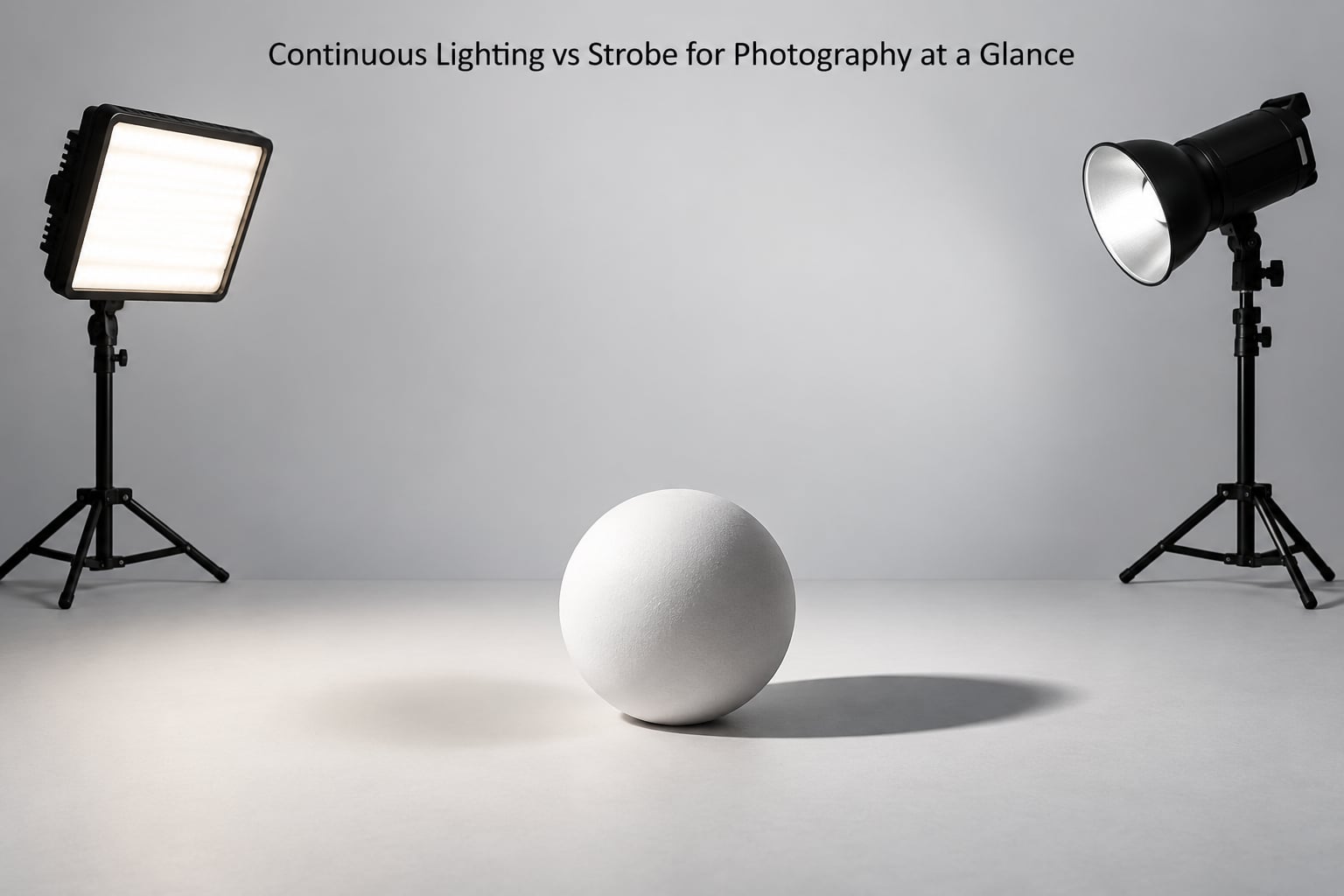
The table is the short answer. Every row below is a real difference in how the two light types behave in a shoot, not a marketing claim.
| Criterion | Continuous lighting | Strobe |
|---|---|---|
| Light output | Lower and spread across the whole exposure | Far higher, dumped into thousandths of a second |
| What you see before shooting | Everything, in real time | Nothing, unless the head has a modelling lamp |
| Shadow quality | Soft if the panel is large and close | Soft if the head is large and close, or bounced |
| Exposure consistency | Every frame identical, no recycle time | Identical once recycled, power can drop over long bursts |
| Freezing motion | Needs a lot of power to reach fast shutter speeds | Freezes action easily, or freezes it selectively with high-speed sync |
| Modifiers | Softboxes, grids, projectors, barn doors, scrims | Softboxes, umbrellas, beauty dishes, grids, snoots, all mount types |
| Colour temperature | Fixed at manufacture, tunable on some units | Fixed per lamp, but every shot is repeatable |
| Colour accuracy | Judge it by CRI or TLCI, 95 and up for accurate skin | Flash tubes are consistent shot to shot |
| Video and hybrid work | Native, the same light works for motion | Not native, needs a separate light for moving frames |
| Heat, noise and power draw | Real heat, real fan noise, mains or heavy battery | Almost no heat, quiet capacitors, battery packs |
| Hidden costs | Bigger fixtures, stands, sandbags, spare panels | Triggers, receivers, packs, spare modelling lamps, extra cables |
| Best suited to | Learning, video, tabletop, macro, quick visible setups | Portraits, products, food, fitness, weddings, daylight exteriors |
Read it as a set of trade-offs, not a scorecard. A row where continuous light wins is usually paid for somewhere else, usually in power.
What Is the Difference Between Continuous Light and Strobe Light?
Continuous lighting is any source that stays on constantly: LED panels, COB fixtures, ring lights, fluorescent tubes, tungsten lamps. The light is there before you press the shutter and it is still there after, so the shadow pattern, the catchlight in the eye and the falloff on the backdrop are all visible in advance.
A strobe, also called a flash, delivers its energy as a burst lasting thousandths of a second. Because the light exists only during the exposure, it can be far brighter than any continuous source of the same electrical wattage, and that brightness is what lets you close the aperture, drop the ISO and freeze a jump.
That difference in delivery is why the wattage numbers on the two types of light are not comparable. A fixture labelled 200 watts draws 200 watts continuously, which sounds impressive until you remember it delivers that light for the whole second of the exposure. A flash head rated 200 watt-seconds delivers its full output in roughly one thousandth of a second, so the camera records a very bright instant. Shooters on TalkPhotography worked this out the same way: a 200 watt-second head produces a burst that a 200 watt continuous lamp of similar wattage simply cannot match during the fraction of a second the shutter is open.
Some light falls in between. LED panels in video-bright mode can dim to a small fraction of their output, which works as a crude high-speed sync for a strobe. And a modelling lamp inside a strobe head is a continuous light, usually a fraction of the flash output, used only so you can see the shadows before the shot.
So the labels matter less than the four underlying facts: how much light reaches the sensor, how long the light lasts, how you shape it, and how well it holds up against ambient light. Judge those, and the vocabulary stops being confusing.
The continuous light subtypes worth knowing
Within continuous lighting, the four families behave quite differently and suit different subjects.
| Type | What it is | Best for |
|---|---|---|
| LED panel | A broad flat source, usually 5500K, often bi-colour | Soft key light, video, anything needing a large source close to the subject |
| COB fixture | A single bright emitter with its own reflector or dome | Punchy, directional, portable light with a Bowens or similar mount |
| Ring light | A circular tube around the lens axis | Beauty, tutorials, macro and tabletop, shadowless by design |
| Tungsten or fluorescent | Older, warm household-type sources, usually 3200K | Cheap warm light, but they run hot, flicker and are being phased out |
Panels and COB lights cover most of what people mean today. Ring lights are a special case worth calling out because they are a fixture that replaces the sun position, not just a light, which is why they flatter faces and destroy texture.
The strobe subtypes worth knowing
Strobes split three ways, and the differences matter more for your budget than anything else.
| Type | What it is | Where it fits |
|---|---|---|
| Speedlight | Hot shoe flash, battery powered, light output, modifiers limited by size | Learning, event work, off-camera fill, travel |
| Monolight | A self-contained pack with a head, no separate power supply | The sweet spot for most working shooters and home studios |
| Power pack with head | A separate battery unit feeding one or more heads by cable | Commercial work where several heads must fire together |
The jump from a speedlight to a monolight is the jump that changes what you can photograph, not the jump from one monolight to the next. Photography communities tend to recommend speedlights to beginners, with a regular consensus that the ones doing stills only should buy strobes when they can.
How Light Output and Power Affect Your Photographs
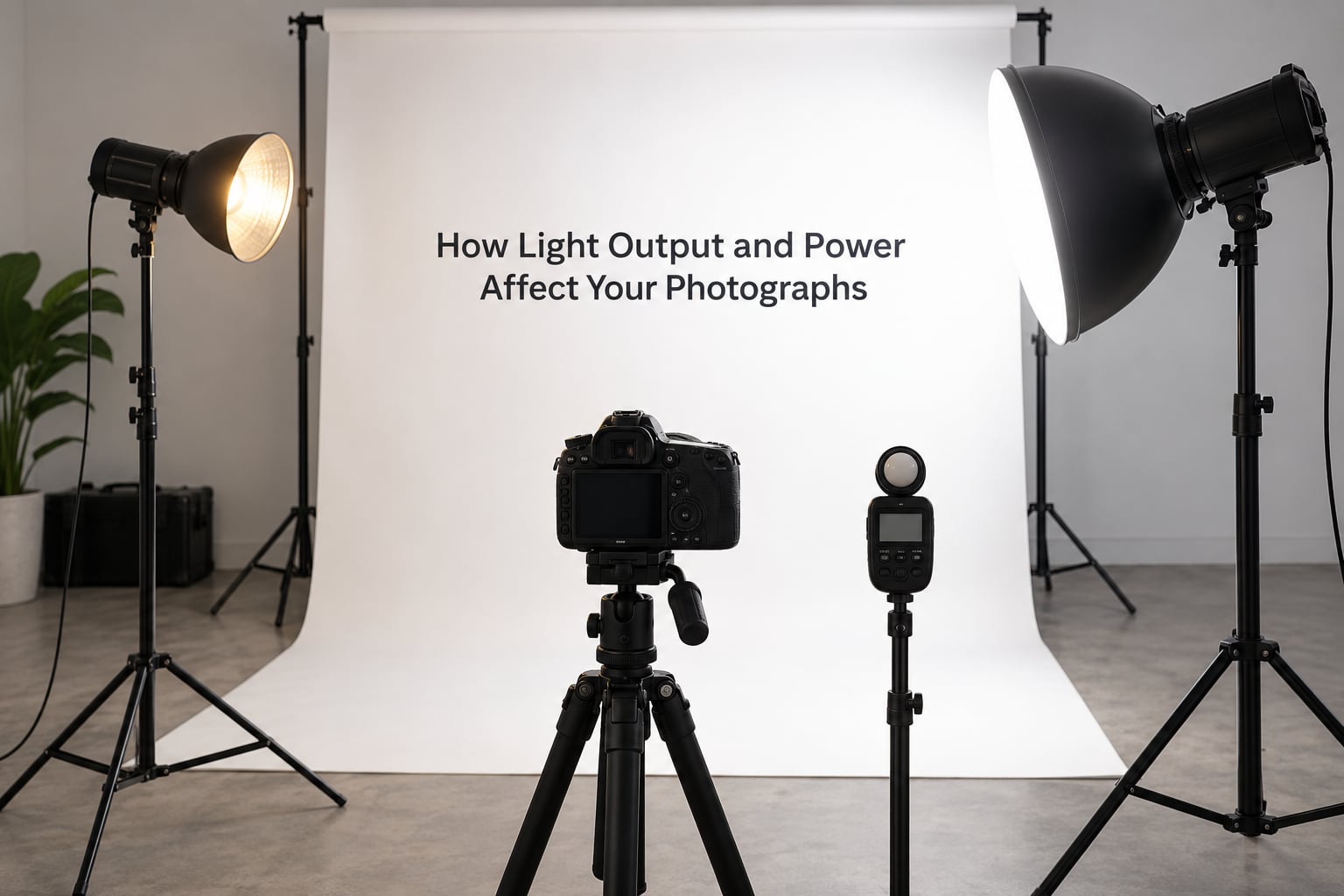
Power is the single biggest practical difference between the two, and it shows up in your settings rather than in a spec sheet.
Take a small room, a subject two metres from the light, and a white background you want to go slightly brighter than grey. With a modest LED panel you will typically be shooting wide open, pushing ISO to keep the shutter usable, and watching the depth of field go shallow. A 200 watt-second head at the same position gives you roughly two to three stops more usable light, which is the difference between f/2.8 at ISO 3200 and f/8 at ISO 100.
Those two extra stops are not just about noise. They decide whether your whole group is sharp or only the person in focus, whether your background is clean, and whether you can shoot at 1/500 without dropping to ISO 6400.
Here is what that looks like in a real room, with one subject, one background and no cheating.
| Setting | Small LED panel | 200 watt-second strobe head |
|---|---|---|
| Aperture | f/2.8 | f/8 |
| ISO | 1600 and above | 100 |
| Shutter speed | 1/160 | 1/200 |
| Depth of field | Very shallow, only the eyes sharp | Deep enough for a head and shoulders plus background |
| Noise in the shadows | Visible, cleanup needed | Clean, no cleanup |
Same subject, same light position, same room. The strobe is not a slightly better version of the panel, it is a different working aperture, and the depth of field that follows is a creative decision rather than a constraint. That gap widens to four stops or more in open daylight, which is exactly where continuous light runs out of options.
What the numbers actually mean
Continuous lights are usually sold by wattage, lumens or lux at one metre. Strobe heads are sold in watt-seconds, and monolights often carry a guide number. None of those convert cleanly into each other, which is where most bad purchases start.
A useful rule is to compare light at the subject instead. Meter the actual setup with a light meter or your camera, then judge the f-stop you land on. If a fixture needs f/2.8 at ISO 1600 to expose correctly, it is a f/4.6 light in practical terms compared with one that meters at f/8.
Stops explain the gap better than raw output. Every stop is a doubling or halving of light, and a decent monolight sits two to three stops above a pro compact LED in a small room. Outdoors at midday, the gap widens to four stops or more, which is why continuous lights struggle as key lights in daylight.
There is a second effect people forget. With a strobe, the background only receives whatever spills or is separately lit. The subject gets a controlled burst while the room stays dark, so exposure is repeatable frame after frame. With continuous light, whatever is in the room lights up too, so you are constantly re-balancing as the sun moves or a cloud passes.
Inverse square law applies to both. Move a light twice as far away and you lose two stops, so a continuous light close and large stays usable, while a strobe can afford distance and still hold exposure. That is a large part of why strobes scale to big sets, tall backdrops and outdoor locations, and why LED panels tend to get brought in close, where they get hot and where small-source hardness becomes a problem.
The forum consensus lines up with the maths. Wedding shooters describe strobes as brighter and easier to carry, and a working studio shooter notes that continuous lights fall short on power often enough to force wide apertures or high ISO that are not acceptable for stills. Several product and food specialists simply state they prefer strobes for still work almost always.
How Shadows, Contrast, and Texture Change
Light type has less to do with shadow quality than people assume. A hard shadow is caused by a small light source relative to the subject, and a soft shadow by a large one. A big LED panel can be as soft as a big softbox, and a bare-bulb speedlight is as hard as a bare strobe head.
The trap is modifier size. Mount a one-metre softbox on a small COB light and you get hard-edged, ugly shadows, because the fixture itself becomes the effective source. Shooters on The Photography Forum hit exactly this problem and diagnosed the fix as source size, not brand: move the light inside a large modifier, put a diffusion panel between, or accept crisp shadows and design for them.
Here is where each type naturally pushes you:
- Soft portrait light. A large panel or a strobe head bounced into a white wall. Continuous gives you instant feedback while you move the subject into the falloff. Strobe gives you the reach to do the same thing across a large room.
- Directional, high-contrast work. A gridded head or a snoot, placed close, gives a controlled, hard-edged pool of light. Continuous lights do this with barn doors and projectors too, and it is one of the places they feel natural, because you can see exactly where the pool lands.
- Still life and tabletop. Small sets, short distances, and careful control of every reflection. Continuous light is genuinely convenient here, since you can work with the camera in the frame and adjust with the light still on.
- Black and texture study. Low fill, high separation, and a lot of patience. Raking a single small source across a surface shows texture better than a soft frontal wash, and either light type will do it. My guide to photographing black objects covers the exposure side in more detail.
- Surreal fine art. Hard, unmistakable shadows are the point. Strobe with a bare head at low power, or a spotlight with barn doors, gives you the control to place a shadow precisely; with a continuous source you are managing brightness and colour at the same time.
A reflector is the cheapest modifier of all and works with either system. Learn to bounce a single source into a white card and you can shape the fill on a face or a bottle without buying anything else. How to use a reflector in portrait photography walks through the angles.
Which Lighting Type Gives You More Creative Control?
Control means different things to each type. Continuous light gives you control over what you can see and adjust. Strobe lighting gives you control over exposure, timing and how much light the room receives.
- Real-time adjustment. Continuous light lets you change output, colour temperature and modifier angle and watch the result. Nothing about a strobe is visible until you fire it.
- Aperture control. Strobe power buys you stops, so you choose the aperture for depth of field and let ISO sit at base. With continuous light the aperture is often decided for you by the light you have.
- Flash duration. A short flash freezes motion; a longer flash blurs it. You can also set flash duration to match the shutter at a chosen sync speed, which lets one subject stay sharp while a dancer blurs behind them.
- Modifier effects. Strobe heads reach modifiers most continuous fixtures cannot, particularly grids, snoots and large octaboxes that stay consistent across frames.
- Colour temperature. Continuous units are often daylight balanced at around 5500K and bi-colour models let you dial from roughly 2700K to 6500K, so you can match tungsten interiors instantly. Flash tubes are fixed but identical on every frame, which for consistency is often worth more.
- Combining sources. You can mix freely, as long as colour temperature and power ratio are deliberate. See the next section for the trap and the fix.
When Continuous Lighting vs Strobe for Photography Favours Feedback
Choose real-time feedback when the subject moves unpredictably, when you are new and still learning where light goes, or when you need the same frame for video. Kids, pets, food styling that keeps moving, tabletop sets you are constantly rearranging: all of these reward seeing the light.
Choose flash-based control when the exposure must be identical across a hundred frames, when you need to overpower something bright, or when the effect depends on the light existing only for an instant. Group shots, catalogue product work, dance, and any outdoor midday session fall here.
There is a third path most guides skip: how you work with strobes when you cannot see the result. Fire a test shot, look at the histogram, adjust. Most heads have a modelling lamp, and the better ones have a bright one, so switch it on, block the flash with a card to avoid blowing the test, and meter the modelling light knowing the flash output is fixed. After a few hours of that, the blind placement problem mostly disappears and it becomes a habit rather than a fear.
Modifiers, Accessories, and Studio Compatibility
Modifier support is where the two systems diverge most, and it is worth checking before you buy anything.
| Modifier | Continuous light | Strobe |
|---|---|---|
| Softbox | Needs a fixture wide enough to fill it | Standard on most heads, Bowens and proprietary mounts common |
| Octabox | Only large panels fill one properly | Common, holds shape and stays consistent |
| Umbrella | Works, but the small panel inside gives hard edges | Designed for it, shoot-through and reflective both standard |
| Beauty dish | Rarely useful, source too small | Standard, gives that crisp yet wrapped skin quality |
| Grid and snoot | Barn doors and projectors instead | Standard, precise beam control at distance |
| Reflector and flag | Fully compatible | Fully compatible |
| Scrim or diffusion | Very common, easy to clip on | Common, usually needs its own holder |
Soften light with diffusion: the effective size of the source is what softens a shadow, and both systems can be enlarged with a scrim or a bounce. A small panel bounced off a pale wall becomes large, and that trick is the single easiest upgrade for a continuous setup.
Accessory costs differ more than the fixture price. Continuous light usually needs a heavier stand, a sandbag, and a cable run or a large battery. Strobe kits need a trigger, a receiver per light, a pack or mains feed, and spare modelling lamps, which is exactly the accessory creep beginners underestimate.
Freezing Motion and Shooting in Bright Locations
The claim that continuous light cannot freeze motion is half right, and understanding the half that is wrong saves you from buying the wrong kit.
To freeze a drop of water you need a short shutter, and a short shutter needs a lot of light. There is no way around the exposure equation. A continuous source bright enough to freeze a splash at 1/1000 would need to be enormous, hot and expensive, which is why nobody builds one for the purpose.
That said, continuous light can absolutely freeze motion, and users point out that it can hold a narrow shutter on water. The catch is what happens elsewhere in the frame. Narrow down to 1/1000 and every hair, hand and falling crumb stops too, and if your continuous light is slightly underpowered you land at 1/250 with a sharp subject and blurred hair. The compromise is built into the physics.
Strobes avoid it because the flash lasts thousandths of a second, not the length of the exposure. Even at a moderate sync speed you get a sharp subject, and at high-speed sync you push past the camera’s native limit and trade a little power for a much wider shutter range. The catch with high-speed sync is a real loss of output, and it gets worse as you go faster.
Free flash makes the opposite effect possible. Use a slow shutter and a short flash to let ambient light smear the background while the subject stays sharp, which is how waterfalls and light trails work. Continuous light can never do this, because the light is on the whole time.
Bright locations is the other place the power gap decides things. Overpowering sunlight is a matter of stops, and a monolight buys you three to four over a pro compact panel, which is often the difference between a usable frame and a silhouette. Strobe wins outdoors for the same reason it wins in a large studio. For food, the lighting tips for food on Instagram cover the window-light approach that works without any of this.
Cost, Setup Time, and Everyday Workflow
Talking numbers here is a trap, because prices move and gear generations turn over fast. What stays true is the shape of the cost, and the shape is what should drive the decision.
Entry continuous setups carry the cost in the fixture itself, because you need a lot of output to reach a usable f-stop, and bigger fixtures cost more. A single capable light can carry a tabletop or portrait session. Building a matched pair, or a key plus background light, pushes the budget up quickly.
Entry strobe setups carry the cost in accessories. Heads look cheap next to a serious panel until you add a trigger, two receivers, a stand set, softboxes and a pack or cabling. Budget kits advertised as complete are rarely complete once you can actually light a face.
Running costs split the same way. Continuous lights draw mains power continuously, produce real heat, and need fans, which means noise in a quiet room. Strobes charge batteries, hold a charge for hundreds of flashes, and stay cool and silent. Over a working life, batteries and replacement modelling lamps are a smaller bill than the electricity and the heat.
Setup time is the factor people underestimate. A continuous setup is usually faster the first time, because you can see the problem. A strobe setup gets faster fast, because you stop rebuilding things blindly once you trust the meter and the test shot.
Portability depends on the system. Strobe heads and packs are heavy but self-contained and quiet on location. Continuous panels are heavier still for their output, need power, and overheat in a closed car. Battery COB fixtures exist and are excellent, but they burn through a pack far faster than a strobe pack would.
One more cost that rarely shows up in comparisons: colour accuracy. A panel with poor colour rendering will make skin and food look dull no matter how good the exposure is, so a CRI or TLCI figure of 95 or better is worth paying for. Cheap fixtures often sit well below that, and the mistake shows up in the edit, not in the room.
Which Should You Choose?
Start with your most common subject and the location you shoot it in, not with the gear you wish you owned. Here is the decision matrix that comes out of that.
| If you mainly shoot | Start with | Because |
|---|---|---|
| Portraits and headshots in a studio | Strobe | Power, modifiers, and the ability to shoot wide open with clean backgrounds |
| Weddings and events | Strobe | Battery powered, quiet, repeatable across hundreds of frames |
| Products, jewellery, cosmetics | Strobe | Flicker free, repeatable, easy to dial power per shot |
| Food and drink | Strobe, with window light as a fill | Long setups, static subject, power for a bright background |
| Fitness, dance, sport | Strobe | Fast shutter speeds and optional motion blur effects |
| Macro and tabletop | Continuous | Close working distances, constant light, easy repositioning |
| Video, or hybrid photo and video | Continuous | The same light works for moving frames |
| Learning your first setup | Continuous | Instant feedback shortens the learning curve |
| Outdoor midday portraits | Strobe | Only flash has the output to hold exposure against the sun |
| Real estate and interiors | Both | Continuous for wide, even coverage; strobe for accents through windows |
Two rules I would add. First, inventory what you already own before buying anything, because a speedlight and a reflector can carry a surprising number of portrait sessions. Second, if you shoot video at all, the economics favour continuous light, since it does double duty instead of sitting in a corner.
Mixing both on one shoot is entirely workable, and plenty of working shooters do it. The rule is that you must match colour temperature and set the power ratio deliberately. A room lit at 3000K with a 5500K panel on the subject will give you orange skin with a blue-white edge, which is the single most common quality complaint in these discussions. Two fixes: gel or dial the panel to match the room, or turn the room lights off and use the continuous light only. The dpreview and forum threads about mixed colour temperature all land on the same diagnosis.
Frequently Asked Questions
Is continuous lighting better than strobe for beginners?
Usually yes, for the first few months. Continuous light lets you see the shadows, falloff and catchlights before you press the shutter, which is how you learn where light actually comes from. A strobe gives you more power but no feedback until you review the frame, which is a hard way to learn alone. Once you can place one light and judge the result, a used strobe kit is the better investment. Most beginners who shoot stills only end up moving to strobes within a year.
Can I use continuous lights and strobes together?
Yes, and hybrid setups are common on commercial shoots. The only real trap is colour temperature: tungsten room light around 3000K mixed with a 5500K panel or flash produces orange skin tones and blue shadows. Either gel the flash and set the continuous light to match the room, or switch off the room lights entirely. Keep a fixed power ratio, shoot a test frame, and meter with the continuous light off so you know exactly what the flash is contributing.
Do strobes always produce better-looking light?
No. Light quality is decided by size, distance and position, not by the label on the fixture. A strobe bounced into a white wall gives beautiful soft light, and a small LED panel used bare gives hard, unflattering shadows. What strobes reliably win on is power and repeatability, so you can choose the aperture you want instead of taking what the light allows. Used badly, a strobe looks worse than continuous light used well.
Can a strobe freeze motion better than continuous lighting?
Yes, and it is not close. Because flash duration lasts thousandths of a second rather than the length of the exposure, a strobe delivers far more usable light at any given shutter speed, so 1/1000 is easy. A continuous light bright enough for that speed would need to be very large and hot. Continuous light can still stop motion, but you usually land at a slower shutter, which leaves hair and edges blurred while the main subject is sharp.
Which type of lighting is best for photography video?
Continuous light, without much argument. Video records across the whole exposure, so a strobe only lights a fraction of the frames and produces flicker. A bi-colour panel lets you match tungsten or daylight and dim output without changing colour. If you mainly shoot stills and only need occasional video, strobes are fine for photos and you can hire or borrow a light for the motion work. Video and stills on the same shoot is the strongest argument for continuous.
Conclusion: Choose Based on the Light You Need
Neither system is better at photography as such, which is the honest answer to continuous lighting vs strobe for photography. Strobes give you more light, more modifiers and more control over exposure, and that is why most working stills photographers reach for one. Continuous light gives you something money cannot buy: instant feedback, and the ability to make motion pictures from the same setup.
So name your most common subject, check what power your location demands, and decide honestly whether you need to see the result or control it. Learning light, tabletop work or anything involving video: start with continuous light. Portraits, products, action, weddings or daylight exteriors: start with a strobe. Whatever you pick, build one setup that works, learn it properly, and add the second light only when you know what you are asking it to do.