
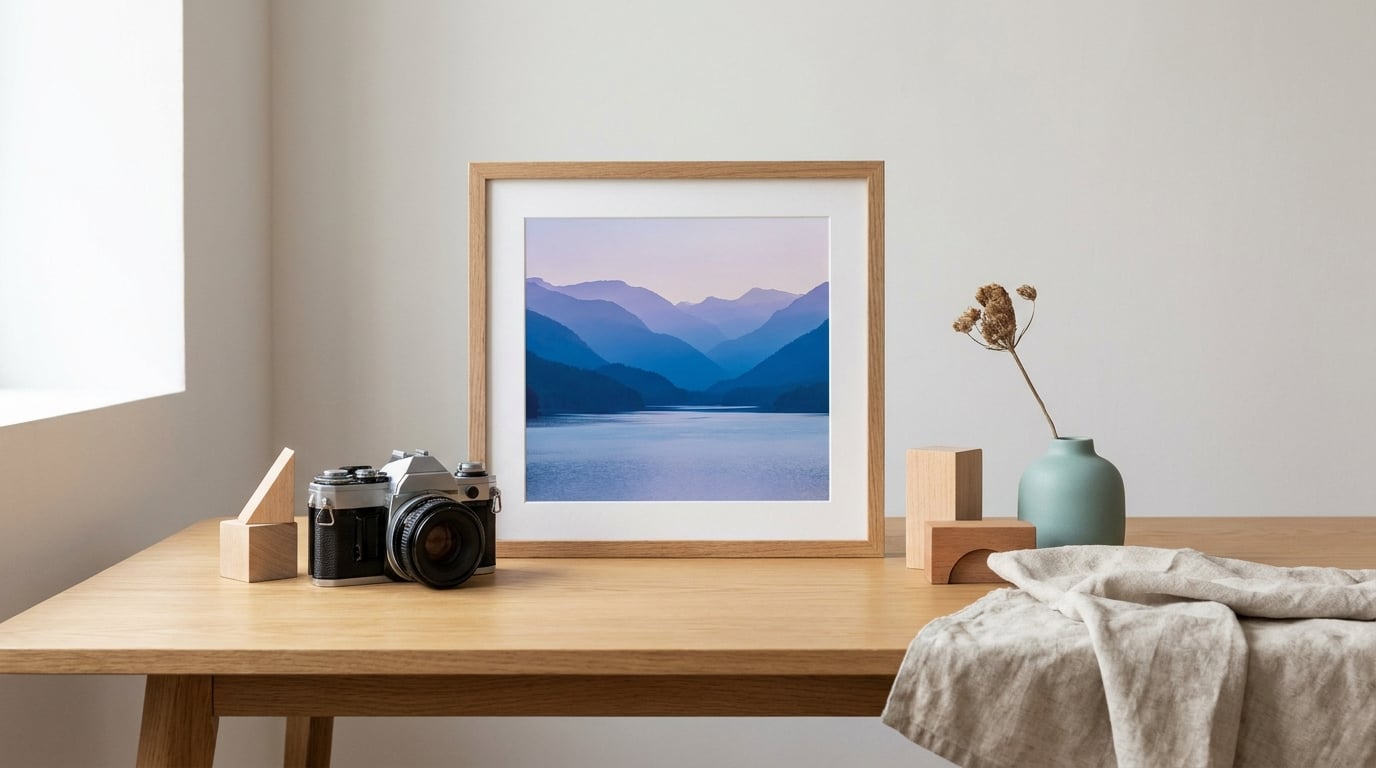
Photographers shoot square photos because the 1:1 frame settles a lot of arguments before they start. Equal sides mean no decision about which way to hold the camera, no trimming a stray edge afterward, and a shape that carries balance on all four sides. The result is a self-contained image that works on a screen, in a grid, on a wall, and in a printed book without reformatting.
That is the short answer. The longer one is that a square frame changes how you build a photograph, who it speaks to, and where it lives after you make it. The nine reasons below cover the aesthetic, compositional, technical, and practical sides of the format.
Table of Contents
- Why Photographers Shoot Square Photos
- How Square Framing Simplifies Composition
- Why Square Photos Create a Strong Visual Rhythm
- How the Shape Changes the Story
- Why Photographers Choose Squares for Platforms and Sharing
- What Square Photography Does to Depth and Motion
- How to Shoot Square Photos Without Cropping at the End
- When Square Is the Right Choice and When It Is Not
- How to Build a Consistent Square Series
- Frequently Asked Questions
- Conclusion
Why Photographers Shoot Square Photos
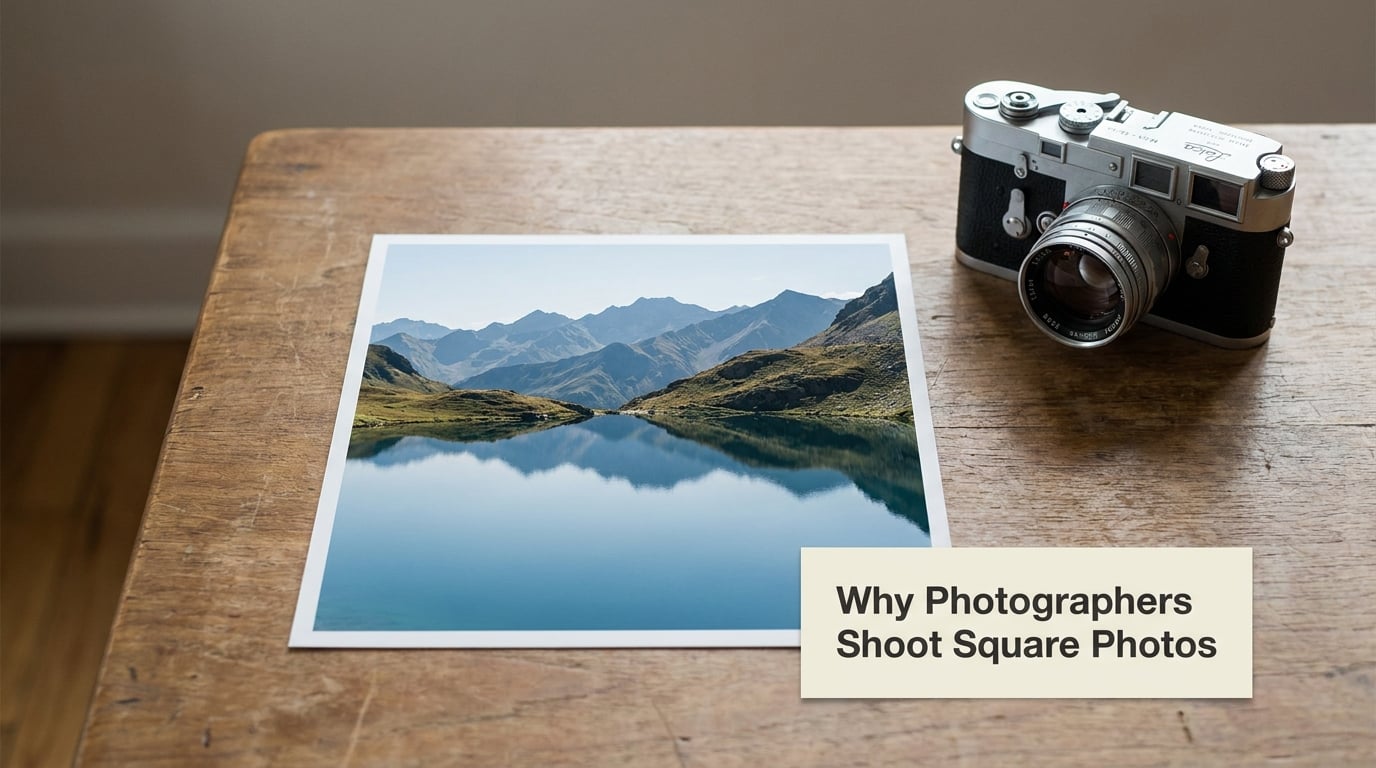
Square frames offer balanced composition, self-contained visual geometry, storytelling flexibility, native platform fit, and a timeless look that survives being printed, tiled in a grid, or cropped for a story. Equal sides mean photographers never have to rotate the camera or trim an edge afterward.
I like the format because it removes a low-level decision. On a 3:2 frame you are constantly re-reading the orientation. On a square, the only choice left is what to put in the middle of it.
A square photograph also has a quality that photographs in wide or tall frames struggle to fake: it feels finished. There is no natural direction for the eye to travel, so it settles. That self-containment is why square images hold a wall, a thumbnail, and a projected slide with roughly the same authority.
How Square Framing Simplifies Composition
A square frame simplifies composition because it distributes visual weight evenly in every direction, which leaves you with fewer places to hide a weak edge and more reason to build one strong relationship at the center.
With a rectangular frame, the eye defaults to reading left to right and looking for the horizon line. A square has no such reading direction, so composition becomes about depth and shape rather than sequence. That is a real shift in how you direct attention.
Three things happen naturally when you work this way:
- Subjects move toward the middle. The eye has no corner to slide into, so off-centre placement reads as intentional tension rather than a framing mistake.
- Peripheral clutter matters more. Because nothing is cropped away by an oblong shape, a stray branch or bright sign at the edge gets noticed. You learn to walk around the subject before you raise the camera.
- Symmetry becomes usable. A centred column, a staircase seen straight on, a horizon and its reflection: these read cleanly in a square where they would fight the aspect ratio of a wide frame.
Negative space also gets a fair hearing. In a wide frame a large empty area can look like an accident. In a square, empty space on two or three sides looks like a decision.
Why Square Photos Create a Strong Visual Rhythm
Square photos create a strong visual rhythm because a repeating shape needs no explanation to read as a set. Squares tile cleanly in a grid, align edge to edge, and hold the eye in a steady pulse rather than pushing it along.
This is why the format shows up so heavily in portfolios, photo books, exhibition walls, and digital art projects. Hang nine squares in a grid and the wall has rhythm before anyone looks at a single frame. Hang nine wide rectangles and the eye jumps between differently sized panels, chasing edges that do not line up.
The trap is making the set too uniform. A series of identically framed squares can read as a screen grab rather than a body of work. The fix is variation inside a fixed outer shape: shift the camera height, change the distance, move the subject off centre in some frames and dead centre in others, alternate dense compositions with near-empty ones.
Rhythm comes from the format being constant while the content moves. Hold the square, vary everything inside it.
How the Shape Changes the Story
The shape changes the story because horizontal frames suggest duration and travel, vertical frames suggest height and lift, and square frames suggest a single self-contained moment you are asked to stand inside for a moment.
A wide frame of a road says the journey continues past the edge. The same road squared down says here is the place, this is where you are. That difference is subtle and it does a lot of work in editing, sequencing, and titling.
In practice, each subject changes under the square:
- Portraits. A square is forgiving about a subject standing off to one side with room to look into. It suits torsos, hands, backs, and profiles as well as straight-on work. Many photographers use it to step away from the head-and-shoulders formula.
- Scenic and outdoor work. A square forces you to pick one relationship: foreground against distance, a single tree against sky, ridge line over ridge line. Wide scenes often become busy when squared, and the crop is where you find out what the picture was actually about.
- Architecture. Frontal elevations, doorways, staircases, and repeating windows gain from the equal margins. Full-height and full-width views, by contrast, want a tall or wide frame and lose their top or bottom in a square.
- Abstract and still life work. Shape and shadow carry a square frame easily. A circle, a mug, a folded cloth, a hard shadow on a wall: all of it sits comfortably inside equal borders.
Why Photographers Choose Squares for Platforms and Sharing
Photographers choose squares for platforms because most major social feeds display 1:1 images at full width with nothing trimmed, so a square is delivered as composed rather than cut.
This matters more than it sounds. When a 3:2 image is placed in a square feed slot, the platform crops it, and it crops from the edges. If your composition lived at the edges, the audience never sees what you built.
A square shot, or a square you composed for in the viewfinder, keeps your subject, your margins, and your focal length intact at full width. On a phone screen the difference between a full-width square and a cropped rectangle is not subtle.
The other practical value is planning. Square images sit flush in a profile grid, so a run of them reads as a deliberate body of work instead of a set of mismatched cards. Photographers building a feed for a client or a print run will often compose a square first and export the rectangle later, so the master image is never compromised.
Worth saying plainly: choosing the format for the platform is a delivery decision, not a creative limit. Plenty of photographers shoot square because the composition demands it, and the platform fit is a bonus.
What Square Photography Does to Depth and Motion
Square photography pushes depth and motion inward: with less width and less height to spend, you build layers through overlap and isolate movement inside a tighter frame instead of across a wide field.
Depth is the first casualty and the first gain. A wide frame has room for foreground, middle ground, and background at full scale. Remove that room and you have to compress, which forces overlap: a branch in front of a wall, a figure against a doorway, near texture against far texture.
Overlap reads as depth instantly, and it reads faster in a small image. On a phone, a square with three overlapping planes feels deeper than a wide shot of the same scene.
Motion works the same way. A running figure, a swing, a hand mid-gesture, waves breaking: in a square you tend to catch one movement at full strength instead of smearing several across a long frame. Directional movement also gains, because a diagonal inside a square has less room to escape and hits two edges at once, which stops the eye.
The cost is honest. A square cannot hold the full height of a cathedral interior or the full span of a ridge line. If the subject is defined by its extent, the square will cost you something.
How to Shoot Square Photos Without Cropping at the End
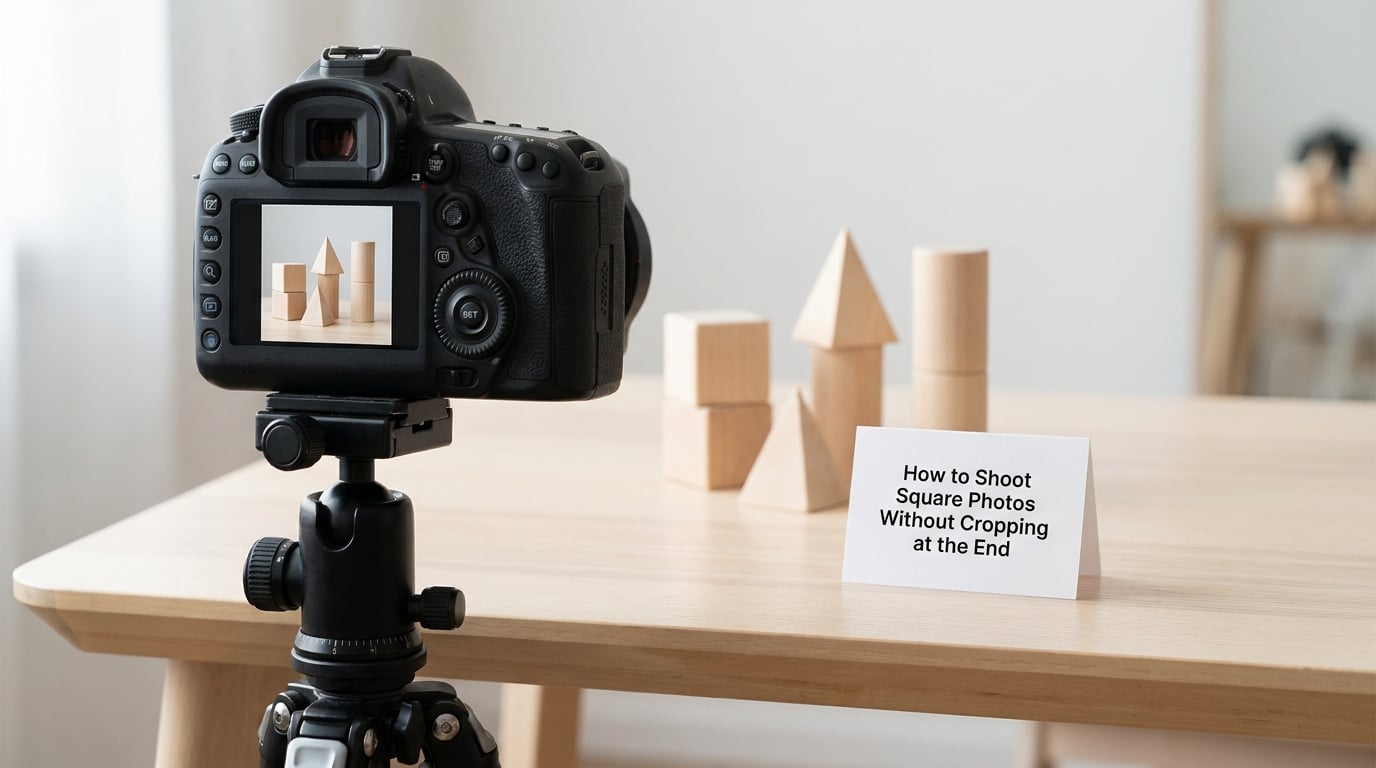
Shooting square without a final crop means framing inside a square preview, leaving margin on all four sides, and deciding the composition before the exposure rather than after it.
Frame in a square preview from the start
Most mirrorless cameras and many DSLRs let you set a 1:1 aspect ratio in live view or in the electronic viewfinder. Use it, even on a camera you will not shoot square on that day. Ten minutes of square framing teaches your eye more about the format than any article, and the skill transfers straight back to rectangular work.
Leave margin you will not use
Compose for a square you will trim slightly smaller. Reserve space on all four sides so a modest crop does not touch your subject. Photographers coming from film habitually frame tight; a small cushion costs nothing and saves the picture.
Keep the resolution the crop needs
If you plan to crop a rectangle down to a square, frame the square you actually want at full resolution. A 4:3 frame cropped to 1:1 keeps the full height and about three-quarters of the width, which is usually enough for screen use and for smaller prints. A 16:9 frame is tighter. For large prints, frame the square directly.
Check the edges, then the middle
Walk the frame edge by edge looking for bright distractions, then confirm the focal relationship in the centre holds up. Also check your slowest shutter speed or your flash sync at square exposure; framing tighter changes your aperture and shutter needs faster than you expect.
Keep a square master and export rectangles from it
Many photographers keep one square master and crop alternate versions for a book, a reel, or a wider submission, rather than making a rectangle master and hoping the square survives later. Whichever direction you work, make the edit while the composition is still fresh in your head.
When Square Is the Right Choice and When It Is Not
Square is the right choice when the subject has one strong central relationship, the delivery is a feed, a book page, or a gallery grid, and the story is about a single moment. It is the wrong choice when the subject is defined by its width or its height.
Run through four quick tests before committing:
- Subject test. Can you describe the picture in one relationship? A tree against a wall, yes. A five-person row of cousins stretched across a sofa, no.
- Extent test. Does the subject need width to exist, like a skyline, or height, like a tower? If yes, shoot the rectangle and crop inside it, or build a wider frame.
- Output test. Where does it land? Grid and book page, square works. Full-bleed spread across two pages, a banner, or a wide print, square is wrong.
- Story test. Is the point duration and travel? A wide frame says that better. Is the point stillness and balance? Square says it better.
And keep irregular crops in your pocket. A 5:4 or a 6:7 frame gives the centred, calm effect of a square while freeing up height or width, which helps when a subject needs just a little more room.
How to Build a Consistent Square Series
A consistent square series keeps the outer shape fixed and varies the inside: same framing logic, same distance and height rules, same spacing on the wall, with different subjects in every frame.
Start by deciding what stays constant. Is it the camera height, the distance to the subject, the lens, the time of day? Pick two or three, not all of them at once. A series that varies only subject and time of day reads as coherent even when no two frames look alike.
Then plan spacing and sequence. Leave the same gutter between prints, and cut between frames that differ in density rather than between similar ones: a busy square followed by a nearly empty one gives the viewer a rest and makes the next image hit harder.
Transitions matter in digital projects too. In a scroll, alternate scale changes with stillness. In a grid, let a few squares break the pattern once so the pattern reads as a pattern.
Finally, review the set as thumbnails, not full size. On a contact sheet, a square series either holds as a rhythm or it does not, and you will see it in a second at thumbnail scale.
Frequently Asked Questions
Why do photographers choose a square format?
A square frame settles composition early. With equal sides there is no orientation to choose, so you stop thinking about how the camera is held and start thinking about what sits in the middle. The shape also distributes visual weight evenly, flatters symmetry and negative space, and produces an image that feels finished without extra trimming. Many photographers also like that square files sit full-width in social feeds and align cleanly in a grid or on a wall.
Is a square photo better for social media?
A square photo is better for social media in one specific sense: most feeds show 1:1 images at full width with nothing cut off. A rectangular photo in a square slot gets trimmed at the edges, so anything you placed near the border is lost. A square shot keeps your subject, margins, and focal length intact. Some creators also shoot wide video or vertical reels from the same square master for the same reason.
Should I shoot square or crop a horizontal image?
Shoot square when the composition is centred and you already see it that way, when you are delivering to a grid or book page, or when you want the discipline of working in one shape. Crop a horizontal frame when the subject needs width, when you only spotted the square idea later, or when the rectangle is the primary deliverable. A crop is fine as long as you still have enough resolution for the final size.
What aspect ratio is needed for printing square photos?
Square prints are 1:1, so an image cropped to equal width and height prints without any further adjustment. Common square sizes are 8 by 8, 10 by 10, 12 by 12, and 20 by 20 inches, and custom framing is often needed because square frames are less common in shops than rectangular ones. Leave a little extra resolution on each side so you can trim slightly for the frame without losing the composition.
Are square photographs harder to compose?
They are different rather than harder. The format removes the orientation decision but asks you to solve everything with shape, depth, and negative space, since there is no extra width or height to hide behind. Photographers used to rectangular framing often need a few sessions of square preview before it feels automatic. Setting the camera to a 1:1 aspect ratio in live view speeds that learning up considerably.
Can square framing work for fine-art photography?
Square framing has a long record in fine art, built on 6 by 6 medium format film cameras such as the Hasselblad and Rolleiflex, so the format is not a social media import at all. Plenty of exhibition work and photo books use squares for the visual rhythm they create in a grid or a sequence. What matters is consistency: a square series with a fixed framing rule reads as considered, and an inconsistent one reads as a crop.
Conclusion
The case for square photography is aesthetic before it is practical, and the practical reasons happen to line up with it. Even sides, no orientation decision, geometry that carries from a phone screen to a print, and a shape that builds rhythm when you put images next to each other.
Start with one subject and a single relationship inside the frame: a tree against a wall, a pair of hands, a doorway, one figure against a long plain surface. Set the camera to a square preview, frame it, and decide whether the square actually improved the picture. Usually, it tells you something about the composition that a wide frame was hiding. That is the whole argument for shooting square, and it has been available on medium format film cameras for a century. Nothing about it changed in 2026 except how quickly you can share the result.