
Most people do not relax in front of a camera because they are shy. They stiffen up because they do not know what to do with their body and they assume they are being judged. To make people comfortable in front of the camera, fix the setup first (light, background, distance, noise) and then keep the session moving with continuous, specific direction instead of long silent pauses. An hour of preparation usually buys you the first ten minutes of any shoot, and the awkward feeling usually fades well before the last frame.
This guide works for a camera on a tripod, a phone on a stack of books, a video call and a studio setup with a lighting crew. The same principle holds: give people something to do, give them something to look at, and give them permission to say no.
Table of Contents
- What You Need
- Step-by-Step
- Common Mistakes
- Frequently Asked Questions
- How do I make people comfortable in front of the camera when they are shy?
- What do you say when someone freezes in front of the camera?
- How do I make children comfortable in front of the camera?
- How do I get good poses from a group instead of a stiff row?
- How do I make a stranger comfortable enough to pose for a photo?
- How do I stay friendly while still getting the shot I actually want?
- Conclusion
What You Need
You need six things before anyone arrives, and none of them are expensive. Have these in place and the session starts halfway won.
- A short written brief. What the images are for, roughly how many you need, and how long the session will take. Send it in advance so nobody walks in bracing for an afternoon.
- A forgiving location. Soft directional light near a window, a background with nothing competing for attention, and enough room to walk.
- A camera that has already been tested. Charged battery, empty card or fresh one, settings you are not going to fiddle with mid-shoot.
- Three or four prompts written down. Movement cues beat poses, and having them on paper removes the awkward pause where you try to invent one.
- Permission in advance. Tell people you will be photographing them, and agree when. Ask before you show anything back on the screen.
- Time you do not need. Over-allocating by double is the cheapest comfort tool there is, and saying the words out loud (“we have plenty of time”) does more than the extra minutes themselves.
Harsh overhead light and direct flash are the two things that make people instantly self-conscious about how they look. A window and a reflector beat both, and a tidy background does more for someone’s confidence than any amount of encouragement.
Step-by-Step
1. Prepare the Session Before Anyone Arrives
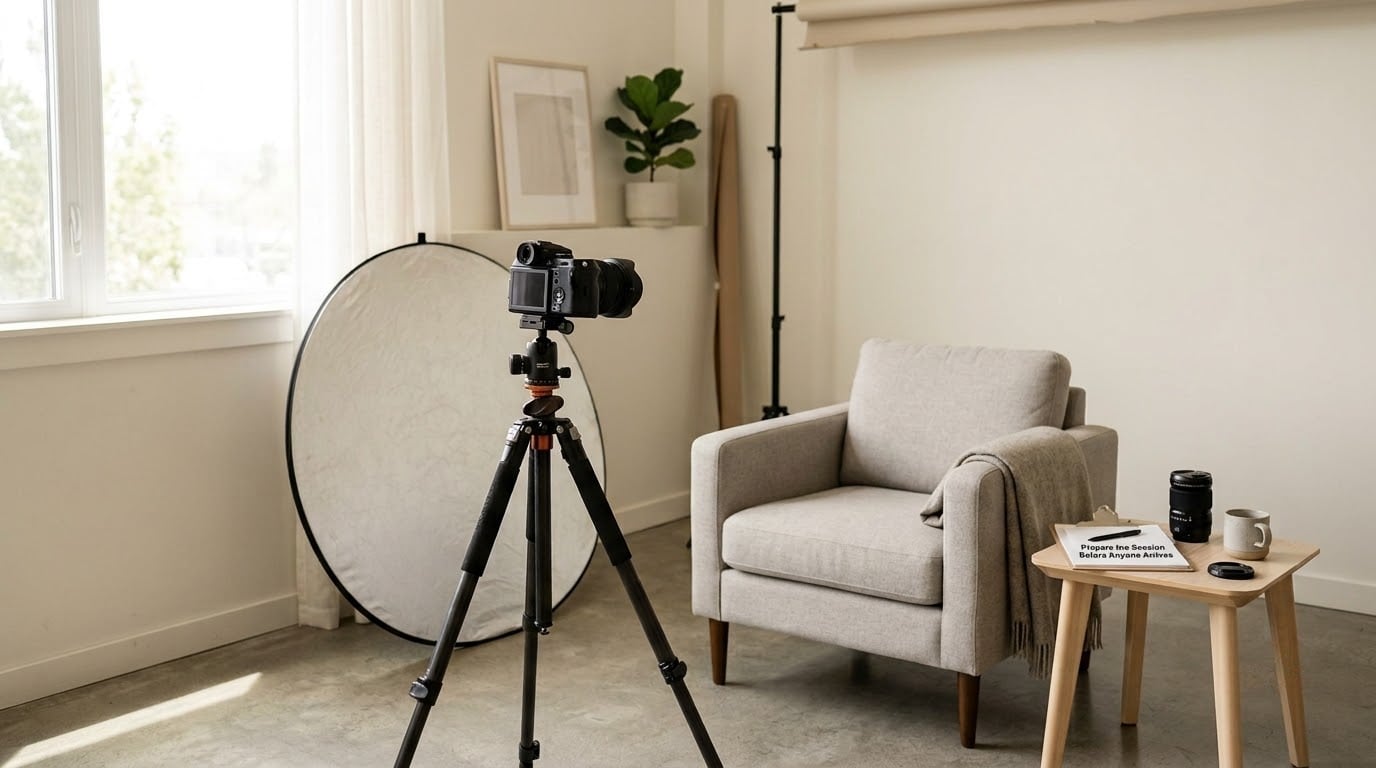
Set up the whole session before your subject walks in, including the parts you do not think count. Clear anything off the table behind them, check the light by taking a test frame of the empty chair, and decide the order of the shots you want. Reducing surprise is the whole job: a person who is not caught off guard does not spend the first ten minutes bracing.
Explain the purpose and the duration in your message the night before. “Thirty minutes for a website headshot, done by four” is more relaxing than “a portrait session” because it has an edge to it. You will know it worked when the subject walks in, looks around once, and does not ask a single question about what is about to happen.
2. Start With Conversation, Not the Camera
Do not raise the camera in the first sixty seconds. Talk first about something with nothing to do with the shoot: their weekend, the room, why they agreed to this in the first place. Then tell them the plan in plain words, including that some frames will be throwaways and that you will keep shooting while they talk so nobody has to perform.
Warm-up frames are the quiet workhorse here. Shoot a few deliberately bad, over-posed frames early, show them, let the subject laugh at themselves, and the tension usually cracks. A room where the photographer has already made three silly mistakes is a room where a fourth one costs nothing.
If there is a partner or a group, shoot the confident person first and let the reluctant one watch the good frames appear on the screen. Photographers report this working on subjects who had flatly refused to be photographed: seeing a genuinely nice frame of someone else makes the idea feel possible. You will know it worked when the reluctant person volunteers a suggestion before you ask.
3. Give Clear, Specific and Kind Direction
Direction is where sessions go wrong, because most photographers reach for vague instructions when they run out of words. “Look natural” is the worst of them, because the subject has no idea what to do with that information. Replace every vague cue with one small physical action: walk toward the window, turn back over your shoulder, put your weight on one hip and let the other knee soften.
Give one instruction at a time and keep talking through the rest of it. Silence is what makes people stiffen, so the gap after a direction should be filled by you, not by them guessing. Demonstrate the pose yourself, badly if you have to. A person who watches a photographer mime a pose understands the shape immediately, and will copy it half as self-consciously.
| What the subject does | What it looks like in the photo | What to say instead |
|---|---|---|
| Stands still and holds a smile | Stiff shoulders, fixed expression, dead eyes | “Walk slowly toward me and stop when I say now.” |
| Holds a phone or bag in both hands | Closed posture, arms locked to the body | “Let the bag hang on one shoulder, then swing it forward.” |
| Stares into the lens | Performed intensity that reads as forced | “Look past my shoulder at the window, then come back to me.” |
| Adjusts hair repeatedly | Constant hand-to-face movement, self-consciousness | “Push your hair back once, then drop your hand and leave it.” |
Time-box each setup to a few minutes and move on before it becomes work. A session with six quick setups beats one long careful pose, and the subject never gets long enough to start overthinking. Invite them to invent poses too. A person who suggests a position has already decided the frame is theirs, and it shows in the result.
On the gear side, two setups from the community are worth stealing. Putting the camera on a tripod with a remote shutter slows the pace down so the subject is not chasing a moving photographer, and it removes the awkward reset every time you change position. On smaller cameras, a flip-out screen lets you frame from the waist and look down instead of locking eye contact with someone who is already uncomfortable. Keeping more distance with a longer lens also helps, because nobody enjoys being scrutinised from a metre away.
4. Let the Subject See Progress and Control
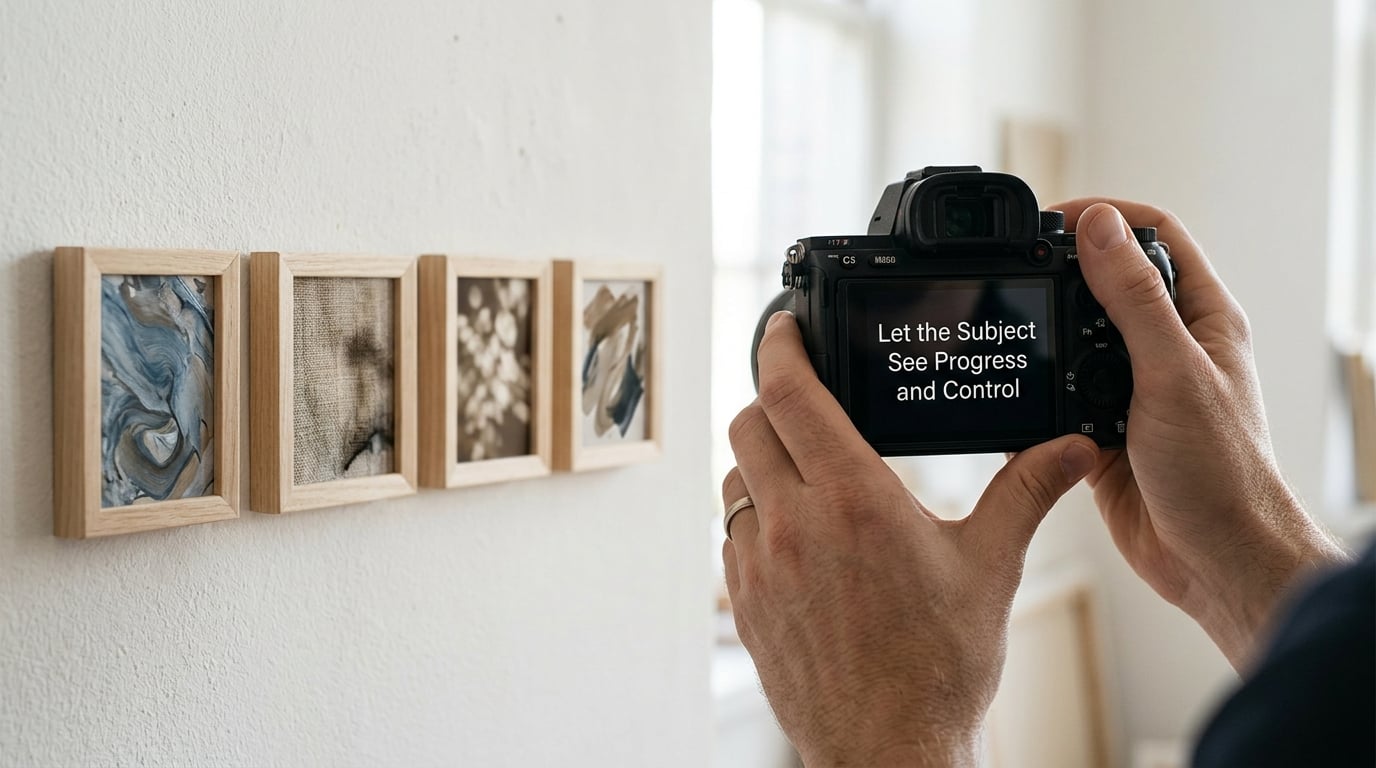
People calm down once they can see that something is working, so show progress early and ask permission before you do it. Two or three frames, not a full review. The subject is looking for one thing: whether their face looked strange. Once they have seen that it did not, the rest of the shoot stops being a test.
Feedback has to be specific to be usable. “You looked great” gives a person nothing to repeat, so their next frame is a guess. “The frame where you were looking at the window is the one, keep that” tells them exactly what you are chasing and makes the following twenty frames easier.
Offer limited choices rather than an open brief. Two framings, both of which you think work, is plenty of control. Feedback is not always helpful either: if a subject winces at playback or starts picking at every frame, they are more self-conscious with the images than they were without, so switch to direction and keep talking.
5. End With Respect and a Clear Next Step
Say clearly when the session is over, then stop looking for one more frame. Extending a session past the point where the subject wants to be there teaches them that being photographed is an endurance test, and they will be harder to shoot next time.
Before they leave, say what happens to the images, roughly when they will arrive, and how many changes they can ask for. A surprised subject who discovers a surprise edit weeks later remembers the whole experience as unpleasant. Answer the basic questions, thank them properly, and most people leave a session in a completely different state from the one they arrived in.
One honest caveat: some subjects never fully relax, and that is fine. You will still get good frames of them, because people who describe themselves as bad at photos often produce the best pictures precisely once they stop trying to perform. Your job is to get them to the point where they forget about the camera, not to convince them they are confident.
Common Mistakes
Letting the silence stretch after a shot
The pause after a photo is the most cited complaint from both sides of the camera, because a person standing still with nothing to do is a person thinking about their face. Fill every gap yourself with talk or a new instruction. Keep a running list of prompts so you never have to invent one on the spot.
Over-directing into a mannequin
Long chains of instructions produce a subject who is following orders rather than being present, and it looks it. One action, then talk, then shoot in bursts so nobody is trying to work out when the important frame happens. Nobody can hold a pose for an entire burst, which is exactly the point.
Giving generic praise
“Perfect, love it” is noise, and an anxious subject cannot act on noise. Name the specific thing that worked and the moment it happened. The correction is simple: say what you want to see again, using words tied to a frame you both just saw.
Forcing poses that are not theirs
A pose the subject invented will always beat one imposed on them, even if yours is technically better. Offer two options, accept a third, and drop the idea if the face says no. If the frames from the self-directed pose look better, which they usually do, there is nothing to argue about.
Shooting straight through someone’s discomfort
Pushing after someone winces, sighs or goes quiet turns a hard shoot into a bad memory. Stop, name it out loud (“that one was not working, we are done with this pose”), and change something real: the light, the lens, the position. Say the words “we have plenty of time” while you do it.
Letting the session get judged by the people standing nearby
Partners and family comment on every frame, and it lands harder than anything you would say. Deal with the onlookers first, in a sentence, then take your subject aside where the conversation is only the two of you. Keep critique out of the room entirely, including well-meant critique from you.
Skipping the setup work
Bad light, a cluttered background, a camera pressed too close and audible shutter noise all get photographed as self-consciousness. Ten minutes of clearing the background, turning the harshest light away from the face and moving the camera back costs nothing and changes the entire tone. The most reliable comfort technique is not a conversation. It is a better setup.
Frequently Asked Questions
How do I make people comfortable in front of the camera when they are shy?
Start with the setup rather than the reassurance. Soft light, a clean background, a longer distance and a quiet room remove the physical reasons people tense up. Then keep talking through the session, give one small action at a time instead of a pose, and shoot in bursts so nobody is trying to hold still for the decisive frame. Warm-up shots that you openly call throwaways get the first laugh out of a shy subject, and the tension usually drops after that.
What do you say when someone freezes in front of the camera?
Name it, then give them something to do. Saying u0022that setup is done, relax, we are changing itu0022 takes the pressure off without singling anyone out, and moving the light or the position makes it true rather than empty. Never say u0022relaxu0022, because that is the one instruction nobody can follow. Give a physical action instead: walk toward the window, turn back, put your weight on one hip.
How do I make children comfortable in front of the camera?
Short bursts, movement and a low-stakes goal beat posing every time. Give a child a job: hold the stuffed animal, blow out the candles, run to the chair. Keep the camera up for a few seconds, put it down, and let the tension drain before going again. Let them see the pictures as soon as there is one, because children recover from self-consciousness much faster than adults do.
How do I get good poses from a group instead of a stiff row?
Break the group into pairs and shoot each pair separately, then assemble the final frame. People relax in pairs and stiffen in lines, and the pairs also give you cut-ins for a group shot that does not look choreographed. Give the group one simple action to perform, such as leaning in and counting down together, rather than a list of positions. Then shoot a burst of a few seconds each time so nobody is holding a pose.
How do I make a stranger comfortable enough to pose for a photo?
Ask, do not assume, and give them an easy exit. Explain what you are doing, ask permission, and say no pressure a few times in one sentence. Keep the camera at a distance or use a longer lens so the interaction feels like a conversation rather than an inspection, and shoot from the waist with a flip-out screen so you can frame without staring straight at them.
How do I stay friendly while still getting the shot I actually want?
Separate the relationship from the frame. Chatting stays friendly, and the direction can be exact: bring your chin forward a little, turn your body ten degrees, look at the window instead of the lens. Most photographers soften the direction because they feel awkward, and the subject feels that hesitation as doubt. Say the instruction plainly, shoot a burst, then chat again about something unrelated.
Conclusion
Before your next session, write down one plan: where you will stand, what the first three movements are, and what you will say in the first sixty seconds. Start with conversation rather than the camera, fix the light and the background before anyone arrives, then give one clear, kind direction at a time. Comfort is not a personality you have to be born with. It is built from preparation, permission and a subject who is never left standing still with nothing to do.