
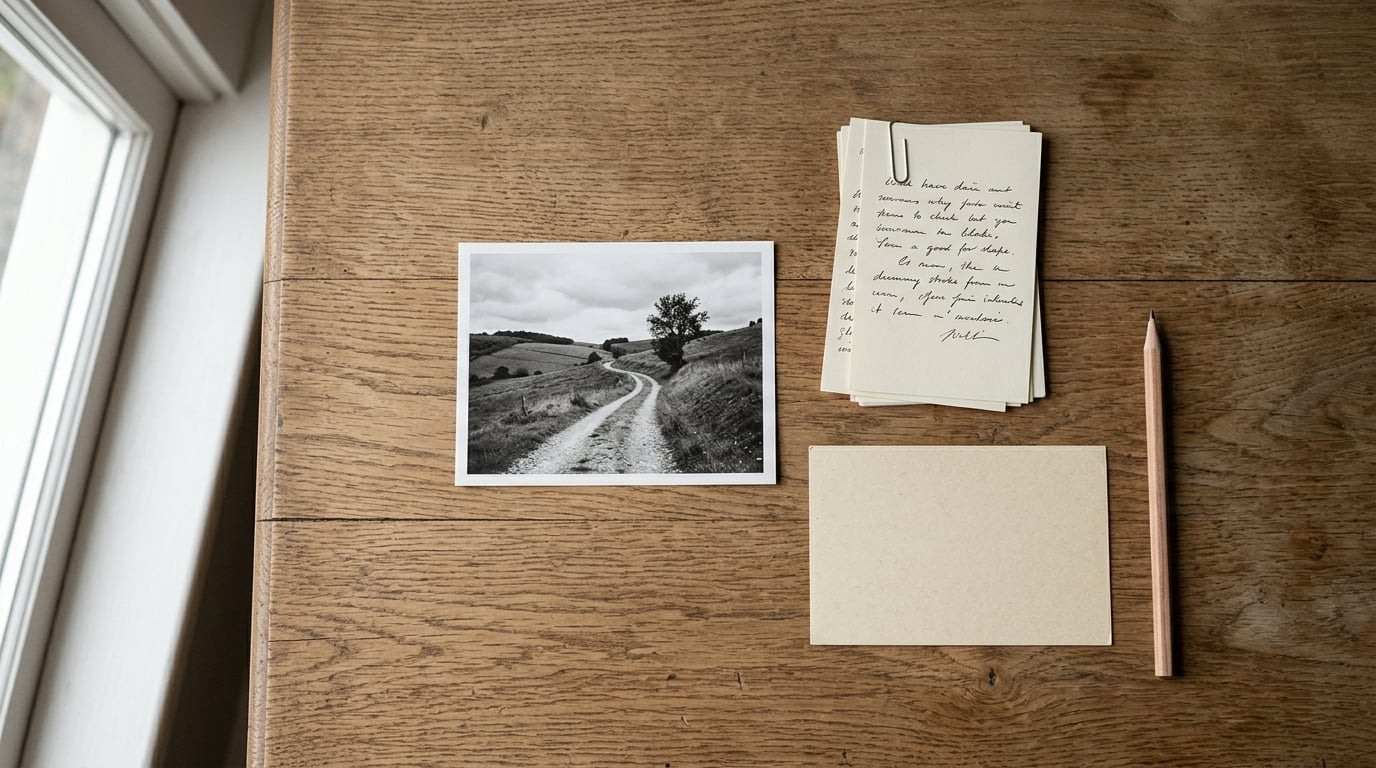
A photograph’s title is the short name you attach to an image, and learning how to title your photographs is mostly a matter of choosing one job for it: state the facts, evoke a feeling, or carry a metaphor. Pick the job deliberately, draft three options, test them, and stop. Most people stall because they try to do all three at once.
The second reason people stall is that nobody told them a title and a caption are different things. A title frames interpretation. A caption delivers context. Conflating the two produces the forty-word wall of text most photographers hate writing.
What follows is the process I use, tested on a lot of other people’s photographs as well as my own. It takes about ten minutes per image once you stop treating it as a creative ordeal.
Table of Contents
What You Need
Four things, and you almost certainly already have all of them.
- The image itself, at the size you intend to present it. Judge the title against the actual print or screen, not the thumbnail.
- One sentence naming the central idea, written before any title exists. Not a subject list. One sentence with a subject and a verb.
- The context it will live in: a portfolio page, a book spread, a gallery wall, a competition entry, a stock licence request, a blog post.
- A place to record candidates, ideally a plain text file or your phone’s notes. Titling decisions scattered across ten apps are the reason you retitle things forever.
The context matters more than most beginners expect. A title that works beautifully on a book spread can be actively unhelpful in a stock library, where a buyer is scanning for keywords. One Talk Photography contributor said he titles almost exclusively for competitions, because that is when the rules require it. Another writes only place and year on his prints, purely so the exhibition install does not need a separate title card for every frame.
Step-by-Step: How to Title Your Photographs
Identify the Image’s Central Idea
Before you can name it, decide what it is about. Write one sentence: a fisherman mends nets in the blue hour, alone, three years after the fleet closed. That sentence is not your caption. It is raw material, and it holds the subject, the action, the mood and the context in a single breath.
Ask three questions while you write it. What is the subject doing? What detail is doing the emotional work? What does the frame leave out that you know but the viewer cannot see?
That last question is where titles earn their keep. The strongest titles usually come from the information the image cannot supply on its own, not from a longer list of what is plainly visible. A wide shot of a woman at a kitchen table does not need the word kitchen in the title. It may need the name of the town, or the year the mill shut.
Choose a Title Style
There are five approaches worth knowing, and they are not competing styles so much as five different jobs. Most photographers use three of them across a body of work without ever naming the difference.
| Approach | Best for | Example title | The risk |
|---|---|---|---|
| Descriptive / informational | Documentary, travel, landscape, editorial | Neko Harbor, Antarctica 2007 | Reads like a caption if it runs long |
| Evocative / poetic | Fine art, personal work, portraits with mood | Solitude | Collapses into vague mood words |
| Metaphorical / symbolic | Conceptual series, staged work, personal projects | Ray of Hope | Imposes a reading the image does not support |
| Formal / abstract | Studies of colour, line, shape, architecture | Study in Ochre, No. 4 | Looks like a catalogue number without the numbering system |
| Untitled, or a code | Sequences and series where the group is the point | Untitled (Summer 2006) | Reads as indecision if nothing else signals intent |
Working photographers you already know use these differently, and the differences are worth studying rather than copying. Gregory Crewdson titles individual images descriptively and gives the body a name, such as Cathedral of the Pines, with an untitled series. Todd Hido uses numbers. Diane Arbus titled her prints by describing the work, and the descriptions are flat on purpose. Martin Parr, quoted by a photographer on the Talk Photography forum, never thought of photographs as individual pictures, always as a group, which is exactly why group-level naming works for some practices and does nothing for others.
One caution before you go metaphorical. In street and documentary work, an invented narrative can misrepresent a person who is not your subject. One forum participant put it plainly: sometimes a title reads as an invitation to laugh at the people in the picture rather than with them. A title that asserts a story the image does not contain is not poetry, it is fiction, and a condescending one can border on defamation.
Match the Style to the Genre
The same photograph rarely wants the same title in every setting, so here is how the five approaches land in practice, with one invented example each.
Landscape. Descriptive is safe and often dull. Loch Achtriochtan, 5.40am works if the point is the record; Before the Wind works if the point is the feeling. Landscape photographers who over-title usually end up with the place and the time twice, once in the title and once in the caption.
Street. Be conservative here, because you are naming a stranger. Red Umbrella, Broad Street is honest and hard to fault. Anything that assigns an interior life to a passing face, however nicely phrased, is fiction with someone’s dignity attached to it.
Portrait. Name the collaboration, not the subject’s psychology. Ana, Portraits or Second Sitting both give the sitter room. The worst portrait titles read like entries in a case file.
Travel. Place and year are not a cop-out here; they are the ticket. Neko Harbor, Antarctica 2007 is a perfect title for a travel photograph, because the viewer planning a trip actually needs the coordinates. Reserve the poetic register for a series whose real subject is your relationship to the place.
Competition entries. Judges read the title alongside the image, and the rules almost always require one. Keep it plain, keep it accurate, and put nothing in it that you would be uncomfortable defending out loud. A working photographer on that forum said he titles almost entirely for competitions, and that occasionally a more obscure name slips in, but the default is straightforward.
Prints and gallery walls. Simplify for the install. One photographer writes only place and year on his framed prints, a habit he picked up because it saved making a separate title card for every frame. If your series does not need per-image titles, the wall will be stronger without them.
Know When to Leave a Photograph Untitled
Untitled is a decision, not a gap, and it has a long pedigree: Crewdson runs untitled series, and on that forum several working photographers title nothing at all. It suits three situations in particular. When the photograph is one frame among many and the sequence carries the meaning. When the image depends entirely on the viewer projecting onto it, and any words narrow that. And when you genuinely have nothing true to add, which is more often than the anxiety tells you.
What untitled is not is a synonym for DSC_1234. One is a curatorial choice with a capital U. The other is the camera’s default, and it tells a viewer nothing while helping you find nothing.
Generate Specific Title Ideas
Write five. Not one, and not twenty. Five is enough to create a real choice and small enough that you finish before you get tired of the image.
The fastest way to get them is a six-slot prompting grid. Fill in what you can for each slot, then combine any two:
- Subject — nets, hands, a bus stop, a wall
- Action — mending, waiting, turning, holding
- Place — the town, the region, the room
- Time — the season, the hour, the year
- Mood — patient, provisional, unresolved
- Abstract noun — drift, threshold, inheritance
Subject plus time gives you Nets, Blue Hour. Action plus place gives you Mending, Grimsby. Mood plus abstract noun gives you Provisional Thresholds, which is probably too much, but it is a real candidate to test rather than a phrase you rejected before trying.
Here is how the same photograph changes depending on the job you assign it:
| Weak title | Stronger title | Why |
|---|---|---|
| Old mill | Mill at Sowerby, 1974 | Adds place and date; the image itself cannot supply either |
| Woman in the kitchen | The Long Table | Drops the description, keeps the spatial idea |
| Sunbeam through window | Afternoon, Room 2 | Turns a caption into a place and a moment |
| Sad man on bench | Bench, 6am | Removes the mind-reading, adds information |
| It was the best holiday ever | Last Day Off | Replaces a claim with a scene the viewer can picture |
| DSC_1234 | Untitled (Rushmere) | Keeps the title’s job separate from the file’s job |
Notice what the rewrite column does not do. It does not get longer, and it does not explain the picture. It swaps filler for information or for an idea.
Test Titles for Clarity and Resonance
Run each candidate through four checks. They take about twenty seconds each.
The stranger test. Show the image to someone who has not seen the series. Ask them to tell you what it is about. If their answer contradicts what you meant, the title is doing too much.
The caption swap. Could this phrase sit under a museum photograph as its caption? Some titles can, and that is usually fine. A pure caption should never be lifted into the title position, because the viewer can see the caption’s facts in the frame already.
Say it out loud. Titles are read silently but imagined aloud, and some survive only on paper. Say yours to another person in a normal voice. If you wince, rewrite it.
The honesty check. Does the title assert anything you did not know when you made the picture? Invented meaning is the failure mode of every metaphorical title worth worrying about.
Then stop testing. The revision loop is the real problem, not the title. One photographer on that same forum described falling into what she called a wormhole of doubts, where a bad title would ruin the perception a viewer has of the work, and the only escape was avoidance. The practical fix is mechanical: shortlist three, sleep on it, keep one. If you can live with the winner tomorrow morning, ship it.
Refine and Format the Final Title
Format is what separates a title that looks considered from one that looks typed. One to three words for fine art work. Up to eight for documentary, where place and year are doing real work. Sentence case is the quieter default. No question marks, no exclamation marks, no puns, no clickbait.
Keep the presentation consistent. If your series uses Neko Harbor, Antarctica 2007, every frame in it does. Mixed conventions within one sequence read as indecision rather than intention.
Then fill in the other metadata fields, because they are not the title’s job. The IPTC Photo Metadata standard separates them, and the definitions came up verbatim in the Talk Photography thread, which is where the terminology stops being a matter of taste:
| Field | What it is for | Length | Who reads it |
|---|---|---|---|
| Title | A short human-readable name for the image | 1 to 3 words | Viewers |
| Headline | A brief synopsis of the contents | One line | Editors, agents |
| Description / Caption | The who, what, and where and when and why | 1 to 4 sentences | Anyone |
| Keywords | Retrieval terms for libraries and search | 10 to 20 terms | Software, search engines |
For finding your own files later, one contributor on that forum uses the 255 characters in a filename rather than the title, because a picture of an old mill has to be findable when he searches for old mill. That is the right call: keep two layers, a public title and a searchable filename, and do not make one do the other’s work.
On the web, the third layer is alt text, and it is where image titles quietly become search traffic. How you title your photographs for the web means writing an alt attribute in plain words that describes what a person would see if the image did not load, then naming the file with hyphenated keywords. The visible title and the alt text should say slightly different things, because one is read by a viewer standing in front of the work and the other by someone who cannot see it at all.
If you are renaming photos already on a phone, the mechanics are simple and separate from all of this. On iOS, open Photos, select the images, tap the share button, choose Edit Actions, then Rename, and confirm with Save at the top right. Do the same in a file manager on Android, or in Finder or Explorer on a computer. Rename what is on the device; the original filename inside your camera’s RAW or JPEG file is not something to overwrite, since editing metadata and renaming files are different operations.
One last thing worth writing down once: your own convention. Fill in the blanks and you have a personal titling standard that stops you relitigating every frame.
- My series names follow: ____________
- My image titles use ____________ words, in ____________ case
- Do I include the year? Yes / No / Only on prints
- Do I use place names? Yes / No / Only when the place matters to the work
- When a series runs long enough, do I number the frames? Yes / No
- My filename order is: ____________
- Words I never use in a title: ____________
- The default I fall back to when nothing fits: ____________
Fill that in once and you will stop arguing with yourself about every frame after it. The final line matters most. Having a deliberate default, including a default of untitled, is what makes the exceptions read as choices.
Common Mistakes
Each of these has a straight correction, and most of them are habits rather than skill gaps.
- Over-describing. If the title names everything visible, it tells the viewer nothing they could not work out themselves. Cut it to the one fact or idea the frame is missing.
- Writes a caption in the title slot. If the phrase answers who, what, where and when, it belongs in the description field.
- Puns and winking titles. They read as a joke at your expense, and they date badly in a portfolio.
- Generic emotional words. Solitude, Freedom, Serenity. Any photograph can wear them, so none of them distinguishes yours.
- Invented narrative. A title that tells a story the image does not contain is a claim, not a title.
- Unjustified abstraction. A colour-and-shape study earns Study in Ochre, No. 4 only if the series actually numbers its studies.
- Punishing length. Fourteen words is a paragraph. If you cannot get under four, you are writing a wall text.
- Default camera filenames. A landscape called DSC_1234 tells a viewer nothing and helps you find nothing. Rename, or route the information into keywords.
- Inconsistency across a series. Switching styles between frames in one body of work looks like a change of mind.
- Endless revision. Three candidates, one night, one decision. The difference between a good title and a great one is invisible to the person standing in front of the print.
One habit that removes most of these at once: write the title, then read only the title, with the image covered. If the phrase still means something, it is carrying its own weight.
Frequently Asked Questions
How do I title my photos?
Decide what the title has to do: state the facts, evoke a feeling, or carry a metaphor. Write one sentence naming the image’s central idea, then draft three candidates that do that same job. Test each against whether a stranger would read the picture the way you meant it, and keep one. Ten minutes per image is normal.
Should photo titles be poetic or descriptive?
It depends on where the photograph is going. Documentary, travel, editorial and stock work want descriptive titles, because a reader needs to know what and where. Fine art and personal projects have room for evocative or metaphorical titles. A photographer on the Talk Photography forum put the standard plainly: at best a good title reinforces the intention and experience of an image, and never more.
How do I caption my photography?
A caption is not a title. Under the IPTC Photo Metadata standard, the title is a short human-readable name, the headline is a brief synopsis for editors, and the description or caption covers the who, what, where, when and why. Keep the title under four words and move the context into the description field, where it will not compete with the picture.
How do you title a photo series?
Give the series one name, then decide what each frame’s title has to carry. Crewdson titles images descriptively and names the body; Hido numbers the frames. Either way the convention has to hold for every image, and the frames should still read sensibly when someone sees a single one out of sequence.
What is the best naming convention for photo files?
Use a keyword-led filename you will actually search for later, kept separate from the public title. Date, place, subject and a short index in order works well, and keeps the file findable in your library or stock catalogue. One forum photographer relies on the 255 characters in a filename precisely because a title cannot double as a retrieval key.
How do you title images for SEO?
Write the alt text first, in plain words, describing what someone would see if the image did not load, since that text carries the description. Then give the file a hyphenated keyword filename, and give the image a short visible title of one to three words. Keep the visible title and the alt text from saying identical things, because they serve different readers.
Conclusion
Learning how to title your photographs comes down to one rule: a title earns its place by doing one job the picture cannot do itself. State a fact, suggest a feeling, carry a metaphor, or deliberately step back and leave it untitled.
So start with the smallest possible step. Pick one image you have been avoiding titling, write one sentence about its central idea, and give yourself three candidates instead of one perfect answer. Three is enough, and it is the end of the wormhole.